
Launch planning
A launch content plan that connects your website, press release and social posts
A product can be ready to use while its launch story is still hard to understand. A visitor arrives from a social post, finds a broad homepage, and cannot tell whether the announced feature is available to them. Before distributing your announcement, build a clear route from the news to the evidence and the next action. This guide offers a practical sequence for a small SaaS team or a brand entering a new market.
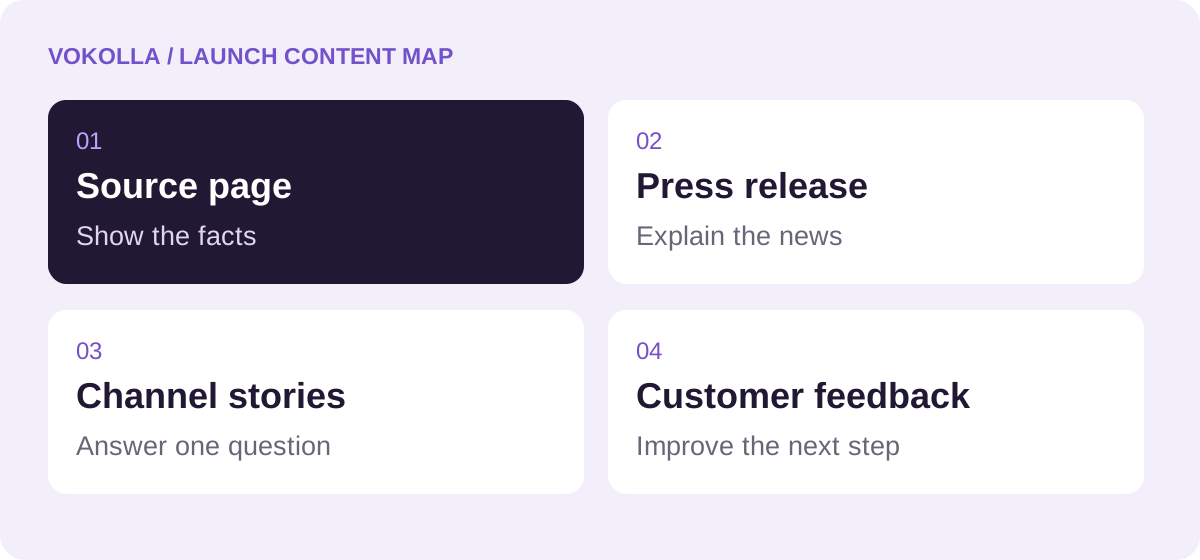
1. Give the announcement a useful destination
Choose one primary page before writing the release. For a new feature, that may be a product update page with a real walkthrough. For entry into a new market, it may be a localized service page. A broad homepage is suitable only when it actually answers the promise made in the announcement.
Imagine a fictional scheduling tool launching an approval workflow for agencies. Its source page should show who approves what, what happens after a rejection, which plan includes the feature, and whether existing customers need to enable it. Those facts are more useful than another paragraph calling the tool innovative. This is an illustrative scenario, not a customer case or a performance claim.
- State the change, intended customer, availability date and supported markets.
- Show a real screenshot, example output or short demonstration with permission.
- Explain material limits, prerequisites and pricing context where relevant.
- Give the reader one primary next step: try the workflow, request a demo or read the setup guide.
- Assign an owner to keep the page current when availability changes.
2. Make the facts easy to find and check
Google says its existing SEO practices apply to AI Overviews and AI Mode; there is no separate special markup requirement. Eligibility does not guarantee inclusion. For your launch page, keep important facts in readable text, make the page reachable through relevant internal links, and check that search access has not been blocked. These are foundations, not a promise of AI visibility.
Treat the page as a working reference for customers and anyone covering the launch. Put the actual feature name beside a plain-language explanation. Replace unsupported superlatives with a demonstrable action. If a performance figure matters, include how it was measured and the conditions under which it holds. A newly published blog post cannot substitute for evidence that does not exist.
Source: Google Search Central — AI features and your website
3. Decide what is genuinely newsworthy
Draft the announcement early enough to expose missing facts. What changed? For whom? Why now? If you cannot answer those three questions without vague adjectives, narrow the angle or finish the missing work before distributing it.
A release should give readers the essential news even if they never click through. The source page supplies the depth: a demonstration, supporting detail or instructions. Keep launch dates and availability aligned across both. An attributed quote should add an explanation or a decision, and the named person must approve it.
Not every update needs paid distribution. A minor interface adjustment may belong in a changelog and a customer email. A substantial launch, new market or meaningful partnership can warrant a broader announcement when the claims are verified and the audience is relevant. Media review and publication outcomes remain separate from preparing a good release.
- Write a factual headline and a first paragraph that explains the change.
- Link to the most relevant source page rather than several competing destinations.
- Check names, dates, permissions, claims and contact details before submission.
4. Give each channel a different reader benefit
A launch can support more than a repeated announcement. Use one post to explain the problem, another to show a decision checklist, and a longer piece to explain the trade-off behind the product. The goal is a useful answer at each touchpoint. Google's content guidance asks publishers to contribute original value rather than merely rework existing material; use that as a practical editorial check.
For the fictional approval tool, an X post might share three questions to ask before adding an approval step. A LinkedIn post could explain when another approval layer slows a team down. A video could demonstrate a request moving from draft to approval and show the exception path. Each asset can point to the same source page, but each earns attention in its own way.
Source: Google Search Central — Creating helpful, reliable, people-first content
- X: one clear takeaway that is useful even before the click.
- LinkedIn: a business decision, concrete example and relevant next step.
- YouTube: a question answered visually with actual product footage or an explanatory diagram.
- Localized editions: adapt examples, terminology and buying context; keep the underlying facts consistent.
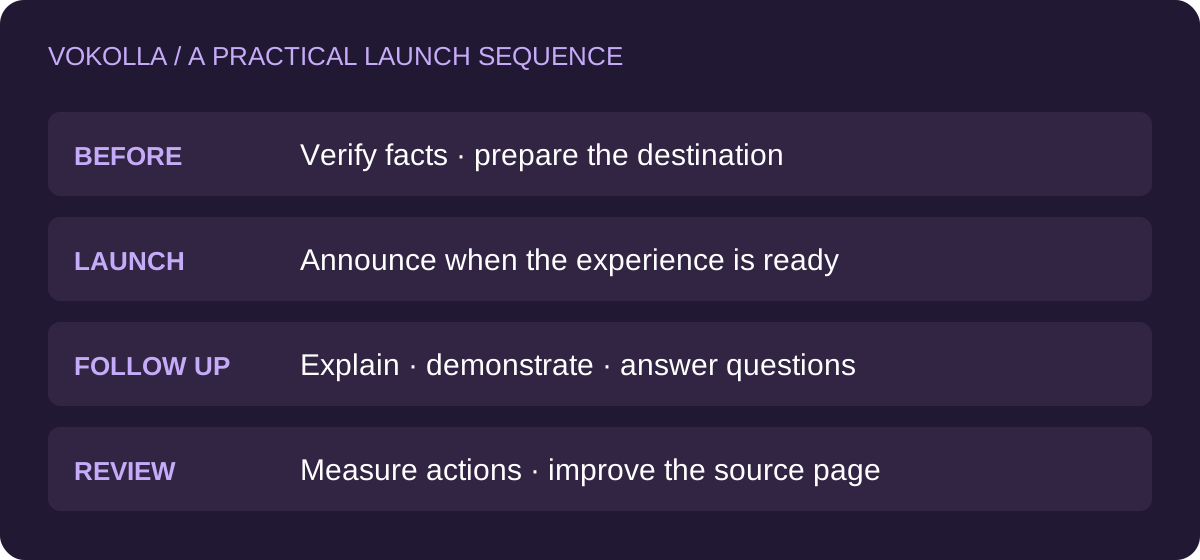
5. Track the journey, not just the announcement
Before launch, choose the action that would make a visit useful: an activated trial, a qualified demo request or a completed enquiry. Record the starting point and the observation period. A distribution report can tell you where a release appeared; it cannot by itself prove that those appearances generated customers.
Where your analytics setup supports it, use consistent campaign parameters on external campaign links. Google Analytics documents utm_source, utm_medium and utm_campaign for identifying campaigns. For example, a social link could use utm_source=linkedin, utm_medium=social and utm_campaign=launch_approval. Use the same naming convention across the launch, and do not put customer information in URLs.
Review both numbers and questions. Visits without the intended action may indicate a mismatch between the post and the destination, an unclear offer, or a product fit issue. Do not assign a cause from a small sample alone. Repeated questions are useful evidence for improving the page even when traffic is too low for a strong quantitative conclusion.
Source: Google Analytics — Collect campaign data with custom URLs
- Confirm that the destination loads and its primary action works on mobile.
- Check that campaign values reach your own analytics reports before comparing channels.
- Separate recorded publication links, visits, qualified actions and customer feedback.
- Record corrections and follow-up topics so the next content cycle answers real questions.
Your pre-launch handoff
Create a one-page brief with the audience, the actual change, proof, availability, primary URL, CTA and responsible owner. Have someone unfamiliar with the launch read only the destination page. Ask them to explain what changed and what they can do next. Any answer they have to guess is a useful editing task.
Then prepare the release and channel assets from that brief. Publish when the destination and promised experience are ready, keep a record of real links, and return to the questions people ask. The value comes from a coherent launch that customers can understand and act on—not from the number of places carrying the same sentence.
Sources and editorial method
Prepared by Vokolla with AI-assisted research and writing. Factual platform guidance was checked against the primary sources below. The diagrams, checklist and examples are editorial recommendations, not platform rules or measured customer results.
- Google Search Central — AI features and your website — Checked 2026-10-17
- Google Search Central — Creating helpful, reliable, people-first content — Checked 2026-10-17
- Google Analytics — Collect campaign data with custom URLs — Checked 2026-10-17