
Search industry · News analysis
Bing Topics Portfolio: choosing AI search content opportunities
Bing launched Topics Portfolio beta on 13 October 2026. It gives content teams new topic clues, but the largest opportunity is not necessarily the best use of a writing budget. Our test is simple: does the question matter to a potential buyer, and can the business publish a useful, supported answer?
What Microsoft announced on 13 October
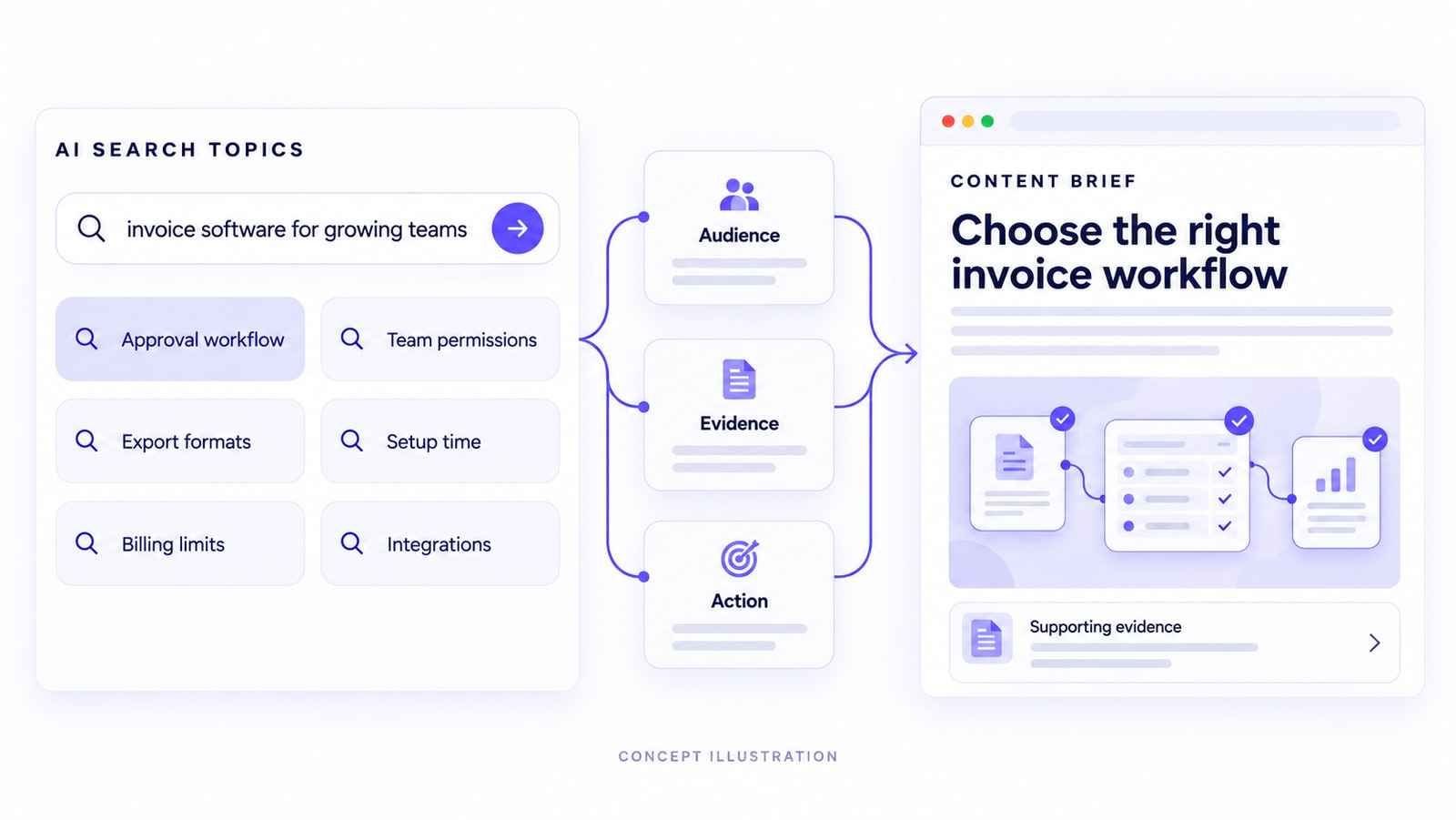
Bing’s Topics Portfolio beta groups a site’s AI grounding queries by theme. It shows approximate ecosystem measures and queries where other sites appear but yours does not. Availability depends on sufficient data. Topic Size counts citations across sites, not keyword search volume; classifications can be imperfect and opportunities can include competitor brand queries.
Source: Microsoft Bing — Topics Portfolio beta announcement, 13 October 2026
Source: Microsoft Bing — AI Performance public preview, 10 February 2026
- Where to look: open your site’s AI Performance report in Bing Webmaster Tools and check for Topics Portfolio.
- Grounding queries are phrases used to retrieve supporting content. Treat them as content clues, not a verbatim record of customer questions.
The decision that belongs to your team
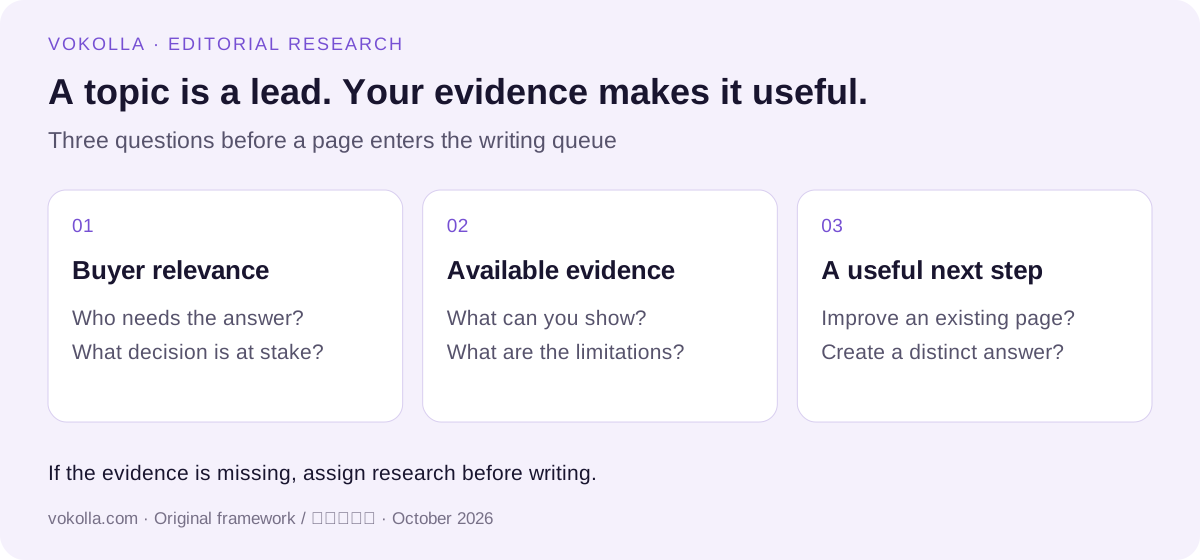
Use three checks before commissioning a page.
Start with the buyer
We would not rank the writing queue by the largest topic number. That would give a dashboard more influence than the company’s customers. Start with the buying question: who needs this answer, what decision are they making, and can your business reasonably help?
Check the evidence
Then check the evidence you can actually publish. A product team may have a reproducible setup guide, supported integrations and a clear statement of limitations. Those materials can answer a narrow implementation question well. A broad industry forecast assembled from other people’s summaries probably adds much less.
Choose the page’s job
Finally, choose the page’s job. A compatibility guide should help someone establish fit. A comparison should explain trade-offs. A release should announce a real change. Calling all three a blog post makes it easier to commission words without deciding what the reader needs.
A worked decision for a small SaaS team
Consider a hypothetical invoicing SaaS business. Its team finds several possible content gaps. The following choices illustrate our method; they are not queries observed in Bing or results from a live campaign.
| Possible question | Evidence the team has | Decision |
|---|---|---|
| Can invoices be exported to our accounting system? | Documented formats, a sample file and known exclusions | Improve the integration guide and show the sample. |
| Which invoicing tool is best for every small business? | Only its own product experience | Narrow the question to a use case it can demonstrate. |
| What changed in this month’s release? | A shipped feature, availability details and a demo | Update the product page; consider a release if the change matters outside the company. |
Replace the article order with a one-page evidence brief
Before assigning the work, require a named reader, a decision, an existing URL and a piece of proof. If the writer cannot identify the proof, the next task is research or a product-team interview, not drafting. If a useful answer already exists, update it instead of creating a near-duplicate.
A sensible first pass is one page, one owner and one review date. This keeps the cost of learning small. It also makes it easier to notice whether readers still ask the question the page was supposed to answer.
- Reader: name the role and situation, such as a finance manager checking an integration.
- Evidence: link the exact documentation, demonstration or approved data the page will use.
- Decision: write the answer the reader should be able to reach, including cases where the product is unsuitable.
- Next step: offer a relevant demo, specification or contact route. Do not force a sales form into every educational page.
What would count as progress?
Bing’s underlying AI Performance report covers supported Microsoft and partner experiences. Its citation counts do not establish ranking or where a page appeared within an answer. That makes citations a useful observation, but an incomplete business result.
Source: Microsoft Bing — AI Performance public preview, 10 February 2026
- Keep a copy of the page before editing and record the specific change.
- Compare the same page and reporting scope over comparable periods. Annotate other campaigns and product changes.
- Review actual reader behavior and qualified questions alongside visibility. A higher count alone does not establish that the edit worked.
- If there is little data, record that limitation. Customer questions and a better documented answer can still justify the work.
When this should become a press release
An interesting dashboard finding is usually an internal editorial task. A genuinely new capability, a market expansion or a well-supported research finding may justify an external announcement. That is the point to prepare a newsworthy release, with a useful source page behind it.
The distinction matters for a small team. It protects both the writing budget and the brand: publish because there is something worth knowing, then measure what readers do with it. This beta can help find questions. Your expertise has to supply the answers.
Event date: 2026-10-13 · Analysis
Sources and editorial method
Source-based news analysis by Vokolla, researched and written with AI assistance. We reviewed Microsoft's announcement and documentation; we did not test a customer account. The prioritization method, diagrams and scenarios are our editorial analysis. Examples are hypothetical, not reported customer results.
- Microsoft Bing — Topics Portfolio beta announcement, 13 October 2026 — Checked 2026-10-17
- Microsoft Bing — AI Performance public preview, 10 February 2026 — Checked 2026-10-17