
Research report · October 2026 edition
AI Search Visibility Report 2026
From brand exposure to business value: evidence across platforms, clicks and conversions. AI visibility is becoming measurable, but it does not yet form a single customer funnel. Our review finds that weaker search click-through, small referral shares and stronger conversion among arriving visitors can coexist. The practical question is which part of that journey your business can observe—and which investment the evidence justifies.
1. What the evidence can—and cannot—answer
This report separates three questions: can an AI product find and cite a business, does it send people to the website, and do those people create value? The evidence is strongest when the question matches the unit being measured.
Four empirical sources cover user behaviour, keyword click-through, retail purchases and referral traffic. Three company cases then test how those patterns translate into business claims. The sources do not describe the same people, websites or period.
Source: Pew Research Center — Google users and AI summaries, 22 July 2025
Source: Ahrefs — AI Overviews and desktop CTR, 4 February 2026
Source: Adobe Digital Insights — US retail AI traffic, 16 April 2026
Source: Ahrefs Web Analytics — AI vs Search, updated 15 October 2026
| Evidence | Population and period | Useful for | Not sufficient for |
|---|---|---|---|
| Pew Research Center | 900 US adults; March 2025 browsing, results reconstructed in April | Click behaviour around AI summaries | A causal effect for every query |
| Ahrefs CTR study | 300,000 keywords; desktop; Dec 2023 vs Dec 2025 | Sensitivity of first-position CTR | A universal website traffic forecast |
| Adobe Digital Insights | US retail analytics; March 2026 conversion comparison | Purchase outcomes among arriving visits | B2B enquiry rates or incremental ROI |
| Ahrefs referral benchmark | 115,254 sites in the reported corpus; Sep 2026 snapshot | Scale of identifiable referral traffic | Global AI usage or zero-click exposure |
2. Four findings behind the headline
The numbers below are reported observations or publisher estimates. Their limitations determine how they can be used; sample size alone does not make unlike metrics comparable.
Search clicks: fewer visits to traditional results alongside AI summaries
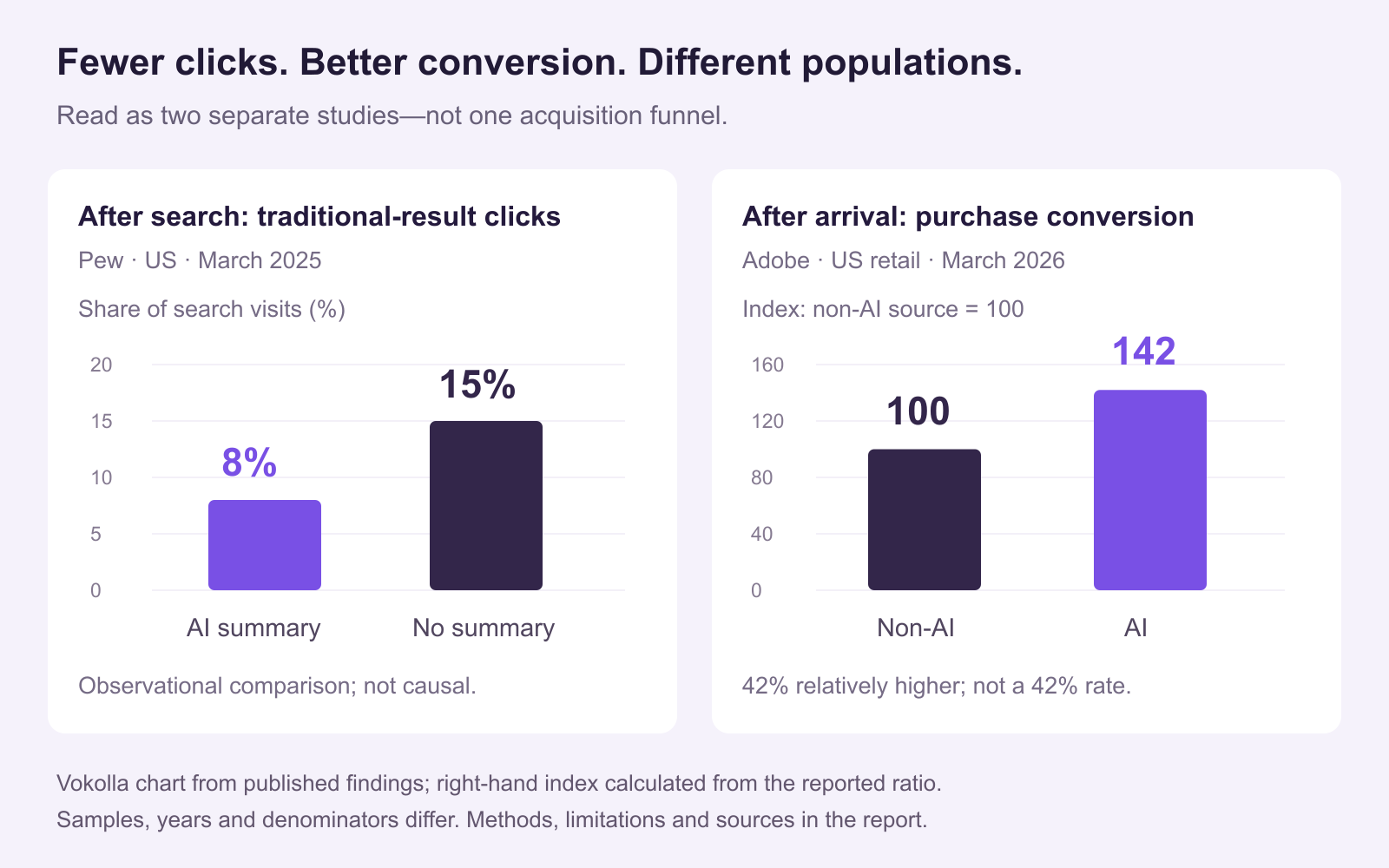
Pew analysed 68,879 unique Google searches. Traditional-result clicks followed 8% of visits with an AI summary, versus 15% without one; summary-source clicks occurred on 1% of visits with a summary. The traditional-result gap is 7 percentage points, calculated from the published rounded values.
Source: Pew Research Center — Google users and AI summaries, 22 July 2025
Boundary: observed association, with a reconstruction delay
Search results were collected on 7–17 April for browsing observed on 1–31 March 2025. Results may have changed, and query intent differs between the groups. Use this as evidence of click pressure in the observed setting, not proof that adding a summary caused every lost click.
Rankings: first position does not secure the same click yield
Ahrefs reports roughly 58% lower position-one desktop CTR against a modelled counterfactual. Its AI Overview cohort’s observed CTR was about 1.57%, versus an estimated 3.73% without the feature, using the comparison cohort’s trend.
Source: Ahrefs — AI Overviews and desktop CTR, 4 February 2026
Boundary: an estimate depends on its comparison group
This is not a 58-percentage-point decline or a forecast for every site. The model assumes the comparison trend is informative for the affected keywords. Device, query mix and other result-page changes can matter. Track your exposed query cohort before deciding how much traffic is at risk.
Purchases: arriving AI visitors can be commercially valuable
Adobe reports that AI-referred visits to US retailers converted to purchases 42% better than non-AI visits in March 2026. Its broader analytics coverage exceeds one trillion retail visits; that is not the size of the AI-only March subset. The public article does not give the absolute conversion rates or that subset’s count.
Source: Adobe Digital Insights — US retail AI traffic, 16 April 2026
Boundary: conditional conversion is not incremental demand
A visitor who has already compared products may arrive ready to buy. That makes the referral valuable without proving the assistant created a new customer. The result also concerns retail purchases, not enterprise sales. Measure your own qualification and sales cycle before borrowing the comparison.
Scale: identifiable AI referrals remain a distinct, smaller stream
Ahrefs’ September 2026 benchmark reports AI assistants at 0.43% of tracked traffic and search at 26.82%. It uses sites participating in its free analytics product, not a representative census of the web. The page was updated on 15 October.
Source: Ahrefs Web Analytics — AI vs Search, updated 15 October 2026
Boundary: channel labels overlap
The benchmark explicitly warns that its six categories overlap and sum to 103.1%. We retain its reported shares without drawing a pie chart or forcing them to 100%. Referrals also omit people who read an answer without clicking. A small measured channel can be useful without representing all AI influence.
3. Company cases: useful signals, weaker claims
We looked for named businesses reporting their own results, rather than anonymous agency success stories. These cases provide a reality check, not independent access to their analytics. Each has a different evidential ceiling.
Webflow: AI’s share of signups increased
Webflow’s SEO lead reports AI sources accounting for 8% of new signups in June 2025, compared with 2% in October 2024. The page was updated in February 2026; the outcome dates remain 2024–25. The disclosure supports a growing signup contribution, not a proven increase in paying customers.
Our reading: a share can rise because its numerator grows, its denominator shrinks, or both. Without signup counts and a stable attribution method, do not turn this into a fourfold increase in total business. Ask which landing pages attract qualified users and whether those users activate or pay.
Source: Webflow — Inside its AEO strategy, updated 24 February 2026
Ahrefs: a small traffic source contributed disproportionately to signups
In its June 2025 disclosure, Ahrefs attributes 0.5% of traffic and 12.1% of signups to AI search over the preceding 30 days. The window’s exact endpoints and absolute counts are not stated in the article text. These are shares of two different totals, not a 12.1% visitor conversion rate.
Our reading: this is a reason to inspect the quality of a small channel. It is not a reason to project another site’s signup efficiency onto a new brand. Ahrefs has an established product and publishes the analytics tool used in the case; both context and commercial interest matter.
Source: Ahrefs — Its own AI referral conversions, 16 June 2025
Glasp: the control group grew too
A company-authored preprint compares an optimised /youtube/ corpus with other pages on glasp.co. Reported ChatGPT referrals grew 6.1× for treated pages and 3.5× for controls from January to May 2026; May ends on the 28th. The conservative placebo test gives p=0.16, so the authors describe the intervention evidence as suggestive.
Our reading: raw growth includes a platform tailwind. This case is more useful as a measurement warning than a promise of uplift. Groups were not randomised or matched, several changes were bundled, bot filtering changed, and absolute counts were withheld. The public metadata dates and manuscript display date also differ; we identify the version rather than treating it as a newly verified experiment.
Source: Watanabe & Nakayashiki, Glasp — AEO and platform growth, arXiv preprint v1
4. Five product families, four documentation checks
We reviewed public documentation for source links, crawl/eligibility guidance, native website-owner visibility reports, and referral-identification guidance. “Documented” means the reviewed sources describe the capability; it is not a successful account-level test. “Not established” is a gap in this corpus, not a claim that the product lacks the feature.
The matrix is our original document coding. It is not an answer-quality ranking. The full 20-row download names the source and section for each judgement.
| Product family | Source links | Crawl / eligibility | Native visibility reporting | Referral guidance in corpus |
|---|---|---|---|---|
| Google Search AI features | Documented | Documented | Documented: impressions | Documented: GA channel classification |
| Bing / Copilot | Documented | Documented | Documented: citations | Not established |
| ChatGPT Search | Documented | Documented | Not established | Not established |
| Perplexity | Documented: Pro Search | Documented | Not established | Not established |
| Claude web search | Documented | Documented | Not established | Not established |
Google and Microsoft expose different units
Google’s dedicated report covers impressions in AI Overviews and AI Mode; its launch documentation records worldwide rollout on 31 August 2026. Property and page aggregation differ, and unavailable display values can become zeroes on export. Preserve those distinctions.
Bing’s report counts citations across supported experiences. Citation activity does not state placement or unique audience. Adding it to Google impressions produces a total without a coherent unit.
Source: Google Search Central — Search Generative AI reports, 3 June 2026; rollout note 31 August 2026
Source: Google Search Console Help — Generative AI performance report (Search)
Source: Microsoft Bing — AI Performance public preview, 10 February 2026
Crawl access establishes eligibility, not a result
The reviewed ChatGPT, Perplexity and Claude documents describe source citations and crawler controls. Google also documents eligibility requirements. Access is a prerequisite to investigate; it does not establish a recommendation, accurate brand description or customer outcome. Separate search crawling from model-training controls when checking settings.
Source: Google Search Central — AI features and your website
Source: OpenAI — Searching the web with ChatGPT
Source: Perplexity — What is Pro Search?
Source: Perplexity — Crawlers
Your analytics configuration changes what you can see
GA’s channel definitions distinguish AI Assistant traffic from Google AI features classified as Organic Search. Filtering only one label therefore misses part of the picture. Reporting identity also affects user counting. Maintain a source/medium view alongside channel groups and document your identity settings; neither reconstructs every unseen answer.
5. Why lower clicks and better conversion can coexist
Search click-through asks what happens after a search visit. Website conversion asks what happens after someone has already arrived. The second population has passed a selection step. It may contain fewer casual visitors and more people ready to act.
That is a plausible explanation, not a mechanism proven by combining these studies. We do not multiply Pew’s click rates by Adobe’s conversion difference: the populations, years, products and outcomes do not align.
For a business, the useful bridge is a consistently measured cohort: attributable visits, qualified outcomes, realised value and cost. If only the first two exist, report them. A booked demo is not revenue; attributed revenue is not automatically incremental revenue.
| Observation in your own data | Interpretation to test | Next decision |
|---|---|---|
| More citations, flat qualified visits | Exposure may not be translating into useful demand | Check source pages, relevance and destination experience |
| Few AI visits, credible qualified outcomes | Small volume may still justify focused maintenance | Evaluate contribution per qualified outcome and costs |
| Traffic grows on changed and unchanged pages | Platform growth or shared factors may explain part | Compare stable cohorts before crediting the work |
| More enquiries, unchanged closed sales | Lead quality or sales-cycle lag may dominate | Wait for a mature cohort; review accepted leads and wins |
| No report or incomplete referrer data | The observation is unavailable | Record unknown; do not report zero influence |
6. A measurement plan a business can actually run
Use a limited topic or product group before expanding spend. Decide in advance what would justify continuing: for example, accepted sales opportunities at an affordable cost. The following is a proposed protocol, not an experiment we have run.
Define the outcome and freeze the baseline
Select a market, language, landing-page set and outcome. For an exporter, “qualified” might require a target country, product fit and a valid business enquiry. State that rule before seeing the results. Preserve the preceding period, source/medium definitions, consent settings and sales-cycle lag.
Change a bounded set of pages and retain a comparison
Where feasible, randomly hold back comparable eligible pages. Otherwise record why the groups differ and inspect their pre-change trends. Log the exact changes and dates; avoid simultaneous pricing, paid-media and content changes if you want an interpretable comparison. A 60-day operational review is a checkpoint, not a guarantee of statistical power.
Keep a separate answer-observation record
If checking AI answers, freeze the prompt panel, language, market, product/model and search mode; repeat at recorded times. Code brand mention, linked citation, factual accuracy and recommendation separately. A share of this panel is a sample statistic, not market share. Save the answer evidence and failures; do not silently remove unfavourable results.
Judge value only after the outcome matures
Report numerator and denominator, not only a percentage: qualified sessions divided by eligible measured sessions, with both counts. Keep CRM leads deduplicated under a documented rule. Where incrementality is credible, compare incremental contribution after fulfilment costs with content, distribution and measurement spend. Without that evidence, label the result attributed performance rather than ROI.
7. What this means for brand communications
A launch announcement should leave a verifiable public record: what changed, who it serves, availability, evidence and a useful destination. That record can serve journalists, buyers and search systems. Distribution is one way to make it discoverable; publication alone does not establish AI citation or demand.
For press-release evaluation, keep publication receipts, answer observations and commercial outcomes in separate records. Join them only when the evidence supports it. Syndicated copies are not independent endorsements, and repeating the same claim across outlets does not turn it into corroborated research.
8. Data, reuse and citation notes
Download the extracted figures, case checks and platform audit below. These are Vokolla’s structured records of public findings, not the original participant or transaction datasets. Numerical claims retain the original attribution. The figures use separate panels because the underlying denominators differ.
Suggested citation: Vokolla (2026), AI Search Visibility Report 2026, October edition, evidence checked 17 October 2026. Cite the original study alongside this report when quoting its result. Our distinct contribution is the cross-source interpretation, documentation audit and decision framework.
This revision replaces the earlier six-document GEO measurement review at the same URL. “2026” denotes the edition; it does not imply that every observation was collected in 2026 or that the full year has elapsed. We excluded an old OpenAI publisher FAQ search result because its URL redirected to unrelated content when opened.
Methodology and scope
2026-10-17 — 2026-10-17
Method
A purposive evidence review, not a systematic meta-analysis. We coded five product families against four predefined documentation fields (20 observations), extracted four empirical studies/benchmarks, and checked three named business cases. The corpus contains 11 official platform/analytics documents and seven empirical or case sources. Each coded row and extracted finding has a source URL, observation period, unit and limitation in the downloads. We did not pool incompatible denominators or reproduce the underlying private datasets.
Sample and scope
October 2026 edition; evidence checked through 17 October, not a full-year census. Product families: Google Search AI features, Bing/Copilot, ChatGPT Search, Perplexity and Claude web search. Empirical periods range from December 2023 comparisons to September 2026. Selection prioritised primary material with identifiable methods or measurable company outcomes. Corporate cases with incomplete methods are retained as limited illustrations, separately from the broader studies.
Limitations
The selection is not exhaustive and favours publicly documented, English-language products and US evidence. Ahrefs supplies two broader sources and one case, so these are not independent research organisations. Company disclosures are self-reported; the Glasp study is a preprint by company-affiliated authors. No independent replication, causal estimate of press release distribution, Chinese exporter sample or cross-platform audience deduplication was performed. Documentation absence means only not established in this corpus.
Sources and editorial method
Prepared by Vokolla with AI-assisted research and writing. The platform coding, evidence appraisal and decision framework are our analysis; numerical performance findings belong to the named original researchers and companies. We checked 18 primary sources on 17 October 2026. Vokolla sells press release distribution and has a commercial interest in brand visibility. No customer analytics, private company dashboards or live answer experiments were used.
- Google Search Central — Search Generative AI reports, 3 June 2026; rollout note 31 August 2026 — Checked 2026-10-17
- Google Search Console Help — Generative AI performance report (Search) — Checked 2026-10-17
- Microsoft Bing — AI Performance public preview, 10 February 2026 — Checked 2026-10-17
- Google Analytics Help — Default channel group — Checked 2026-10-17
- Google Analytics Help — Reporting identity — Checked 2026-10-17
- Google Search Central — AI features and your website — Checked 2026-10-17
- OpenAI — Searching the web with ChatGPT — Checked 2026-10-17
- Perplexity — What is Pro Search? — Checked 2026-10-17
- Perplexity — Crawlers — Checked 2026-10-17
- Anthropic — Enable and use web search — Checked 2026-10-17
- Anthropic — Web crawlers and website controls — Checked 2026-10-17
- Pew Research Center — Google users and AI summaries, 22 July 2025 — Checked 2026-10-17
- Ahrefs — AI Overviews and desktop CTR, 4 February 2026 — Checked 2026-10-17
- Adobe Digital Insights — US retail AI traffic, 16 April 2026 — Checked 2026-10-17
- Ahrefs Web Analytics — AI vs Search, updated 15 October 2026 — Checked 2026-10-17
- Webflow — Inside its AEO strategy, updated 24 February 2026 — Checked 2026-10-17
- Ahrefs — Its own AI referral conversions, 16 June 2025 — Checked 2026-10-17
- Watanabe & Nakayashiki, Glasp — AEO and platform growth, arXiv preprint v1 — Checked 2026-10-17