
Exporting and B2B
Your next overseas distributor will check you online first: a public-proof checklist for exporters
At home, your business may sell largely on reputation: decades of customers, a sales team that knows the trade, a name people recognize at industry events. Then you go after export orders, perhaps a distributor in Germany, an importer in the Gulf or a retail buyer in Japan, and the person on the other side has never heard of you. You send a quote and a catalogue, and the reply goes quiet. Often the buyer has not lost interest; they are checking you. Is this company real? Has anyone independent written about it? Do the website, the catalogue and the sales rep say the same thing? Research on B2B buyers shows that most of this checking happens before they contact a supplier at all. This article summarizes that research and gives exporters a checklist of what a buyer abroad should be able to find.
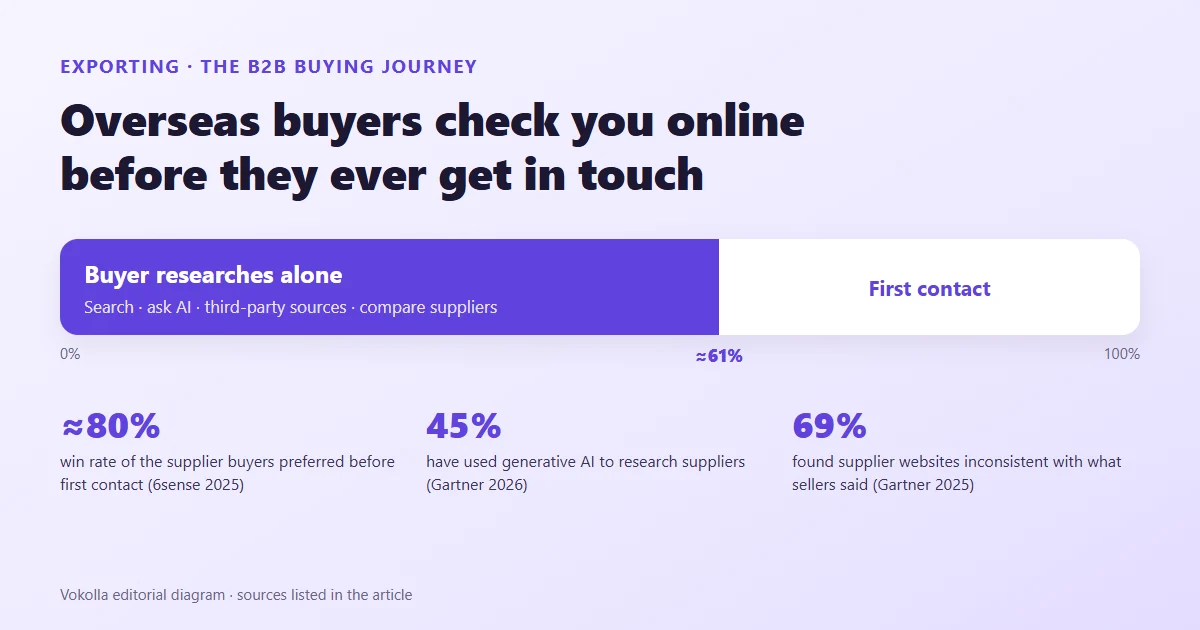
Buyers do most of their homework before they contact you
In 2025, 6sense surveyed nearly 4,000 B2B buyers in North America, EMEA and Asia-Pacific. On average, buyers first contacted a supplier about 61% of the way through the buying process, earlier than the 69% recorded the year before, but most of the research was still done on their own. The supplier a buyer already preferred before first contact went on to win about 80% of the time, and buyers initiated 79% of first contacts.
Gartner's research points the same way. Its June 2025 survey found that 61% of B2B buyers prefer a buying experience without a sales rep, most would rather research through digital channels on their own, and 73% actively avoid suppliers that send irrelevant outreach.
For an exporter, the implication is uncomfortable. Before your quote arrives, a buyer abroad may already have compared you with suppliers in their own country, who share their language, time zone and legal system. What they can find out about you online decides whether you make the shortlist.
Source: 6sense: The B2B Buyer Experience Report for 2025
Source: Gartner: Sales survey finds 61% of B2B buyers prefer a rep-free buying experience (2025-06-25)
| Finding | Figure | Source |
|---|---|---|
| Point at which buyers first contact a supplier | About 61% of the buying journey | 6sense 2025 |
| Win rate of the supplier preferred before first contact | About 80% | 6sense 2025 |
| Buyers who prefer a rep-free buying experience | 61% | Gartner 2025 |
| Buyers who have used generative AI to research suppliers and products | 45% | Gartner 2026 |
| Buyers who found supplier websites inconsistent with what sellers said | 69% | Gartner 2025 |
More buyers ask AI about suppliers, then verify what it says
Gartner's May 2026 survey of 645 B2B buyers found that they consulted an average of seven information sources in their latest purchase, and 45% had used generative AI, mainly to gather information about suppliers and products.
The same survey found that 51% of buyers believe they are more likely to get misleading information from generative AI, and 69% turn to sales reps to validate AI-generated insights. AI helps buyers build a first shortlist faster, but the final decision still rests on information they can verify.
So an exporter does not need a better slogan. It needs facts that appear consistently across several credible sources: when the company was founded, what it makes, its capacity, its certifications and the markets it already ships to. AI can find and summarize them, and a buyer who checks them finds that they match.
A strong reputation at home can be invisible abroad
Domestic customers know you through channels a foreign buyer cannot see: long relationships, referrals, your trade association and the reps who visit them. Online, many established manufacturers and producers still have a website written for that domestic audience. Phone numbers lack a country code, prices are shown in the home currency with local tax, delivery promises say “nationwide”, and the certifications listed are the ones domestic customers expect rather than the ones the destination market requires.
None of this means the business is not ready to export. It means the evidence is not where a foreign buyer looks. Closing that gap is mostly a matter of publishing what you already know, and it supports every quote you send.
A public-proof checklist for exporters
The list follows roughly the order in which a foreign buyer checks a new supplier. Review it each quarter or before a trade show:
Google's guidance says trust is the most important part of E-E-A-T and asks whether content provides original information, research or analysis. For an exporter, real photos of the facility, certificate numbers a buyer can verify and specific capacity figures carry more weight than “world-class quality”.
Source: Google Search Central: Creating helpful, reliable, people-first content
- An export page: the markets you already ship to, the Incoterms you usually quote, typical lead times, minimum order quantities and payment terms.
- Certifications that matter in the buyer's market, for example ISO 9001, CE or UKCA marking, or FDA facility registration, with numbers or registry links a buyer can check.
- Contact details that work from abroad: a phone number with the country code, a monitored email address, your time zone and the languages your team handles.
- Product pages whose specifications, minimum order quantities and lead times match the quotes and catalogue you send.
- An independent public record: news releases about company and product milestones on third-party news sites, searchable by your company name.
- One set of numbers: the same founding year, capacity and customer figures on the website, LinkedIn, the catalogue, your capability statement and the sales deck.
When an exporter should publish a release
You do not need major news. Any development a buyer would care about, and could verify, is a candidate. Common moments include:
- Before or after a trade show abroad, with your stand number and what you will show;
- A new product line, material or process;
- A new certification, approval or patent, especially one that opens a market;
- Appointing a distributor, opening a warehouse or office abroad, or formally entering a new market;
- An export or industry award.
What a release can and cannot do
A release gives your company name a verifiable public record on third-party sites that buyers see when they search and AI tools can read when they summarize. It is not a way to pass ranking signals to your website: Google's spam policies list links with optimized anchor text in press releases distributed on other sites as an example of link spam, and paid links like these should be marked nofollow or sponsored.
With Vokolla, you can upload a finished release, or start from notes and let AI draft it, then check it against your package's media guidelines. Depending on the package, releases can appear on international sites such as AP News, USA Today, StreetInsider, Yahoo and The Globe and Mail. Your report lists every published link, so you can send them to a prospective distributor or add them to a capability statement. Releases are subject to editorial review.
Source: Google Search Central: Spam policies for Google web search (link spam)
Sources and editorial method
Prepared by Vokolla with AI-assisted research and writing. Factual platform guidance was checked against the primary sources below. The diagrams, checklist and examples are editorial recommendations, not platform rules or measured customer results.
- 6sense: The B2B Buyer Experience Report for 2025 — Checked 2026-10-18
- Gartner: Sales survey finds 61% of B2B buyers prefer a rep-free buying experience (2025-06-25) — Checked 2026-10-18
- Gartner: Survey finds 69% of B2B buyers turn to sales reps to validate AI-generated insights (2026-05-20) — Checked 2026-10-18
- Google Search Central: Creating helpful, reliable, people-first content — Checked 2026-10-18
- Google Search Central: Spam policies for Google web search (link spam) — Checked 2026-10-18