
Press release guides
How to get your company featured in major media: a press release writing and distribution playbook
A familiar story: the CEO says 'we should put out a press release', someone turns the About page into a release, it goes out, a list of links comes back, and nothing else happens. The money was spent and the release did appear on media sites, yet a year later nobody can say what it did for the business. The problem is rarely distribution itself. It is usually one of three things: no real news, a format editors don't expect, or no plan for using the release afterwards. This playbook takes them in order.
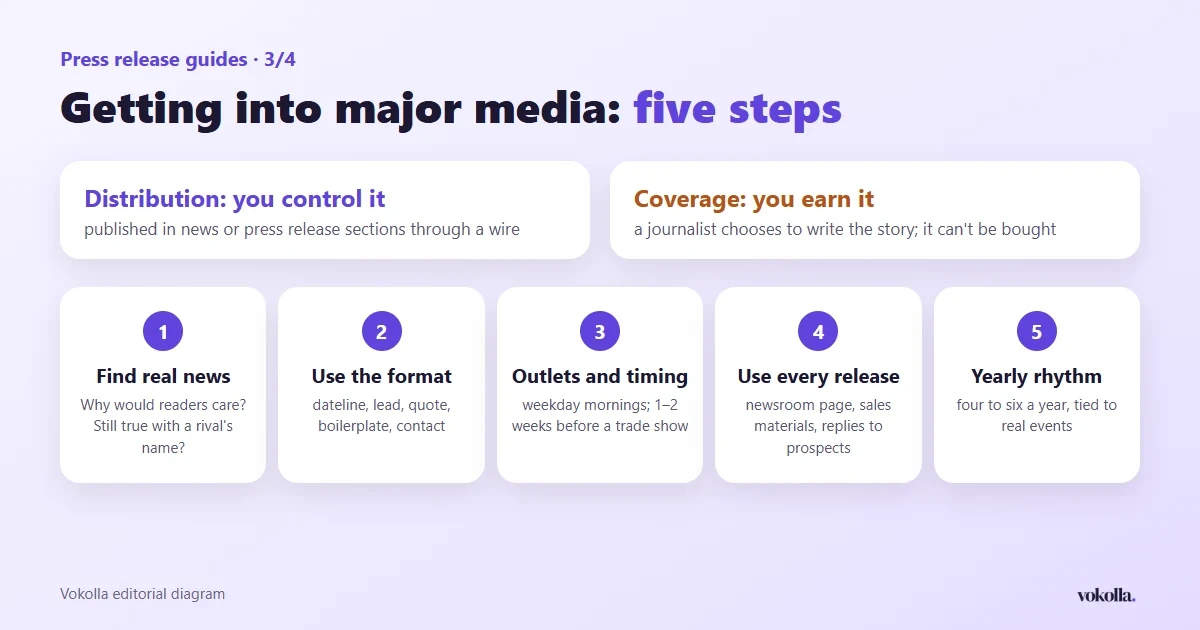
What's the difference between press release distribution and media coverage?
Short answer: distribution means your release is published in the news or press release sections of media sites through a wire; you control the timing, wording and reach. Coverage means a journalist sees your news, decides it matters and writes their own story; you can earn it, but you can't buy it.
The two work together. Distribution builds a steady public record, and every release is also a chance to earn coverage. Everything below helps with both.
One warning: treat any offer of 'guaranteed coverage' or a 'guaranteed front page' as a red flag.
Step 1: how do you find a story editors will care about?
Short answer: editors ask one question first: what does this mean for my readers? Specific events that affect readers get through; corporate milestones that only matter inside the company don't.
Anniversaries, office moves, 'strategic transformations', industry awards you entered yourself and visits from dignitaries rarely interest anyone outside the company. The table shows the kind of rewrite that does (illustrative headlines, not real cases).
A quick test: put a competitor's name in your headline. If the sentence is still true, it isn't specific enough.
Original data is the other strong angle. An e-commerce brand can analyse thousands of its own reviews to show which problems customers mention most; a SaaS company can publish anonymised usage benchmarks; a manufacturer can report failure rates by climate. Data only you have is useful to journalists and quotable by AI tools.
Muck Rack's State of Journalism 2026 (1,044 journalists surveyed, 897 analysed) points the same way. Asked what they want in a pitch, 70% chose clear relevance to their beat, 58% interview access to relevant sources, 40% original data or research and 37% high-resolution images. And 88% said they immediately disregard pitches that don't match their coverage area.
Source: Muck Rack: The State of Journalism 2026 (1,044 journalists surveyed, 897 analysed, March 2026)
| Inside-the-company version | Version an editor can use |
|---|---|
| Company launches next-generation smart product | New portable power station can top up an EV in an emergency; first shipments go to the US and Canada |
| Fifteen years of industry leadership | New plant cuts North American delivery times from 45 days to 20 |
| Company wins prestigious industry award | Product earns UL and CE certification and enters a national retail chain |
| We are committed to sustainability | Switch to recyclable packaging removes about 30 tonnes of plastic a year |
Step 2: how should a press release be structured?
Short answer: use the standard structure editors expect. It gets through review faster and reads better. Each part is below.
| Part | How to write it | Common mistake |
|---|---|---|
| Headline | Who did what, in one line, active voice, specific | 'Revolutionary', 'disruptive', 'game-changing' |
| Dateline | City and date at the start of the first paragraph | Missing, or the date of drafting rather than release |
| Lead | One or two sentences: who, what, when, where, why it matters. Many readers stop here | Opening with company history |
| Body | Most important first; facts before background; every number with source and year | Figures with no source |
| Quote | One or two sentences from a named person, giving judgement or meaning, not repeating facts | Slogans no person would say |
| Boilerplate | A fixed 'About [Company]' paragraph: legal name, founding year, what you do, where, website. Same text every time | A different description in every release |
| Media contact | A real name, email and phone number | An unmonitored info@ address |
What mistakes do companies make when writing for international readers?
Short answer: writing for insiders, leaving local context unexplained, inconsistent names, keyword-stuffed links and superlatives.
Writing for insiders
Internal shorthand, product codenames and sector jargon mean nothing to an editor in another market. Decide the one-sentence news point first, then write for a smart reader who has never heard of you.
Leaving local context unexplained
If you announce outside your home market, readers won't know your state grant program, your national certification body, your regional award or the city your plant is in. Explain each in one clause or replace it with something they know. Convert units, currencies and date formats for the target market. This matters as much for a Canadian company announcing to US readers, or a UK brand entering Australia, as for an Asian manufacturer entering Europe.
Inconsistent names
Use one spelling of the company name, the brand name and each executive's name on your website, marketplace listings, LinkedIn and every release. Consistency helps customers recognise you, and it helps search engines and AI tools work out that all these pages describe the same company.
Keyword-stuffed links
Google's spam policies list 'optimized anchor text in articles, guest posts, or press releases distributed on other sites' as an example of link spam. Link with your brand name or URL, not a string of keywords.
Source: Google Search Central: Spam policies for Google web search (updated 2026-08-28)
Superlatives and unproven claims
'Leading', 'number one' and 'world's best' get cut by editors, discounted by readers and ignored by AI tools. They can also be a legal problem: in the US the FTC expects advertising claims to be truthful and backed by evidence, and the UK and Australia have similar rules. Replace adjectives with checkable facts such as certification numbers, launch dates and markets served.
Source: FTC: Advertising FAQ's: A Guide for Small Business (edited January 2025)
Source: ASA: The CAP Code, section 03, Misleading advertising (rules 3.1 and 3.7)
Source: ACCC: False or misleading claims
Should you pitch journalists as well as distributing the release?
Short answer: for news that matters, yes. Distribution creates the public record; a short personal pitch to the few reporters who cover your beat is how coverage usually starts.
Muck Rack's 2026 report summarises eight years of its journalist surveys on what a good pitch looks like: 62% prefer a one-to-one email, 69% prefer pitches under 200 words, 78% want them before noon, and 50% say one follow-up is ideal, with 51% saying it should come three to seven days later.
In practice: find five to ten reporters who have written about your category in the last few months, write each a short email with the news point, why it matters to their readers and what you can offer (data, an interview, images), and link the published release for the full details. Don't mass-mail; 50% of journalists in the same survey said they are put off by mass emails.
Source: Muck Rack: The State of Journalism 2026 (1,044 journalists surveyed, 897 analysed, March 2026)
Step 3: how do you choose outlets and timing?
Short answer: decide who the release is for, then choose the outlet mix. Publish on a weekday morning in your target market's time zone, avoid major holidays, and put trade-show news out a week or two before the show.
Consumer launches suit local news and TV station sites with broad reach. News for buyers, distributors and partners suits trade and financial sites. Real milestones, such as entering a new market or a major partnership, are where named outlets like AP News, USA Today or Yahoo Finance are worth adding.
For US readers, a weekday morning Eastern time is a safe default; for the UK or Australia, use local business hours. Avoid the Thanksgiving-to-New-Year stretch in the US, and avoid days when your industry's biggest news will drown you out. This is practitioner experience, not a measured rule. For CES or your sector's trade show, publish a week or two before, so visitors who pick up your brochure find the news when they search.
Before you publish, make sure the page you link to exists: a product or news page on your own site with more detail and a way to contact you or buy.
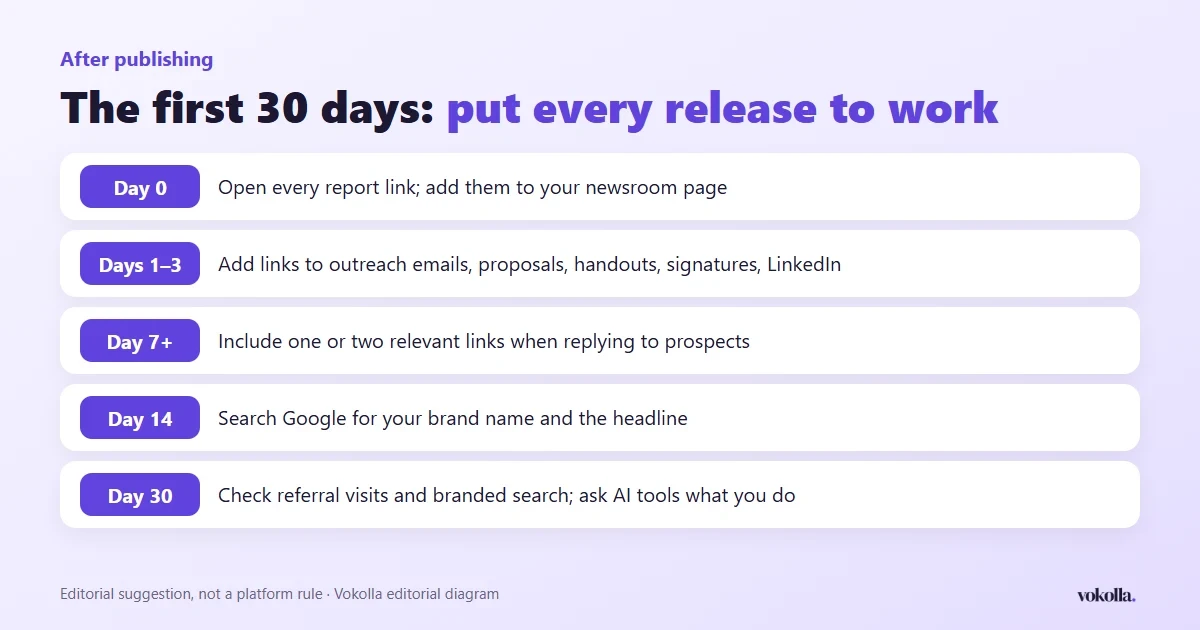
Step 4: what should you do in the 30 days after publishing?
Short answer: most companies stop at the link list. The month after publishing is when a release starts working. Use the checklist below.
Add a newsroom or 'In the news' page to your site, list each release by date with links to the published pages. That page becomes a dated history for customers, partners and AI tools.
Put the links into sales materials: outreach emails, proposals, trade-show handouts, email signatures and your LinkedIn company page. When you reply to a prospect who has never worked with you, one or two relevant links do more than a capabilities deck.
Describe placements accurately. Write 'published on AP News' and link the page; don't turn outlet logos into an 'as featured in' or 'partners' badge that implies the outlet endorses you. Accurate wording looks more professional, and it keeps you on the right side of truth-in-advertising rules.
How do you measure whether a press release worked?
Short answer: check three things: third-party pages on the first page of results for your brand, referral visits from those pages, and whether AI tools describe you correctly. Change is gradual and builds release by release.
- Search Google for your brand name. Do third-party pages appear on the first page?
- In your analytics, look for referral visits from the outlet pages, and in Google Search Console for changes in branded queries.
- Ask ChatGPT, Gemini or Perplexity what your company does. Are you mentioned, and is it correct? If something is wrong, find the source that says it and fix that first.
Step 5: how many releases a year, and on what schedule?
Short answer: four to six a year, following real business events. That is an editorial suggestion, not a platform rule.
A brand's public profile isn't built by one release. A workable rhythm: a product launch in Q1, a trade show in Q2, a new market or partner in Q3, annual data in Q4. Each release extends the timeline. Don't reissue the same news under a new headline.
Which of these steps can you do yourself on Vokolla?
Short answer: drafting, checks, submission and a report with every live link. Disclosure: I'm the founder of Vokolla, a self-service press release platform.
You can upload your own release, or describe the news in your own words and let the AI assistant draft it; missing facts are flagged for you to fill in rather than invented. Before submission the draft is checked against your package's media guidelines, including overly promotional wording. You track progress in your workspace, and the final report lists every live link, ready for your newsroom page.
Packages are priced per release: Brand Starter US$69 (400+ regional news and industry sites), Global Reach US$129 (500+ outlets, including 100+ TV and radio station websites), Premium Media US$379 (everything in Global Reach plus AP News, USA Today, Barchart and StreetInsider) and Global Impact US$659 (a separate network of 300+ outlets concentrated on 20+ high-traffic sites such as Yahoo, Business Insider, MarketWatch and The Globe and Mail; not the other packages combined).
Every release is subject to editorial review, and each outlet decides whether to publish it.
Source: Vokolla: Publishing packages and prices
Source: Vokolla: Partner media list (DR and monthly visits are third-party estimates, October 2026)
How did we check the facts in this guide?
Journalist survey figures, Google's policy and the FTC guidance were checked against the original sources and cited under the paragraphs that use them. Muck Rack's survey is about PR pitches, which are not the same as press releases, and its 'perfect pitch' figures summarise eight years of surveys; we kept both distinctions. Muck Rack sells media relations software, so it has an interest in findings like these.
The headline rewrites, the 30-day checklist, the timing advice and the yearly rhythm are editorial suggestions, not real cases or platform rules. This guide was researched and drafted by Vokolla with AI assistance, every fact was checked against its original source, and the author reviewed it. Vokolla's packages are as published on our pricing and media list pages.
Frequently asked questions
Questions people ask about writing and distributing releases.
How long should a press release be?
There's no fixed length; the release should explain one piece of news fully. Most run to a few hundred words. Make the lead understandable on its own and order the rest by importance, so an editor can cut from the bottom without losing the point.
Can I use AI to write a press release?
Yes, as a drafting tool. Check every fact yourself: certifications, figures, customer names and job titles must be real and verifiable. If you can't confirm something the AI added, delete it.
How many links can a release include?
It depends on the outlet and package. Link to the page on your site that covers this news, use your brand name or URL as the link text, and don't stuff keywords.
Can I put outlet logos on my website?
Say 'published on [outlet]' and link the page. Avoid presenting logos as partners or endorsements, which can mislead customers.
Sources and editorial method
Prepared by Vokolla with AI-assisted research and writing. Factual platform guidance was checked against the primary sources below. The diagrams, checklist and examples are editorial recommendations, not platform rules or measured customer results.
- Muck Rack: The State of Journalism 2026 (1,044 journalists surveyed, 897 analysed, March 2026) — Checked 2026-10-21
- Google Search Central: Spam policies for Google web search (updated 2026-08-28) — Checked 2026-10-21
- FTC: Advertising FAQ's: A Guide for Small Business (edited January 2025) — Checked 2026-10-22
- ASA: The CAP Code, section 03, Misleading advertising (rules 3.1 and 3.7) — Checked 2026-10-22
- ACCC: False or misleading claims — Checked 2026-10-22
- Vokolla: Publishing packages and prices — Checked 2026-10-22
- Vokolla: Partner media list (DR and monthly visits are third-party estimates, October 2026) — Checked 2026-10-22