Press release guides
Why press releases matter: your company needs a public record people can check
An ad buys attention. A press release leaves a record. Plenty of companies treat a release as promotion, but readers treat it as something else: a dated statement, signed by a company, saying what happened and whom to ask. This guide skips the 'ten benefits of press releases' list and answers one question: what is a release in the eyes of the people who read it, what can it do for a growing company, and what can't it do?
What is a press release, from the reader's side?
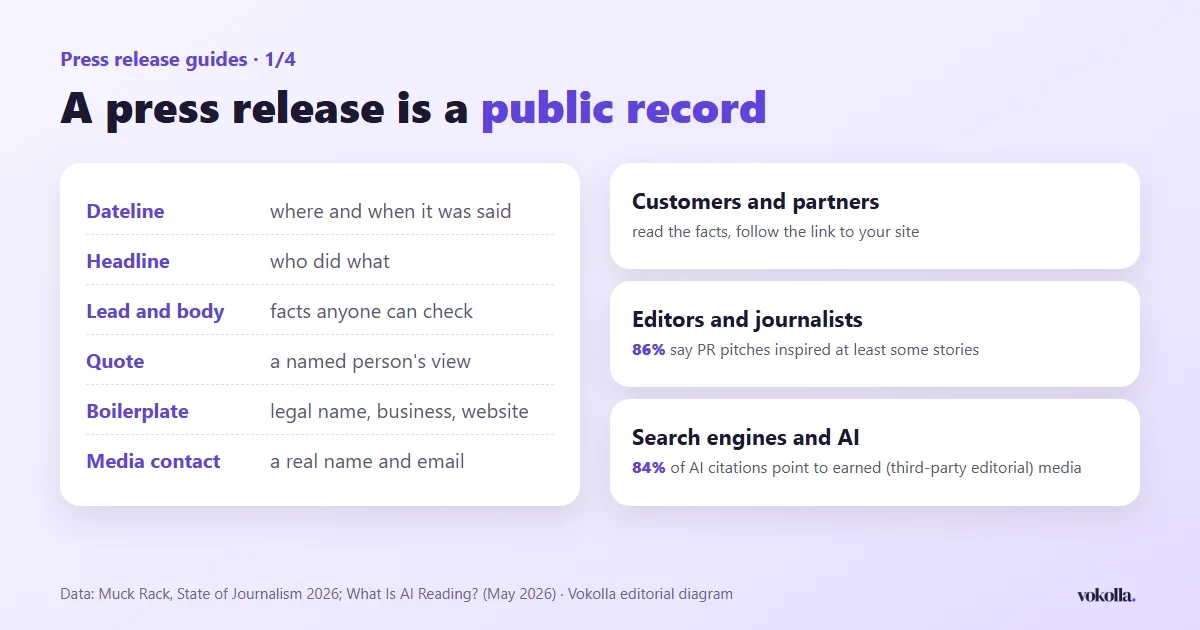
Short answer: a press release is a statement a company writes and publishes in its own name, with a date and a contact, so anyone can check it. Readers treat it as 'what this company has said on the record', not as an ad.
The format is more than a century old. In October 1906 a train fell from a bridge into the water near Atlantic City, New Jersey, and more than fifty people died. At the time, news mostly came from reporters chasing sources, and companies in trouble usually said nothing. The Pennsylvania Railroad, which owned the line through a subsidiary, did the opposite: its adviser Ivy Lee wrote up the facts as a formal statement, sent it to the newspapers in the company's name and took reporters to the scene. According to PR histories, the New York Times printed it almost word for word. It was not a reporter's story but a company's own written account, handed to the press. That is what a press release is, and why Lee's statement is often called the first modern one.
One detail is worth keeping: the railroad's early view of the cause was later contradicted by the official inquest. That is the point of a release. It is a signed public statement that others can check against the facts, and when it's wrong, the record shows it.
Releases also carry regulatory weight. The SEC's Regulation FD, in force since October 2000, requires a US public company that discloses material non-public information to analysts or investors to make it public at the same time (or promptly, if the disclosure was unintentional). The SEC lists a press release distributed through a widely circulated news or wire service as an acceptable method, alongside press conferences, conference calls and Form 8-K. The UK and Australia have their own channels: UK issuers must disclose regulated information through a Regulatory Information Service, and ASX-listed companies must give price-sensitive information to the ASX before releasing it to the media. None of these rules says that every company must issue press releases. They show why a release is read as an official statement.
Source: FCA Handbook: DTR 6.3 Dissemination of information (regulated information through a RIS)
Source: ASX: Guidance Note 8, Continuous disclosure (amended 27 May 2024), section 4.16
How do buyers decide whether to trust a company they don't know?
Short answer: they search for it. Whether the first page shows third-party records often decides whether there's a second conversation.
Referrals, site visits and long relationships build trust when buyers already know you. A distributor in another state, a consumer who saw your ad on Instagram, a procurement manager who met you at a trade show: each does the same thing next. They look you up.
If the first page shows only your website, your store and your ads, they're reading 'we say we're good'. If it also shows dated articles on news sites saying who you are, what you launched and where you sell, they have a reference point that isn't you. However good your website is, it is still you talking about yourself.
This matters most when you are the unfamiliar name: a startup, a company entering a new country, or an overseas brand selling into the US, UK or Australia. People are wary of brands they've never heard of, especially for expensive products or anything shipped from far away. What they find when they search is your first impression.
Why is one release news, but six a track record?
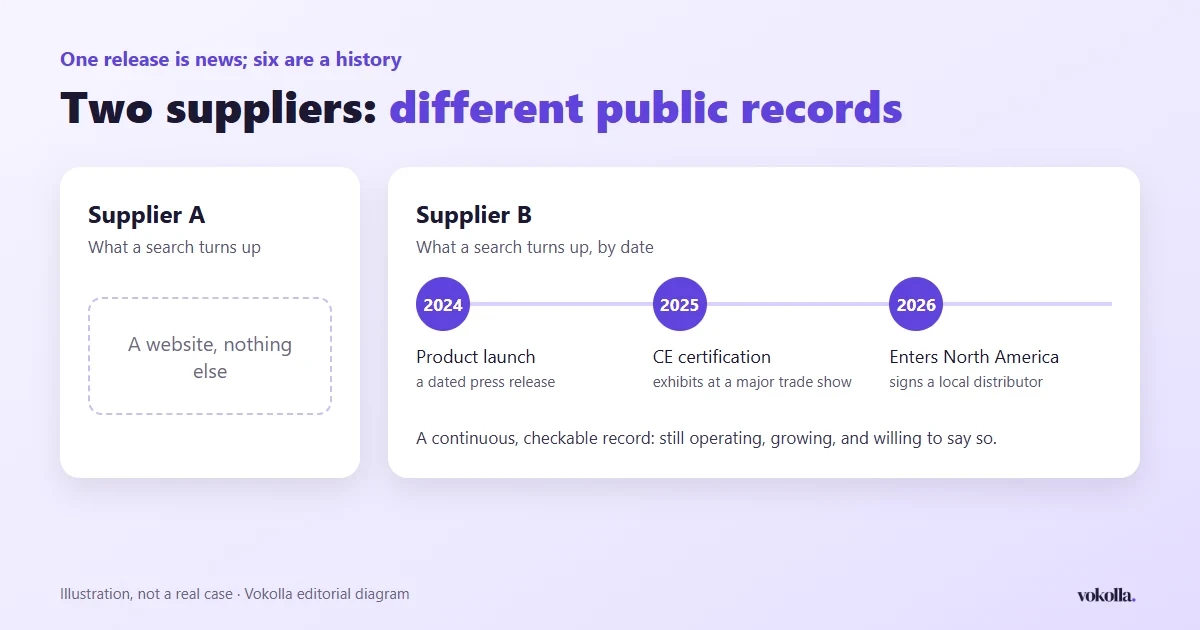
Short answer: one release explains one event. A series of dated releases over several years shows a company that is still operating, growing and willing to say what it did.
Imagine a buyer comparing two suppliers (an illustration, not a real case). Supplier A has a website. Supplier B also has a website, and a search turns up a product launch in 2024, a certification and a trade show in 2025, and a North American distribution agreement in 2026. Even if the products are similar, most buyers will trust B more, because B has a record they can check.
That is the basic difference from advertising. An ad buys attention; when the budget stops, so do the clicks and enquiries. A release leaves a page on a media site that stays online for as long as the publisher keeps it. Over time, those pages become your public history.
| Compared on | Advertising | Press release |
|---|---|---|
| What you get | Attention and clicks | A dated, signed public record |
| When you stop paying | Exposure stops | Published pages stay online for as long as each publisher keeps them |
| How readers see it | The brand talking about itself | The company's official statement, which they can check |
| What it's good for | Creating demand and clicks | Being findable and credible to people who look you up |
Who actually reads a press release?
Short answer: three kinds of reader. Customers and partners read the facts, journalists look for leads, and search engines and AI tools collect public information they can cross-check.
Customers and partners want to know what you launched, what problem it solves, where it's available and how to reach you. A proper release ends with a company description, a contact and a web address, so it hands them to your site.
Editors and journalists use releases as raw material. Muck Rack's State of Journalism 2026 surveyed 1,044 journalists (897 responses analysed); 86% said PR pitches inspire at least some of their stories. A pitch isn't the same as a release, but the lesson carries over: clear, newsworthy material is where coverage starts, and a source journalists can quote.
Search engines and AI tools are the newest reader. More people now ask ChatGPT, Gemini or Google's AI Overviews 'is this company legitimate?' or 'which brands make this?'. In May 2026 Muck Rack analysed more than 25 million links cited in ChatGPT, Claude and Gemini answers: 84% pointed to earned, third-party editorial content. Google's documentation says there are no additional requirements or special optimisations needed to appear in AI Overviews; the basics still apply.
In short, AI tools, like people, weigh what others say about you. A brand with almost no third-party record is easy for an AI answer to miss or confuse with someone else. These studies describe overall patterns; they don't mean any particular release will be cited.
Source: Muck Rack: The State of Journalism 2026 (1,044 journalists surveyed, 897 analysed, March 2026)
Source: Muck Rack: What Is AI Reading? (May 2026 edition, updated 2026-05-07)
Source: Google Search Central: AI features and your website (updated 2025-12-10)
Why build third-party proof before you scale ad spend?
Short answer: many people who click an ad don't buy straight away; they search for your brand name first. What that search shows decides whether the ad spend turns into a sale.
Most growing companies spend real money on Google, Meta or LinkedIn ads. If a prospect searches your name and finds only your own pages, while a competitor has releases on Yahoo Finance or USA Today, you paid for the click and the competitor gets the credibility.
If you already have a dated public record on known media sites, you keep the customers you paid to reach, and you show up when prospects compare options, sometimes catching people who were looking at a competitor.
So the order matters: a public record first, then more ad spend.
How can a release help when you launch a new brand name?
Short answer: after you've searched the trademark registers and filed your application, and before you commit to inventory and big ad budgets, publish one or two brand announcements so the name is public early and any conflict surfaces while it's still cheap to change.
Search before you invest: the USPTO's Trademark Search in the US, the UK IPO's trade mark search, IP Australia's Australian Trade Mark Search, and WIPO's Global Brand Database for other registers. Rebranding after you've printed packaging and built an audience is expensive.
A dated announcement also gives the brand a public starting point. To be clear, a release is not trademark clearance, registration or legal advice. Whether you can use and register a name depends on the searches and on advice from a trademark attorney; do both.
Source: USPTO: Search our trademark database
Source: GOV.UK: Search for a trade mark
Source: IP Australia: Australian Trade Mark Search
Source: WIPO: Global Brand Database
What can't a press release do?
Short answer: it doesn't close sales, it isn't link building, it isn't earned coverage and it can't carry exaggeration. Know the limits before you spend.
It doesn't close sales. It makes you easier to find and easier to believe; closing still depends on product, price and service.
It isn't link building. Google's spam policies say paid links are fine when they carry rel="nofollow" or rel="sponsored", and list 'optimized anchor text in articles, guest posts, or press releases distributed on other sites' as an example of link spam. A release earns its keep through visibility and credibility, not link equity. Use your brand name or URL as the link text.
It isn't earned coverage. Appearing on news sites through distribution is different from a reporter choosing to write about you. You control the first; you earn the second with news value. Good distribution is where earning coverage starts.
It can't carry exaggeration. 'World-leading' and 'number one' get cut by editors, discounted by readers and ignored by AI tools. In the US, the FTC expects advertising claims to be truthful and backed by evidence, and the UK and Australia have similar rules. Checkable facts are what give a release weight.
Source: Google Search Central: Spam policies for Google web search (updated 2026-08-28)
Source: Google Search Central: Qualify your outbound links (sponsored, nofollow; updated 2025-12-10)
Source: FTC: Advertising FAQ's: A Guide for Small Business (edited January 2025)
Source: ASA: The CAP Code, section 03, Misleading advertising (rules 3.1 and 3.7)
Source: ACCC: False or misleading claims
What news is worth a press release?
Short answer: you don't have to be big. Anything real and relevant to customers can be a release. Common examples:
- A new product or feature.
- A certification or test result that opens a market (UL, CE, FCC or similar).
- A trade show such as CES or your industry's main event. Publish a week or two before, so visitors who take your brochure find you when they search.
- Entering a new country or market, or signing a distributor.
- A partnership, funding round or new facility.
- Original industry data or research.
- A new website, store or app.
How many releases a year?
Our suggestion is four to six substantive releases a year, tied to real business events. A steady, truthful rhythm persuades more than one big burst. This is an editorial suggestion, not a platform rule.
How can a smaller company publish press releases today?
Short answer: distribution used to be opaque in reach, price and results. Now you can use a self-service platform with published prices and do the choosing, drafting, submitting and checking yourself.
Disclosure: I'm the founder of Vokolla, a self-service press release platform. What follows is based on what our site publishes, so you can compare it with any other provider.
The old way was hard in three places. It was difficult to know which outlets a vendor really reached or how a release should be written; quotes varied by who asked and passed through several resellers; and it was hard to confirm afterwards what had been published, and where. So media coverage felt like something only large companies could afford.
On Vokolla you submit in a self-service workspace: upload your own release, or describe the news and let the AI assistant draft it. The partner outlets are listed with their type, location, authority score and estimated monthly traffic. Prices are public, from US$69 per release. Premium Media (US$379) includes four named outlets such as AP News and USA Today; Global Impact (US$659) is a separate network concentrated on 20+ high-traffic outlets such as Yahoo, Business Insider and The Globe and Mail. After publication, your report lists every live link so you can open each one.
Every release is subject to editorial review, and each outlet decides whether to publish it. Packages use different networks, and the report shows where your release actually appeared.
Source: Vokolla: Publishing packages and prices
Source: Vokolla: Partner media list (DR and monthly visits are third-party estimates, October 2026)
How did we check the facts in this guide?
History, regulation, surveys and platform policies were checked against original sources and cited under the paragraphs that use them. Some notes: accounts of Ivy Lee's statement differ in detail (sources give 29 or 30 October for the New York Times printing), so we say 'according to PR histories'; Billy Penn (WHYY) gives 53 deaths and 28 October 1906, which we round to 'more than fifty'. We describe Regulation FD and the UK and Australian rules only as disclosure channels, not as a legal duty to issue press releases. Muck Rack's journalist survey is about PR pitches, which are not the same as releases, and Muck Rack sells media relations software, so it has an interest in findings like these.
The two suppliers are an illustration, not real customers. Vokolla's packages, prices and rules are as published on our pricing, media list and refund policy pages. This guide was researched and drafted by Vokolla with AI assistance, every fact was checked against its original source, and the author reviewed it.
Frequently asked questions
Questions growing companies ask about press releases.
Is a press release worth it for a small company?
It depends on whether people who don't know you need to find and trust you. Size isn't the test. Real news, such as a launch, a certification, a trade show or a new market, is worth a release. Smaller companies often need third-party records more, because customers know less about them.
Does a distributed press release count as media coverage?
No. Appearing in the news or press release section of media sites through a wire is distribution. Coverage is a journalist choosing to write about you. The two work together: distribution creates the record and gives journalists a chance to notice you.
Do press release links help SEO?
Don't treat them as link building. Google's spam policies list optimised anchor text in distributed press releases as link spam, and paid links should carry nofollow or sponsored. Links in a release are there to bring readers to your site; use your brand name or URL.
Will AI tools recommend us after we publish a release?
No one can promise that. Research shows AI answers mostly cite third-party content, but whether and when a given page is cited is up to each AI platform. What you can do is make sure consistent, checkable facts about your company appear in several credible places.
Sources and editorial method
Prepared by Vokolla with AI-assisted research and writing. Factual platform guidance was checked against the primary sources below. The diagrams, checklist and examples are editorial recommendations, not platform rules or measured customer results.
- Billy Penn (WHYY): A tragic Jersey Shore train crash spurred the first-ever press release (2023-11-05) — Checked 2026-10-21
- SEC: Selective Disclosure and Insider Trading (Regulation FD final rule, Release 33-7881, effective 2000-10-23) — Checked 2026-10-21
- Muck Rack: The State of Journalism 2026 (1,044 journalists surveyed, 897 analysed, March 2026) — Checked 2026-10-21
- Muck Rack: What Is AI Reading? (May 2026 edition, updated 2026-05-07) — Checked 2026-10-21
- Google Search Central: AI features and your website (updated 2025-12-10) — Checked 2026-10-21
- Google Search Central: Spam policies for Google web search (updated 2026-08-28) — Checked 2026-10-21
- Google Search Central: Qualify your outbound links (sponsored, nofollow; updated 2025-12-10) — Checked 2026-10-21
- FCA Handbook: DTR 6.3 Dissemination of information (regulated information through a RIS) — Checked 2026-10-22
- ASX: Guidance Note 8, Continuous disclosure (amended 27 May 2024), section 4.16 — Checked 2026-10-22
- USPTO: Search our trademark database — Checked 2026-10-22
- GOV.UK: Search for a trade mark — Checked 2026-10-22
- IP Australia: Australian Trade Mark Search — Checked 2026-10-22
- WIPO: Global Brand Database — Checked 2026-10-22
- FTC: Advertising FAQ's: A Guide for Small Business (edited January 2025) — Checked 2026-10-22
- ASA: The CAP Code, section 03, Misleading advertising (rules 3.1 and 3.7) — Checked 2026-10-22
- ACCC: False or misleading claims — Checked 2026-10-22
- Vokolla: Publishing packages and prices — Checked 2026-10-22
- Vokolla: Partner media list (DR and monthly visits are third-party estimates, October 2026) — Checked 2026-10-22