
AI search · Research
How AI search answers “Can I buy it, what does it cost, can I return it?” — 2026 ecommerce AI search study, wave 1
Shoppers increasingly ask AI directly: “How much is this shoe on the German official store? Can it ship to Berlin? Can I return it?” On 22 October 2026 we put fixed questions about 17 named products and named sellers to Google AI Mode and ChatGPT, collected 28 formal answers, coded every requested item and checked specifications against official manufacturer material. This is the first wave of the study. The sample is limited, but it already shows where AI search is reliable and where it most often goes wrong.
Five key findings
These findings come from 28 formal wave-1 answers (17 from Google AI Mode, 11 from ChatGPT) covering 17 fixed product configurations in running shoes, robot vacuums, carry-on luggage and earbuds. They describe this observation; they are not platform-wide accuracy rates or brand rankings.
- Manufacturer static specs were almost always right: none of 29 checkable values contradicted the manufacturer. Five involve RIMOWA, whose own site gives inconsistent metric and imperial widths.
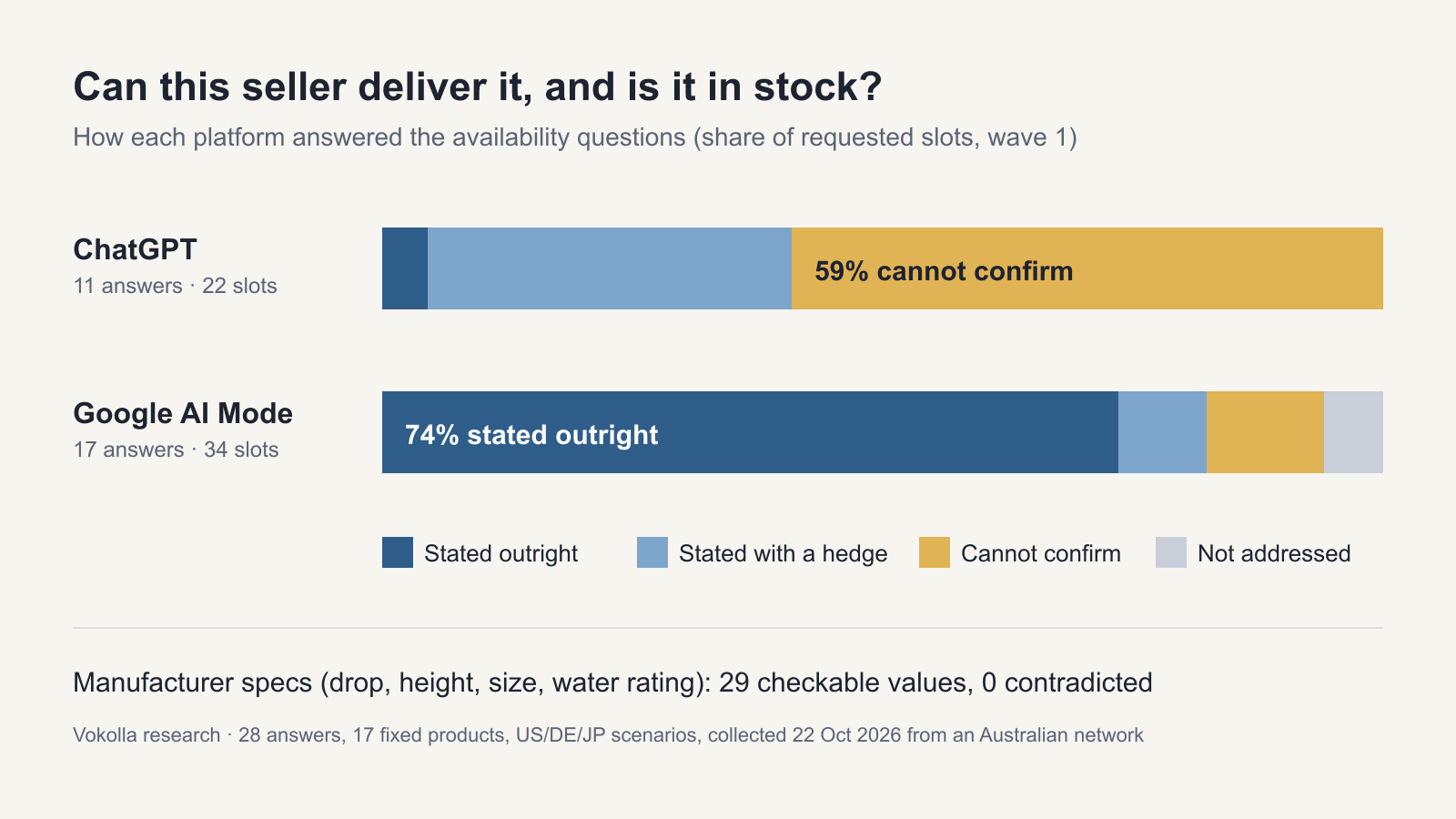
- Very different answering styles: on the availability items, ChatGPT said “cannot confirm” 59% of the time and asserted outright only once; Google AI Mode asserted outright 74% of the time.
- Google AI Mode contradicted itself more often: 7 of 17 answers, against 2 of 11 for ChatGPT.
- Claims not matching their sources were the most common problem: On Germany’s “official price” cited a Dutch third-party store, and US returns terms for Sony earbuds cited PUMA Australia’s returns page.
- The same product can get prices nearly 2× apart within minutes: for eufy Omni E25 in Japan, Google AI Mode said ¥79,900 and ChatGPT ¥149,900, captured about three minutes apart.
How we did it
Each question names one fixed product configuration (model, regional identifier, colour or bundle, size) and one official seller. It asks the AI to verify five groups of information with sources — identity, category parameter, price (including tax and shipping), whether the seller sells and delivers to the destination, and return window and fees — and to distinguish five stock states. Questions were asked in English (United States, delivery to New York 10001), German (Germany, Berlin 10115) and Japanese (Japan, Tokyo 100-0001).
Collection took place on 22 October 2026 (Sydney time) from an Australian network, signed out on both platforms, with a new session for every question. A program read each question from the frozen file and submitted it, so nothing was retyped. Every answer page’s full text, links and structure were archived with hashes. Answers were coded item by item (16–19 requested items each, 496 in total) with AI assistance, every quoted span was checked against the original, and parameters were checked against official brand sites.
| Category | Google AI Mode valid answers | ChatGPT valid answers |
|---|---|---|
| Road-running shoes (On, HOKA, Nike, ASICS) | 7 | 7 |
| Robot vacuums (eufy, Dreame, ECOVACS) | 4 | 2 |
| Carry-on luggage (RIMOWA, Travelpro, DELSEY PARIS) | 4 | 2 |
| Earbuds (Sony, soundcore) | 2 | 0 |
| Total | 17 | 11 |
“Can I buy it, is it in stock?”: two answering styles
On the 11 configurations answered by both platforms, every ChatGPT answer flagged items it could not verify, 44 in total; only 3 Google AI Mode answers did, 6 items in total. Neither platform swapped the model or seller, and both used the local currency.
The difference is how uncertainty is handled. ChatGPT tends to mark stock, postal-level delivery and return details as “cannot confirm, check at checkout”. Google AI Mode tends to give a definite answer, which more often conflicts with the rest of the same answer — for example claiming “all data verified” while saying stock and shipping are unknown.
| Measure | Google AI Mode | ChatGPT |
|---|---|---|
| Asserted | 153 | 139 |
| Asserted with a hedge | 18 | 38 |
| Explicitly cannot confirm | 6 | 22 |
| Not addressed | 22 (16 from one page that returned only web results) | 0 |
| Answers flagging at least one unverified item | 3/11 | 11/11 |
| Answers with an internal contradiction | 4/11 | 2/11 |
| Model or seller substituted | 0/11 | 0/11 |
Specs were right; measurement state was the weak point
All 14 shoe-drop answers (On 6 mm, HOKA 5 mm, Nike 10 mm, ASICS 8 mm) and all 6 robot-height answers (eufy 11.1 cm, Dreame 10.38 cm, ECOVACS 10.4 cm) matched the manufacturer. Travelpro, Sony and soundcore dimensions or water ratings also matched. RIMOWA’s site gives a width of 44 cm and 17.8 in (about 45.2 cm); the answers copied the official figures, and we do not score that item right or wrong.
The weak point is measurement state. None of the three robot-vacuum brands says under what state height is measured, yet five answers (four from Google AI Mode, one from ChatGPT) called it the “normal” height — an unsupported addition. Only one ChatGPT answer said the state was unknown. Two items could not be verified: DELSEY dimensions (the brand does not say whether wheels are included, and the answer cited an Amazon listing for another colour) and the soundcore case rating (not published separately).
Source: On — Cloudsurfer Max men’s product page (drop)
Source: HOKA — Bondi 9 men’s product page (heel-to-toe drop)
Source: Nike — Winflo 12 HV9272-001 product page (drop)
Source: ASICS Germany — NOVABLAST 6 product page (Fersensprengung)
Source: Anker Japan — eufy Omni E25 product page (dimensions)
Source: Dreame — L60 Ultra PE product page (dimensions)
Source: ECOVACS US — DEEBOT N30 PRO OMNI product page (dimensions)
Source: RIMOWA US — Essential Sleeve Cabin Plus 84256631 product page (measurements)
Source: Travelpro — Optima Expandable Carry-On Spinner product page (overall dimensions)
Source: DELSEY PARIS US — HELIUM AERO 21-inch carry-on 0764011 product page (exterior dimensions)
Source: Sony — LinkBuds Open WF-L910 Help Guide (water resistance)
Source: Anker Japan — soundcore Space A40 product page (water resistance)
| Platform | Matches manufacturer | Matches one of two conflicting official values | Contradicted | Unverifiable |
|---|---|---|---|---|
| Google AI Mode | 14 | 3 (RIMOWA) | 0 | 2 |
| ChatGPT | 10 | 2 (RIMOWA) | 0 | 0 |
The most common problem: claims that do not match their sources
Price, stock and returns must be checked against seller pages captured the same day. Wave 1 did not complete that step, so we do not compute accuracy for them; we report only problems visible in the answers themselves. Each example below comes from a single Google AI Mode answer and is pending human review:
- On Germany: an “official price” of €190 cited the Dutch third-party store Sneaker Squad.
- ECOVACS Japan: called an official-store price, but the listed sources are Rakuten and Yahoo! shops; it also replaced the given identifier with a model code it found.
- Nike US and ASICS Germany: the price cards belonged to another style code (another colourway) of the same shoe.
- US returns terms for Sony earbuds cited PUMA Australia’s returns page; the ASICS Germany return start date cited Onitsuka Tiger.
- 9 of 17 Google AI Mode answer pages showed Australian or New Zealand links (such as RIMOWA’s Australian store in US and Japanese scenarios); ChatGPT 1 of 11. This likely reflects our Australian network and shows that answers respond to the user’s location.
| Platform | Answers | External links | Brand-official | Answers with AU/NZ links |
|---|---|---|---|---|
| Google AI Mode | 17 | 112 | 89 | 9 |
| ChatGPT | 11 | 49 | 45 | 1 |
The same product, prices nearly 2× apart within minutes
Of the 7 configurations where both platforms gave a single price, 6 agreed. The exception was eufy Omni E25 in Japan: Google AI Mode said ¥79,900 (calling it 47% off) and ChatGPT said ¥149,900, captured about three minutes apart. For HOKA Bondi 9 in the US it was $175 against a $140–175 range. Without a contemporaneous seller snapshot we do not say which price was right, but for shoppers, getting different prices for the same question on different platforms is itself a risk.
What this means for brands
How reliable AI search is depends largely on whether a brand’s own official information is clear, consistent and findable.
- Publish static specs clearly and consistently: state measurement conditions (wheels included, sensor retracted) and make metric and imperial figures agree.
- Organise price, stock and return policies by region and style code, and say on the page which style and country they apply to, so other colourways, other countries’ sites or third-party stores are less likely to override them.
- Do not assume shoppers see the same information everywhere: regularly check major platforms with the questions your customers actually ask.
Limitations and next steps
This study is ongoing, and wave-1 results should be read with these limits:
- Small sample: 28 answers, 17 configurations, two platforms, one round. Results describe this observation, not platform-wide accuracy or any brand’s overall performance.
- Not yet included: unprompted brand recommendations (the “brand visibility” measure), English-paired questions, Perplexity (which required sign-in) and later rounds.
- Accuracy was checked only for manufacturer static specs; price, stock, delivery and returns are reported for coverage and visible problems only, because contemporaneous seller snapshots are missing.
- Collected from an Australian network while signed out; answers can vary by region, account and time.
- Coding was AI-assisted; the planned 20% human double coding and human review of negative findings are not yet complete, so “contradiction” and “source mismatch” examples are observations pending review.
- Vokolla provides press-release distribution and brand communication services; this study received no funding from any brand or platform, and none took part.
Methodology and scope
2026-10-21 — 2026-10-25
Method
Fixed group-B questions (named product, configuration and official seller) submitted on 22 October 2026 (Sydney) to Google AI Mode and ChatGPT, signed out, from an Australian network; 28 valid answers coded on 16–19 requested items each (496 items) with AI assistance and verbatim-span checks; manufacturer static specs checked against official brand pages.
Sample and scope
17 fixed configurations in four categories (running shoes, robot vacuums, carry-on luggage, earbuds) across US/English, Germany/German and Japan/Japanese scenarios; wave 1, one round.
Limitations
Small single-round sample; no unprompted brand-recommendation results, Perplexity or later rounds yet; price, stock, delivery and returns not scored for accuracy without same-day seller snapshots; AI-assisted coding with human double coding and review of negative findings pending; Australian network and signed-out state may affect answers.
Sources and editorial method
Original research by Vokolla. Answers were collected through a program and coded with AI assistance, with every quoted span checked against the archived answer; human double coding and review of negative findings are still pending. No brand or platform funded or took part in this research. Vokolla provides press-release distribution and brand communication services.
- On — Cloudsurfer Max men’s product page (drop) — Checked 2026-10-17
- HOKA — Bondi 9 men’s product page (heel-to-toe drop) — Checked 2026-10-18
- Nike — Winflo 12 HV9272-001 product page (drop) — Checked 2026-10-18
- ASICS Germany — NOVABLAST 6 product page (Fersensprengung) — Checked 2026-10-18
- Anker Japan — eufy Omni E25 product page (dimensions) — Checked 2026-10-17
- Dreame — L60 Ultra PE product page (dimensions) — Checked 2026-10-24
- ECOVACS US — DEEBOT N30 PRO OMNI product page (dimensions) — Checked 2026-10-24
- RIMOWA US — Essential Sleeve Cabin Plus 84256631 product page (measurements) — Checked 2026-10-18
- Travelpro — Optima Expandable Carry-On Spinner product page (overall dimensions) — Checked 2026-10-24
- DELSEY PARIS US — HELIUM AERO 21-inch carry-on 0764011 product page (exterior dimensions) — Checked 2026-10-24
- Sony — LinkBuds Open WF-L910 Help Guide (water resistance) — Checked 2026-10-24
- Anker Japan — soundcore Space A40 product page (water resistance) — Checked 2026-10-17