
Ecommerce brands
Selling into a new country? You're the foreign brand there. Here's how to close the trust gap
Many online sellers start on a marketplace such as Amazon, Etsy or eBay, where the platform lends its trust: the reviews, the returns policy, the payment protection. Moving to your own Shopify store, or shipping to customers in another country, removes most of that borrowed trust. Whether it is a US brand selling into Canada, a UK maker shipping to the US or an Australian label opening in the UK, the shopper meets a name they have never seen, from a company based somewhere else. Before buying, they search the brand, and more of them now ask an AI assistant to compare the options. This article uses public data to describe the trust gap foreign brands face, and how independent news coverage helps a brand leave a credible public record in search and AI.
Marketplace trust doesn't move with you
On a marketplace, a shopper is mostly trusting the platform. They know how returns work, they can read hundreds of reviews, and payment disputes go through a company they already use. When a seller opens its own store or starts shipping abroad, the shopper is asked to trust the brand directly, often with no reviews from their country, a currency they have to convert in their head and a returns address on another continent.
That is why the move from seller to brand is less about a logo than about evidence. A shopper who has never heard of you needs to find something about your brand that you did not write yourself.
The foreign-brand trust gap
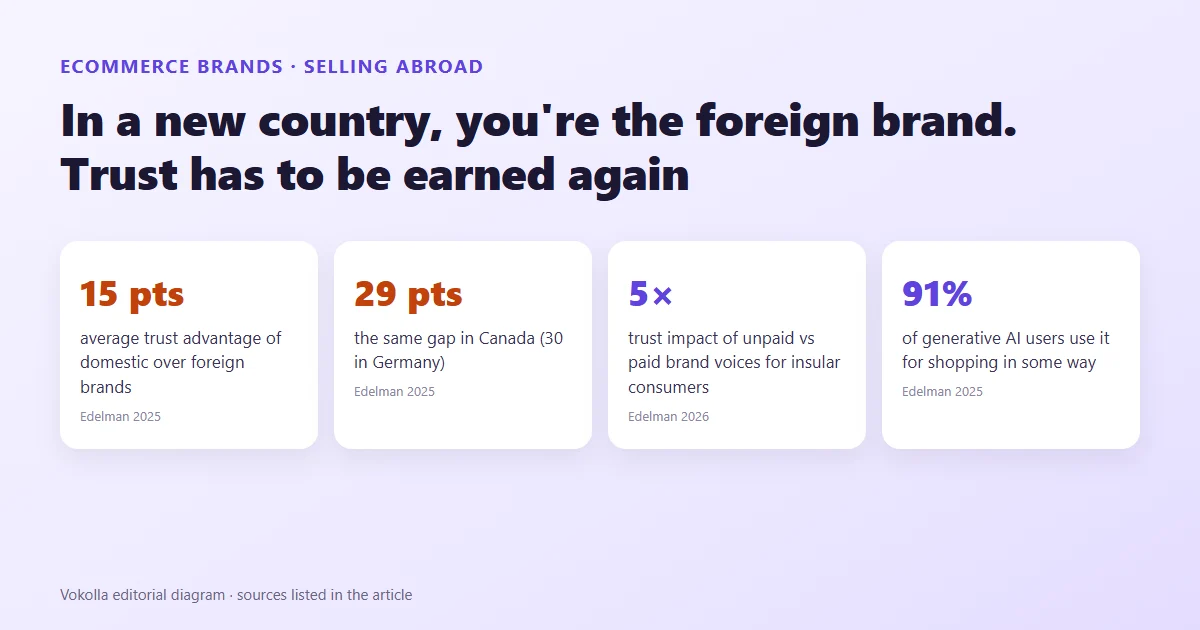
Edelman's 2025 brand trust report found that, across the markets it surveyed, trust in domestically headquartered brands was on average 15 points higher than trust in foreign brands. The gap was 30 points in Germany and 29 in Canada. For a US brand expanding north, or a UK or Australian brand entering Germany, that is the starting line.
Your own advertising struggles to close that gap. Edelman's 2026 report found that two-thirds of consumers are hesitant or unwilling to trust those with different core values, and for this insular group unpaid voices are five times more powerful than paid brand voices in driving trust. Unpaid voices include friends, family and reviews, and also independent public coverage. The brand needs other people to speak for it.
Source: Edelman: 2025 Trust Barometer Special Report, Brand Trust, From We to Me
Source: Edelman: Trust and Relevance Together Unlock Brand Growth in an Insular World (2026-06-20)
Shoppers are asking AI to shortlist brands
The same Edelman 2025 report found that among the 55% of people who use generative AI platforms, 91% use them for shopping in some way, such as researching brands, comparing products and summarizing reviews. Pew Research Center reported in 2025 that 34% of US adults had used ChatGPT, rising to 58% of adults under 30.
Shopping traffic is following. Adobe Analytics found that, during the US holiday season from November 1 to December 31, 2025, traffic from generative AI tools to retail websites rose 693.4% year over year. Adobe also noted that this traffic still comes from a small base.
When AI recommends a brand, it can only draw on information that is already public. GEO research found that content containing citations, quotations and statistics is more likely to appear in generative engine answers, and the effect is stronger for sources that have not yet built visibility. A factual brand story published on news sites is exactly that kind of content.
Source: Edelman: 2025 Trust Barometer Special Report, Brand Trust, From We to Me
Source: Adobe: 2025 holiday season online spending and generative AI shopping traffic (2026-01-07)
Source: Aggarwal et al.: GEO: Generative Engine Optimization (KDD 2024)
| Data point | Scope | Source |
|---|---|---|
| 91% of generative AI users use it for shopping in some way | Among the 55% who use generative AI platforms | Edelman 2025 |
| 34% of US adults have used ChatGPT | 58% of adults under 30 | Pew 2025 |
| Generative-AI traffic to US retail sites up 693.4% year over year | 2025 US holiday season; still a small base | Adobe 2026 |
What a growing ecommerce brand can announce
You do not need a big news event. Real developments that a reporter or shopper can verify all count:
- Launching in a new country, for example shipping to Canada with duties and taxes calculated at checkout, or opening a warehouse in the UK or EU;
- A product launch, a crowdfunding campaign, or opening your own online store alongside your marketplace listings;
- A first stockist or retail partner in the new market;
- The brand story: materials, manufacturing, sustainability claims you can back up, or the founder's background;
- A trade show appearance, certification, test report or industry award.
- Launching in a new country? Publish the news before you pay for ads →
- Before entering a new market, test what your product page lets customers buy →
Put the coverage to work on your own store
The most direct use of a release is on your own site: an “As seen on” section on the homepage or About page, with links to the actual published articles, so a first-time visitor can click through and check. Media logos without links can have the opposite effect and raise doubts.
Keep expectations for the links realistic. Google's spam policies list links with optimized anchor text in press releases distributed on other sites as an example of link spam, and paid links should be marked nofollow or sponsored. A release earns its value through exposure, what appears when people search your brand and a credible public record, so use your brand name or URL as the link text.
Source: Google Search Central: Spam policies for Google web search (link spam)
Choosing a release package by budget
Vokolla distributes through established international press release networks, and package prices are published on the site. You can pay per release or top up credits for up to 25% extra. Each package covers a different media network, and releases are subject to editorial review:
| Package | Price | Good for | Media network |
|---|---|---|---|
| Brand Starter | US$69 | A first release and everyday brand updates | 400+ regional news and industry websites |
| Global Reach | US$129 | Product promotion and ongoing brand news | 500+ media outlets, including 100+ TV and radio station websites |
| Premium Media (recommended) | US$379 | Product launches and brand milestones | The Global Reach network plus AP News, USA Today, Barchart and StreetInsider |
| Global Impact | US$659 | Expanding international media presence | A separate network of 300+ outlets, focused on 20+ premium sites such as Yahoo, Business Insider and The Globe and Mail |
Sources and editorial method
Prepared by Vokolla with AI-assisted research and writing. Factual platform guidance was checked against the primary sources below. The diagrams, checklist and examples are editorial recommendations, not platform rules or measured customer results.
- Edelman: 2025 Trust Barometer Special Report, Brand Trust, From We to Me — Checked 2026-10-18
- Edelman: Trust and Relevance Together Unlock Brand Growth in an Insular World (2026-06-20) — Checked 2026-10-18
- Adobe: 2025 holiday season online spending and generative AI shopping traffic (2026-01-07) — Checked 2026-10-18
- Pew Research Center: 34% of U.S. adults have used ChatGPT, about double the share in 2023 (2025-06-25) — Checked 2026-10-18
- Aggarwal et al.: GEO: Generative Engine Optimization (KDD 2024) — Checked 2026-10-18
- Google Search Central: Spam policies for Google web search (link spam) — Checked 2026-10-18