
Launch planning
Launching in a new country? Publish the news before you pay for ads
A brand that sells well at home usually has years of trust behind it: repeat customers, reviews, stockists, local press and word of mouth. When the same brand launches in another country, whether an Australian skincare label opening US sales, a UK cycling brand shipping to Canada or a US kitchenware maker entering the UK, very little of that comes along. A shopper who sees the first ad will often search the brand name or ask an AI assistant whether it is any good. If all they find is your own store and your ads, the campaign is asking strangers to take you at your word. This guide uses public data to explain why the first step of an international launch can be a news release, and how to write one that local reporters, search engines and AI tools can use.
What a customer in a new market finds when they look you up
At home, a new customer has many ways to place you: a friend who owns your product, a stockist they already shop at, a story in the local paper. In a new country, the first contact is often an ad or a creator's post, and the next step is a check. Increasingly, that check happens in two places. Google said in July 2025 that AI Overviews, the AI summaries at the top of search results, had more than 2 billion monthly users in more than 200 countries and territories and 40 languages. OpenAI said in October 2026 that more than 1.2 billion people use ChatGPT every week.
In 2024, Gartner predicted that traditional search engine volume would fall 25% by 2026 as people turned to AI chatbots and virtual agents. That was a forecast, and the real size of the shift is still debated, but the direction matters for a launch: customers will type your brand name into a search box and also ask an assistant questions such as “Is this brand legit?” or “What are the alternatives?”
Both can only draw on information that is already public. In the week a brand enters a new market, that information is usually thin: an online store, perhaps a marketplace listing, and the ads themselves. Coverage you earned at home may exist, but it was written for another audience, often quotes another currency or stockist, and rarely answers the question a customer in the new market is asking.
Source: Google: Alphabet Q2 2025 earnings call, CEO remarks (2025-07-23)
Source: OpenAI: GPT-6 and Intelligent UI for everyone (2026-10-07)
| Data point | Source | What it means for a market launch |
|---|---|---|
| More than 2 billion monthly users of AI Overviews | Google, July 2025 | AI summaries at the top of results draw on public pages about your brand |
| More than 1.2 billion weekly ChatGPT users | OpenAI, October 2026 | Customers can ask an assistant about your brand before they visit your store |
| Traditional search volume forecast to fall 25% by 2026 | Gartner, February 2024 (prediction) | Search ads alone may miss customers who research through AI |
Ads buy attention in a new market; trust has to come from elsewhere
Advertising can put your product in front of the right people, but a brand that is new to them has not yet earned the benefit of the doubt. In its June 2026 brand report, Edelman found that two-thirds of consumers are hesitant or unwilling to trust people with different core values, a group it calls the insular. For them, unpaid voices are five times more powerful than paid brand voices in driving trust. Unpaid voices include friends, family and reviews; they also include independent public coverage.
Being the foreign brand widens the distance. Edelman's 2025 brand report found that, across markets, trust in domestically headquartered brands was on average 15 points higher than trust in foreign brands. The same report found that among the 55% of people who use generative AI platforms, 91% use them for shopping in some way, such as researching brands, comparing products and summarizing reviews, and it linked what appears in AI to reputation, credibility and earned coverage.
Google's guidance on helpful content says trust is the most important of the qualities it groups as E-E-A-T (experience, expertise, authoritativeness and trustworthiness), and asks whether content provides original information, reporting, research or analysis. A factual launch announcement published on news sites is a third-party public record of that kind: who you are, what is launching, where and when.
Source: Edelman: Trust and Relevance Together Unlock Brand Growth in an Insular World (2026-06-20)
Source: Edelman: 2025 Trust Barometer Special Report, Brand Trust, From We to Me
Source: Google Search Central: Creating helpful, reliable, people-first content
How a release helps AI tools find, check and cite your launch
Generative engine optimization (GEO) is the practice of making content easier for AI search and chat tools to cite. In the KDD 2024 paper “GEO: Generative Engine Optimization”, researchers from Princeton and other institutions tested a range of writing methods and found that suitable GEO methods could raise a source's visibility in generative engine answers by up to 40%. Adding citations, quotations and statistics performed best, with relative improvements of 30% to 40% on the paper's position-adjusted word count measure.
The effect depended on where a source already ranked. For the site ranked fifth in search results, citing sources raised visibility by 115.1%, while the top-ranked site lost 30.3% on average. In other words, GEO matters most for brands that have not yet built visibility, which is exactly where a brand entering a new market starts.
Google says there are no additional requirements or special optimizations for appearing in AI Overviews or AI Mode; existing SEO fundamentals still apply. For a market launch, the practical step is to write the release as a set of facts that can be checked, localized for the market:
Source: Aggarwal et al.: GEO: Generative Engine Optimization (KDD 2024)
Source: Google Search Central: AI features and your website
- Say in one sentence what the product is, who it is for in this market and what problem it solves, using nouns and numbers rather than adjectives.
- Use the new market's details: local price and currency, the availability date, where to buy, shipping and returns for that country, and the units and spelling local readers expect.
- Include an attributed quote from a founder or market lead explaining why you are entering this market now.
- Give the company facts, such as where you are headquartered, how long you have traded, your website and a media contact, so reporters and AI tools can cross-check them.
A launch order for entering a new market
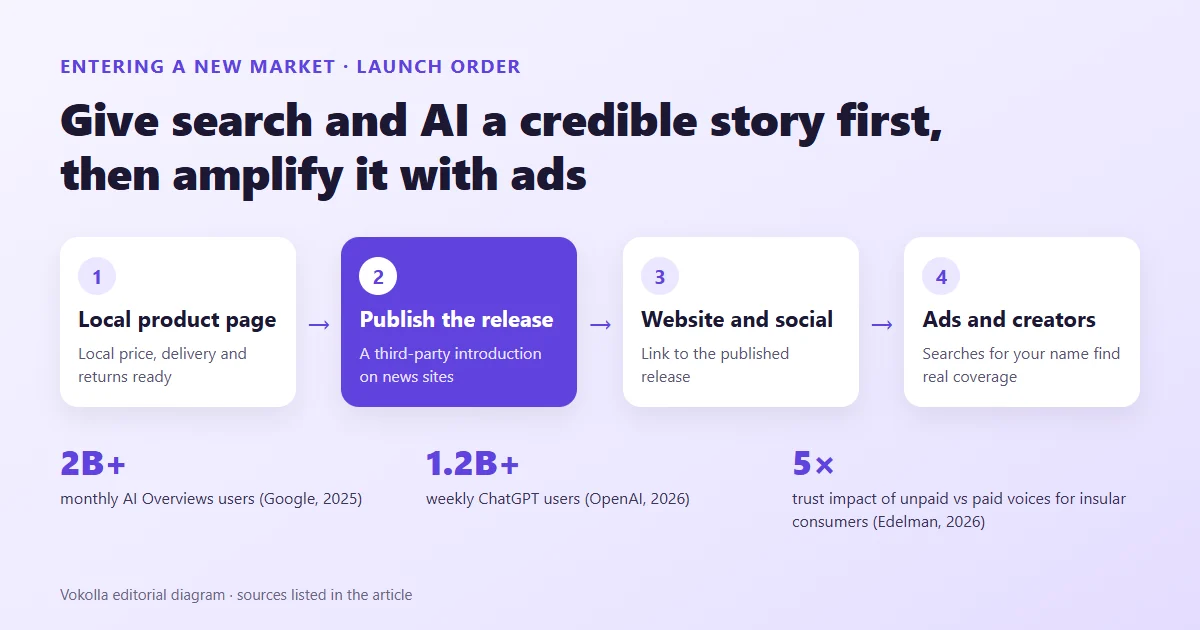
Putting the release ahead of the ads means every search the ads trigger has something credible to land on. A common sequence, which you can adapt to your launch calendar:
If you have not yet planned how your website, release and social posts fit together, start with our launch content plan. If this is your first launch in the market, test the buying path on your product page before announcing it.
- Step 1: the market-specific product page is live, with local pricing, delivery, returns and contact details that work from that country.
- Step 2: publish the news release, naming the market and the date the product becomes available there.
- Step 3: share the news on your website and social channels, linking to the published release.
- Step 4: start ads and creator partnerships; people who search your brand name now find news coverage alongside your own pages.
- Step 5: use the distribution report and search data to choose the next story, such as a first stockist, a distribution partner or a 90-day update.
- A launch content plan that connects your website, press release and social posts →
- Before entering a new market, test what your product page lets customers buy →
Write for the new market's editors, not your home audience
Journalists still value press releases. Cision's 2025 survey of more than 3,000 journalists in 19 markets found that 72% consider press releases the most useful resource PR teams can provide, while 86% reject pitches that are not relevant to their coverage or audience.
Muck Rack's 2026 survey of nearly 900 journalists, mostly in the United States with others in the United Kingdom, Canada and India, found that 86% say at least some of their stories originate from PR pitches, while 88% immediately disregard pitches that miss their beat. 78% said a pitch feels genuinely relevant when it directly affects the community their audience belongs to. The elements they value most are clear relevance to their beat, access to relevant sources, original research or data, and high-resolution images.
For a market launch, that means leading with what changes for people in that market, not with your history at home. Put the news in the headline; answer who, what, where, when and why in the first paragraph; replace words like “leading” and “revolutionary” with facts and figures; include a clear product image; and give a real contact who can answer questions during the new market's business hours.
Source: Cision: 2025 State of the Media Report (2025-05-07)
Source: Muck Rack: 2026 State of Journalism Report (2026-03-19)
Links and results: what to expect
A release earns its value through exposure, a credible public record and what people find when they search your brand, not by passing ranking signals to your website. Google's spam policies list “links with optimized anchor text in articles or press releases distributed on other sites” as an example of link spam, and paid links should be marked nofollow or sponsored. Using your brand name or URL as the link text is the safer choice.
With Vokolla, you can start from a few launch notes, have AI draft the release, and check it against your package's media guidelines before you pay. Depending on the package, releases can appear on international news sites such as AP News, USA Today, Yahoo and The Globe and Mail. Each package covers a different media network, releases are subject to editorial review, and indexing and AI citation are decided by each platform.
Source: Google Search Central: Spam policies for Google web search (link spam)
Sources and editorial method
Prepared by Vokolla with AI-assisted research and writing. Factual platform guidance was checked against the primary sources below. The diagrams, checklist and examples are editorial recommendations, not platform rules or measured customer results.
- Gartner: Gartner Predicts Search Engine Volume Will Drop 25% by 2026, Due to AI Chatbots and Other Virtual Agents (2024-02-19) — Checked 2026-10-18
- Google: Alphabet Q2 2025 earnings call, CEO remarks (2025-07-23) — Checked 2026-10-18
- OpenAI: GPT-6 and Intelligent UI for everyone (2026-10-07) — Checked 2026-10-18
- Edelman: 2025 Trust Barometer Special Report, Brand Trust, From We to Me — Checked 2026-10-18
- Edelman: Trust and Relevance Together Unlock Brand Growth in an Insular World (2026-06-20) — Checked 2026-10-18
- Google Search Central: Creating helpful, reliable, people-first content — Checked 2026-10-18
- Aggarwal et al.: GEO: Generative Engine Optimization (KDD 2024) — Checked 2026-10-18
- Google Search Central: AI features and your website — Checked 2026-10-18
- Cision: 2025 State of the Media Report (2025-05-07) — Checked 2026-10-18
- Muck Rack: 2026 State of Journalism Report (2026-03-19) — Checked 2026-10-18
- Google Search Central: Spam policies for Google web search (link spam) — Checked 2026-10-18