Guide · AI search
Press releases and AI search
In short
AI assistants answer questions about companies from pages they can read, check against each other and link to, and independent, dated pages on news sites are among the most useful of them. A press release published on recognised sites can give ChatGPT, Google’s AI features and Perplexity a clear, independent page that states who you are and what you did, and it gives buyers the same page when they check you out. We saw it in our own results: when ChatGPT was asked “What is Vokolla?” on 4 November 2026, it described us accurately and cited a US newspaper’s business page that carried our release of 25 October 2026.
Why publish with Vokolla
Press releases are one of the simplest ways to put clear, dated facts about your company on independent sites, for AI assistants and for the buyers who check you out. With Vokolla, prices are public and low, from US$69 per release, with no quote, sales call or subscription. You write the release or draft it with the Vokolla AI assistant, choose the package, pay online and keep control, and an editor reviews every release before publication.
To try it first, publish one free release every 30 days on news sites. Packages and prices are on the pricing page.
How AI assistants choose what to cite
Each product describes its own sourcing in public documentation. Google says its AI Overviews and AI Mode may run several related searches across subtopics and data sources to build an answer, and that to appear as a supporting link a page must be indexed and eligible to be shown in Google Search with a snippet. It adds that there are no additional requirements or special optimizations for either feature.
OpenAI uses a crawler named OAI-SearchBot to surface websites in ChatGPT’s search features, and recommends allowing it in robots.txt; when a user asks a question, ChatGPT-User may also visit a page. These settings are independent of GPTBot, which relates to model training. Perplexity works the same way: PerplexityBot surfaces and links websites in Perplexity’s search results, and Perplexity-User may visit a page to answer a user and link to it in the response.
Across all three, assistants read pages that search engines can already find and link to the ones that answer the question, and no product promises that a given page will be cited. Clear, indexable pages on well-known sites give you the best chance.
Why a press release gets read
Muck Rack’s “What Is AI Reading?” study keeps finding the same pattern: the headline of its 28 October 2026 edition is that earned media still drives more than 84% of AI citations. “Earned” is broader than press coverage, and the study does not measure distributed releases, so we use it for one point only: assistants lean on independent pages far more than on a brand’s own site. Muck Rack sells PR software, which is worth knowing when you read it.
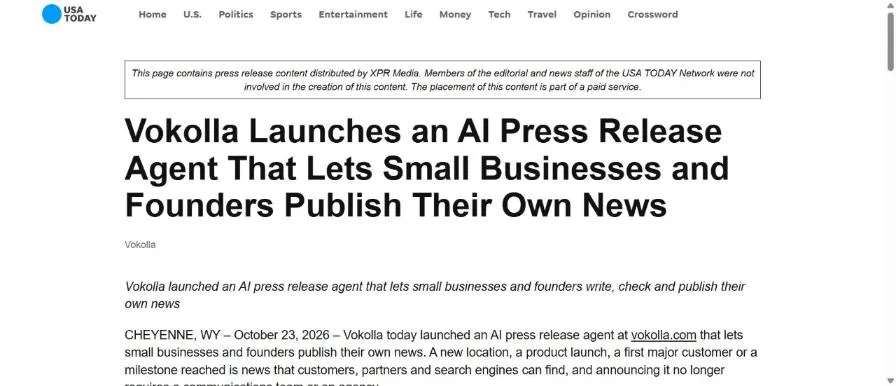
It fits what we see. A release distributed to news and finance sites is a dated page on an independent site with the facts in plain words, which is the kind of page an assistant can quote. On 4 November 2026 ChatGPT cited a newspaper business page carrying our release, and a Bing search for “Vokolla” showed two of our USA Today releases in positions two and four, right after vokolla.com. Our USA Today release went live 39 minutes after we submitted it on 23 October 2026 and was in Google’s index when we checked.
Writing a release an assistant can cite
These are the points to check before you submit a release:
- Say who you are and what you do in the first sentence, in plain words, with the company name written the same way everywhere.
- Use specific facts: dates, places, prices, figures you can back up.
- Give a named person a quote, with their title.
- Keep the About paragraph identical from release to release, so every copy describes you the same way.
- Link to your own site with your brand name or web address, and to the page the news is about.
- Write the Chinese and English names once and keep them fixed, for example Vokolla and 沃声.
Our guide to writing a press release covers each part, and our editors check them before publication.
Brand facts checklist
Assistants compare what different pages say about you. Write one fact card and copy from it everywhere. Check these places match:
- Company legal name, brand name and the Chinese or local name, written once.
- The one-sentence description, identical on your site, in your releases and on your profiles.
- Founding year, location, leadership names and titles.
- Your About page, with a named editorial or leadership team, and organization structured data on your site that lists your official profiles (sameAs).
- Your LinkedIn company page and any directory profiles such as Crunchbase, using the same description and links.
- Product names, prices and availability: the same on your site, your releases and your store pages.
- A contact address that appears the same everywhere.
Update the card first and every page second. Google says no special optimization is needed for its AI features, so this is about making the same facts easy to find and cross-check, not a trick. When your news changes, publish a release so the new facts also sit on independent sites.
Letting AI crawlers in
If you want to appear in ChatGPT’s search features and Perplexity, allow OAI-SearchBot and PerplexityBot in robots.txt, and keep your public pages indexable. OpenAI says robots.txt changes can take about 24 hours to take effect, and that each of its crawlers can be set independently, so you can manage training and search separately.
ChatGPT-User and Perplexity-User fetch a page when a user asks, and both companies note that robots.txt rules may not apply to those requests. Vokolla’s own robots.txt leaves public pages open to every search and AI crawler and blocks only the API and admin areas. The outlets that carry your release manage their own settings, so choose established news and finance sites that search engines already crawl.
Overseas and Chinese AI assistants
ChatGPT, Gemini, Perplexity and Google’s AI features mostly read English-language sites on the open web, which is where press releases published through distribution appear. Chinese assistants such as Doubao, DeepSeek and Kimi serve Chinese-language searches, and the Chinese articles we published on Sohu, Ifeng, Sina, China.com and Zhihu in October 2026 were all online when we checked on 4 November.
We have not yet measured how Chinese assistants use these pages, so we do not make claims about it. For a brand selling in both markets, the practical approach is an English release for overseas assistants and Chinese articles for Chinese readers, with the same brand facts in both.
A monthly check: does AI mention you?
A 20-minute check you can run each month. We ran it for the first time on 4 November 2026:
- Write down six questions customers would ask: “What is [your brand]?”, “Is [your brand] a good [category] provider?”, “Best [category] companies in [market]”, and three of your own.
- Ask each question in ChatGPT with search on, in Google’s AI Mode, and in Perplexity, signed out so personalisation does not affect it.
- Record whether your brand appears, how it is described, and which pages are cited, with the date.
- Compare with last month, and note which of your releases or pages were cited.
Search results for your brand name are the baseline. Our first run was one question set, on one day, in one location, so we treat it as a starting point and repeat it after every release.
Get started with Vokolla
Publish your first release free and see where it appears, or choose a package from US$69; the media list shows every outlet. Draft with the Vokolla AI assistant, and an editor reviews every release before it goes out.
Every page in this guide
Pages marked “Planned” are not published yet. They are listed so you can see everything this guide will cover, and they are linked here when they go live.
Published guides
- How brands get mentioned by ChatGPT and Google AI: E-E-A-T and GEO (Chinese edition only so far)Not published yetWhich sources AI tools cite and what a brand can do about it. An English edition is planned.
- How AI search answers “Can I buy it, what does it cost?” (study, wave 1)Our own test of Google AI Mode and ChatGPT on 17 products: where the answers held up and where they went wrong.
Planned
- Which sources AI assistants citePlannedWhat ChatGPT, Google and Perplexity read, with their own documentation.
- Correcting wrong information AI gives about your brandPlannedWhere wrong facts come from and how to fix them at the source.
- A monthly AI visibility testPlannedQuestions, tools and a log you can repeat every month.
- Overseas and Chinese AI search comparedPlannedHow ChatGPT and Doubao, DeepSeek and Kimi differ for brands.
- AI crawlers and robots.txt settingsPlannedWhich bots do what, and how to set each one.
Vokolla pages for this step
- Packages →Six packages from US$69 to US$659 per release, each with a report of the live links.
- Pricing →Every package’s public price, reach and what it includes, side by side.
- Free press release →One free release every 30 days on news sites, after editor review.
- AI assistant →Connect your AI assistant to Vokolla to draft, check and save a release.
Other guides
- The complete guide to press releasesWhat a press release is, when one is worth publishing, its standard parts, and how to write one editors accept.
- How press release distribution worksNewswires, networks and named outlets, what sets the price, and how to check what you bought.
- Where your press release appearsThe news sites in each package. For now this is the media list; a page per major outlet is planned.
- Press releases and SEOHow releases help search and AI: discovery, brand search results, dofollow and nofollow links, and the right anchor text.
- Press releases by moment and industryPlannedLaunches, funding, trade shows, entering a new market, and releases for SaaS, ecommerce and exporters.
Sources
Written and checked by the Vokolla editorial team. Vokolla provides the packages described here; prices and outlets are as published on vokolla.com on the date above, and the results quoted come from our own releases. Search rankings depend on many factors, so no distribution service can guarantee them.
- Vokolla publishing records: our own releases on USA Today and partner networks (October 2026), Google, Bing and AI-answer checks on 4 Nov 2026 (internal records; the method is described on this page) — checked 2026-11-04
- Google Search Central: AI features and your website (updated 2025-12-10) — checked 2026-11-04
- OpenAI: Overview of OpenAI Crawlers (OAI-SearchBot, GPTBot, ChatGPT-User) — checked 2026-11-05
- Perplexity: Perplexity crawlers (PerplexityBot, Perplexity-User) — checked 2026-11-05
- Muck Rack: “Generative Pulse: Earned Media Still Drives More Than 84% of AI Citations” (What Is AI Reading?, 28 Oct 2026 edition; Muck Rack sells PR software) — checked 2026-11-05
- USA Today: “Vokolla Launches an AI Press Release Agent…” (press release section, 23 Oct 2026) — checked 2026-11-04
- Google Search Central: Spam policies for Google web search (updated 2026-08-28) — checked 2026-11-04
- Google Search Central: SEO Starter Guide (updated 2025-12-10) — checked 2026-11-04
- Vokolla: Press release distribution pricing (packages, prices and reach) — checked 2026-11-04