AI search
Businesses in ChatGPT: what Business Hub counts, and the citations it leaves out
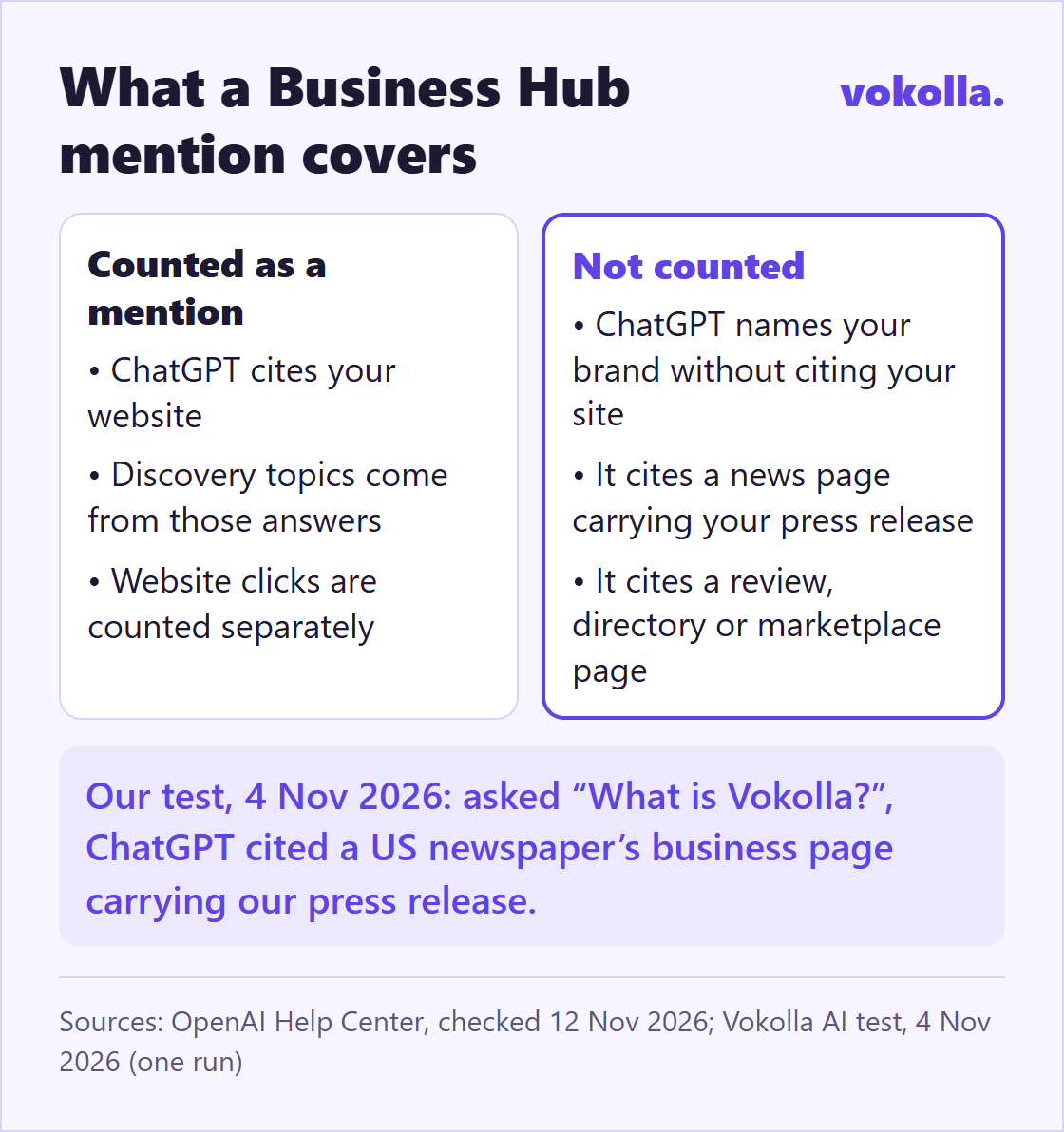
On 10 November 2026 OpenAI opened Businesses in ChatGPT in beta. You can claim your business, correct its details and, for the first time, see how often ChatGPT mentions you. Read the definition before you read the number: according to OpenAI’s help centre, an online business gets a “mention” only when ChatGPT references its website, and the brand name alone doesn’t count. By that definition the dashboard tells you when ChatGPT cites your site. It doesn’t show the other pages ChatGPT used to describe you, such as a news site carrying your press release, a review or a directory, and an answer that cites only those pages isn’t counted at all. Those outside pages are what a buyer who has never heard of you can check without taking your word for it.
What OpenAI launched on 10 November
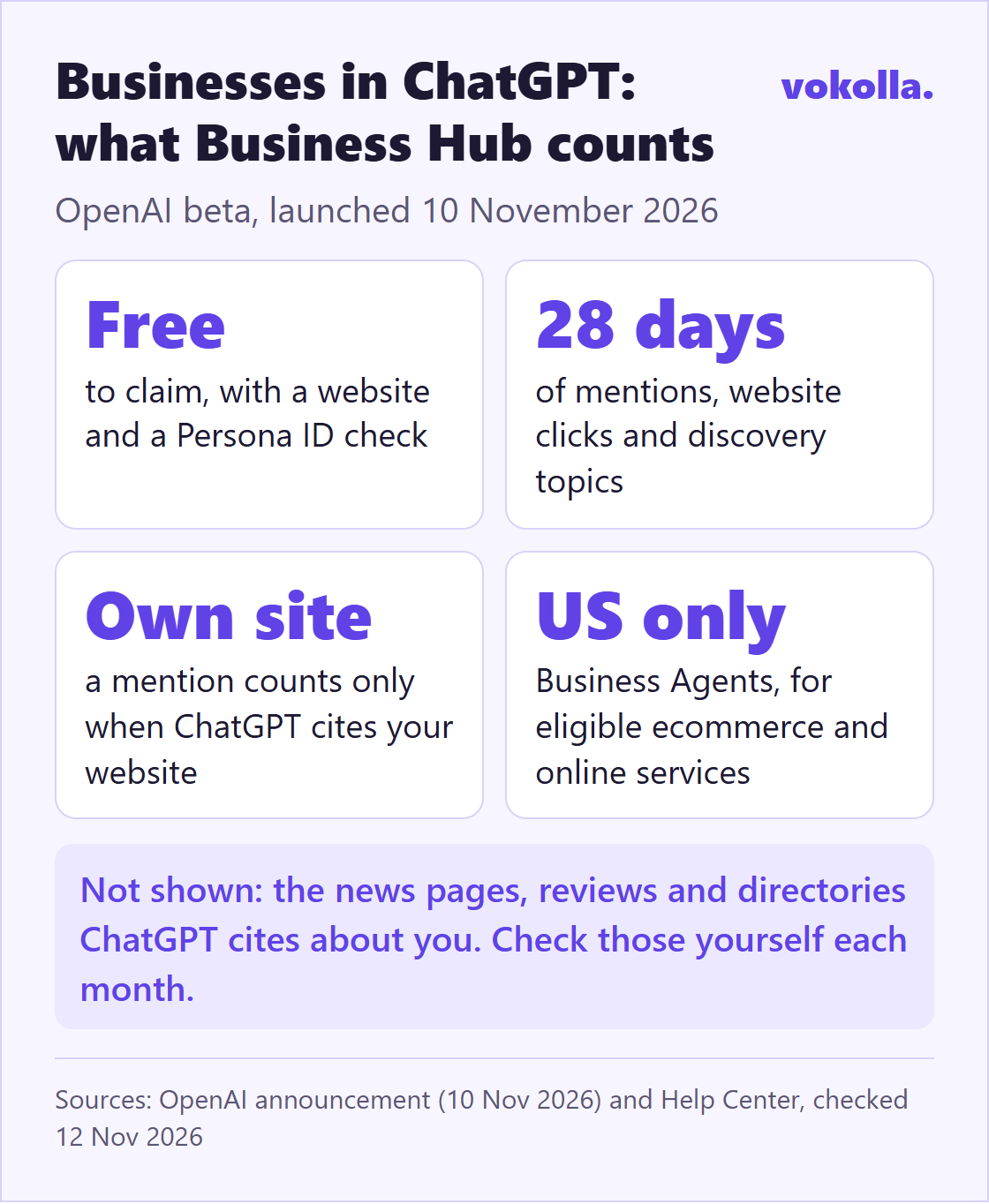
Businesses in ChatGPT is a profile and a dashboard for companies, run from Business Hub at chatgpt.com/business-hub. OpenAI’s announcement pitches it at the 1.2 billion people it says use ChatGPT each week, a figure from OpenAI itself. It has three parts.
The table below sums up the three parts. Two details matter for online sellers: Shopify merchants can connect their store from Business Hub or the Shopify admin, and OpenAI says eligible Shopify products are already in ChatGPT through Shopify Catalog. A Business Agent can link to your site but can’t take orders or bookings, and it can be sponsored as the destination of a ChatGPT ad, with the placement labelled. Discovery topics are the themes of the answers you appeared in; you never see individual prompts or conversations.
Claiming needs no ads account and no Enterprise contract. You verify by business phone, business email, a DNS TXT record on your domain or your Shopify store, then complete identity verification with Persona, which may ask for a government ID, business registration details and proof that you can act for the business; names and numbers must match your official records. A new profile created through Persona goes live as soon as OpenAI approves it, and support can’t unpublish it, so prepare the details first. Eligibility follows ChatGPT’s own list of supported countries: on 12 November 2026 it included the US, the UK, the EU countries, Japan, South Korea, Singapore and Taiwan, but not mainland China, Hong Kong or Macau.
Source: OpenAI: Introducing Businesses in ChatGPT (10 November 2026)
Source: OpenAI Help Center: Setting up your business on ChatGPT (updated 12 November 2026)
Source: OpenAI Help Center: ChatGPT supported countries
| Part | Who can use it now | What you get |
|---|---|---|
| Business profile | Eligible businesses with a website, located where ChatGPT is available | Edit details, logo and policies; product feed with prices and stock; a blue check after Persona verification |
| Insights | Claimed profiles that passed Persona verification | Mentions, website clicks and discovery topics for the past 28 days, above a privacy threshold |
| Business Agent | Eligible US ecommerce and online service businesses | An AI agent that answers product and policy questions in a labelled chat; can be sponsored |
What claiming changes, and what it doesn’t
OpenAI is direct about the limits. Its business page says ChatGPT keeps making independent recommendations and comparisons, and that “claiming does not guarantee higher placement or sales.” The help centre adds that advertising doesn’t influence ChatGPT’s independent answers, that a product feed doesn’t guarantee your products get recommended, and that ChatGPT may use other sources when it answers questions about your business. The profile policy says the same from the other side: a profile can include information from other sources.
So the profile is one input among several. It is the right place to correct what is plainly wrong: an old address, a discontinued product line, a return policy you changed in the spring. It doesn’t replace what the rest of the web says about you, and the rest of the web is what an independent answer draws on when someone asks if you’re any good, how you compare or what you cost.
Claim it anyway if you can. It costs nothing, it puts a verified badge on your profile, and it is the only way to see the numbers at all. Just plan the rest of your work on the basis OpenAI itself describes, with your profile as one of several sources.
Source: OpenAI: Businesses in ChatGPT, claim your business (page and FAQ)
Source: OpenAI Help Center: Setting up your business on ChatGPT (updated 12 November 2026)
Source: OpenAI: Businesses in ChatGPT policy (updated 10 November 2026)
Read the definition of a mention before the number
In the help centre’s definition, an online business is credited with a mention only when ChatGPT references its website; naming the brand isn’t enough. Local businesses are counted differently: any result shown for the location counts. Discovery topics come from the same set of answers, the ones that mentioned or cited your business.
Think about what that leaves out. A buyer asks ChatGPT about your company and gets an accurate description, but the source it points to is a trade publication, a review site, a marketplace listing or a news page that carried your press release. By the help centre’s definition, that answer isn’t counted, because your website wasn’t cited, even though ChatGPT has just told a potential customer who you are.
We have seen exactly that answer for our own brand. On 4 November 2026 we asked ChatGPT, signed out and with web search, “What is Vokolla?”. The description was accurate (AI-assisted writing, editorial checks, distribution, a report of every published link), and it cited two sources: vokolla.com and a US newspaper’s business page carrying our own press release of 25 October, ten days earlier. In Business Hub that answer would show up as a mention of vokolla.com; the newspaper page standing next to it would not appear anywhere. That is one run of one question, and AI answers vary from day to day, but it shows the pattern: for a young brand, a dated page on someone else’s site is part of the evidence an AI assistant puts in front of a buyer.
Two smaller cautions from the same help page. The numbers cover 28 days and appear only above a reporting threshold, so a small business may see blanks for a while; OpenAI says a blank doesn’t necessarily mean zero activity. And counts may be incomplete. Treat the numbers as a minimum.
Source: OpenAI Help Center: Setting up your business on ChatGPT (updated 12 November 2026)
Why the pages about you matter as much as your profile
A press release is issued in your company’s name, with a date and a contact, and published on news sites that search engines index and AI tools can read and cite. For a buyer meeting you for the first time, such a page states your company name, what you make, where you sell and when you launched, on a site that isn’t yours. Our own checks show these pages being used. Besides the ChatGPT answer above, Perplexity’s answer to “What are the best press release distribution services in 2026?” on 4 November cited another company’s press release syndicated on Yahoo Finance, and a Google search for “Vokolla” on 7 November showed our two USA Today press-release pages at positions 1 and 7. Each is one check on one day, so take them as examples of what is possible.
One technical condition sits with you. OpenAI’s crawler documentation says sites that opt out of OAI-SearchBot won’t be shown in ChatGPT search answers, and that a robots.txt change takes about a day to register. If your robots.txt blocks it, by name or with a blanket rule, no profile will make up for it. The same goes for being cited on your own site: keep the facts buyers ask about (prices, shipping, returns, where you sell) on your pages in plain text, so there is something to cite.
The two work together. Business Hub is where you tell ChatGPT your facts directly; a press release puts the same facts, with a date, on pages other people can check. When you launch a product, enter a new market or change your prices, do both on the same day: update the profile and publish the news.
Source: OpenAI: Overview of OpenAI crawlers (OAI-SearchBot, GPTBot, ChatGPT-User)
A monthly check that records both halves
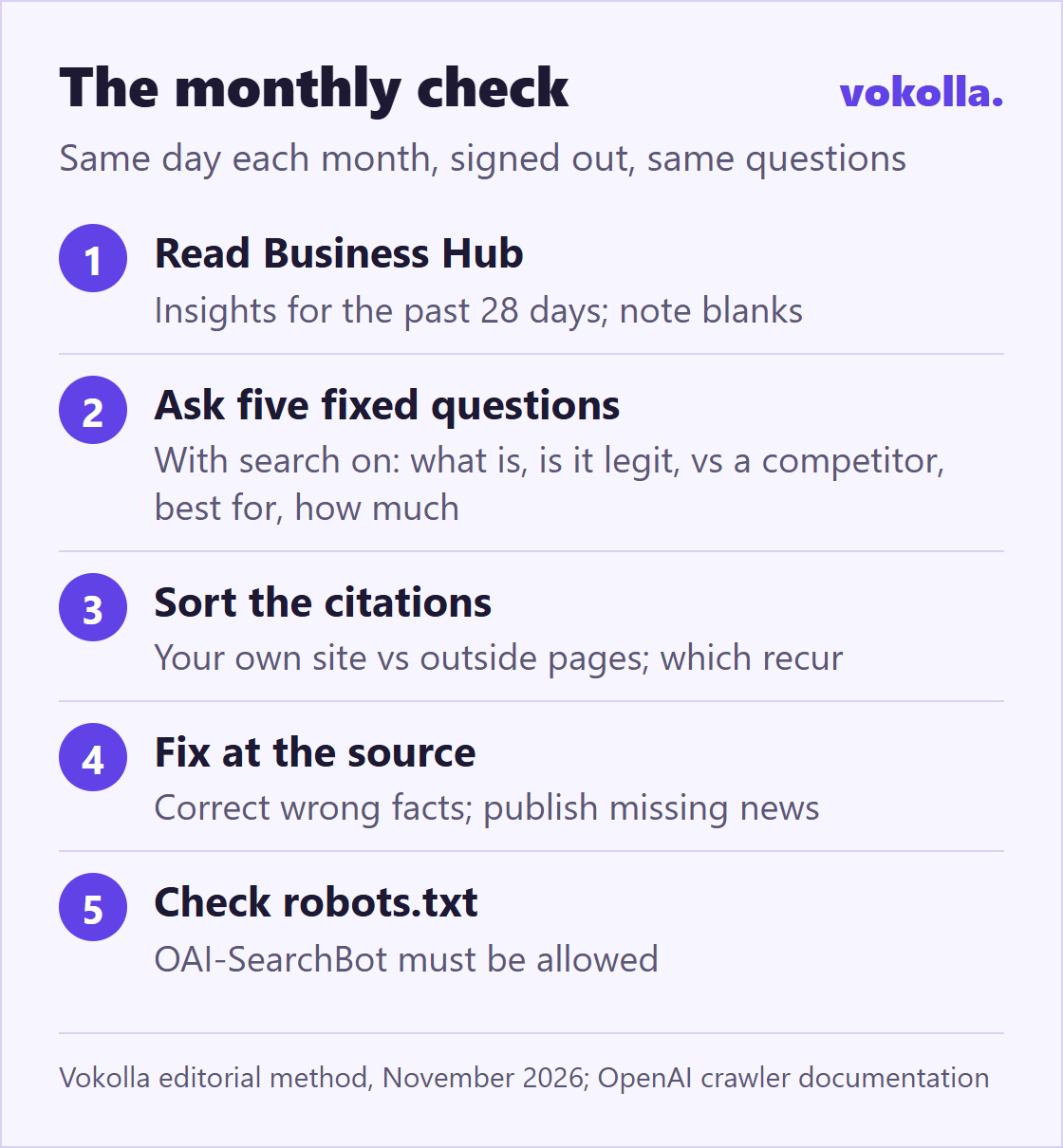
Business Hub gives you the first half of the picture. You collect the second half yourself: five questions and a short log. Do it on the same day each month, signed out, with the same questions, so one month can be compared with the next.
The third step tells you the most. If the same two or three outside pages keep turning up, those pages are your reputation in ChatGPT, whatever the dashboard says. If none turn up, or only old ones, that is the gap to close with fresh, dated news.
| Step | What to do | What to write down |
|---|---|---|
| 1. Business Hub | Open Insights (past 28 days) | Mentions, website clicks, top discovery topics; note blanks |
| 2. Five fixed questions | With search on, ask: What is [brand]? Is [brand] legit? [brand] vs [main competitor]? Best [category] for [use]? How much does [brand] cost? | Is each answer accurate? Every URL it cites |
| 3. Sort the citations | Split the cited URLs into your own site and outside pages | The count of each, and which outside pages recur |
| 4. Fix at the source | A wrong fact on your site or profile: correct it. Missing or outdated news: publish it | What you changed, and when |
| 5. Crawler check | Open yourdomain.com/robots.txt | Is OAI-SearchBot allowed? Yes or no |
Should you claim now?
Yes, if your business is eligible and has a website: it is free, and it is the only way to see the numbers. Before you start, make sure the name, address and registration number you will give Persona match your official records, decide which ChatGPT account will own the profile (teammates and agencies get access through it), and remember that a new profile goes live as soon as it is approved.
A Business Agent can wait unless you are a US ecommerce or online service business with clean, current product and return information. The agent answers from what you give it, and OpenAI’s agent policy forbids inventing prices, availability, guarantees or results.
Then put the effort where the dashboard can’t see. Keep your own site accurate, and when you have real news, publish it where buyers and AI tools both look. With Vokolla that is a self-service job: you write the release or let AI draft it, an editor reviews it before publication, prices are on the site from US$69, you can publish one release in English free every 30 days, and the report lists every live link. That list is also where to start in step 3 of next month’s check.
Source: OpenAI Help Center: Setting up your business on ChatGPT (updated 12 November 2026)
Source: OpenAI: Business Agents Policy (updated 10 November 2026)
Sources and editorial method
Factual platform guidance was checked against the primary sources below. The diagrams, checklist and examples are editorial recommendations, not platform rules or measured customer results.
- OpenAI: Introducing Businesses in ChatGPT (10 November 2026) — Checked 2026-11-12
- OpenAI: Businesses in ChatGPT, claim your business (page and FAQ) — Checked 2026-11-12
- OpenAI Help Center: Setting up your business on ChatGPT (updated 12 November 2026) — Checked 2026-11-12
- OpenAI: Businesses in ChatGPT policy (updated 10 November 2026) — Checked 2026-11-12
- OpenAI: Business Agents Policy (updated 10 November 2026) — Checked 2026-11-12
- OpenAI Help Center: ChatGPT supported countries — Checked 2026-11-12
- OpenAI: Overview of OpenAI crawlers (OAI-SearchBot, GPTBot, ChatGPT-User) — Checked 2026-11-12
- Vokolla own tests: ChatGPT and Perplexity answers (4 November 2026) and a Google brand search (7 November 2026), one run each, from our test records; the ChatGPT test is also described in our AI search guide — Checked 2026-11-12
- Vokolla: publishing packages and prices — Checked 2026-11-12
- Vokolla: free press release (one every 30 days) — Checked 2026-11-12