Guide · Use cases
When to publish a press release: launches, new markets, sellers and exporters
In short
A press release is worth publishing whenever something has changed that a customer, buyer or journalist could check: a product launch, a new country, a certification, a distributor, a trade show, a funding round, an award. Published on news sites, it gives everyone who searches your name, and the AI assistants that summarise you, one dated, independent page that says what happened. This guide covers the moments that justify a release and, for online sellers, exporters and software companies, why it helps and how to use it.
Why publish with Vokolla
Whatever the moment, the job is the same: put clear, dated facts about your company on independent news sites, where customers, buyers, search engines and AI assistants will find them. With Vokolla the price is public and low, from US$69 per release, with no quote, sales call or subscription. You write the release or draft it with the Vokolla AI assistant, choose the package, pay online and keep control from start to finish, and an editor reviews every release before it is published.
To try it first, publish one free release every 30 days on news sites. Packages and prices are on the pricing page.
Moments that are worth a release
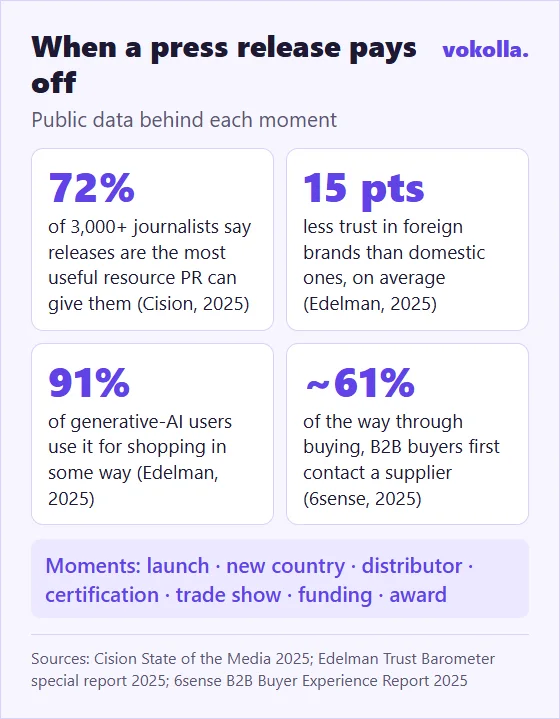
You do not need big news. A release works when there is something new that a reader could verify, and these are the moments businesses most often use:
- A product or feature launch, with the date it is available and the price.
- Entering a new country or market: where you ship, in what currency, who to contact there.
- A first stockist, distributor or retail partner in a market.
- A certification, test report, patent or approval that a buyer can look up.
- A trade show appearance, with your stand number and what you will show.
- A funding round, a senior hire or a partnership.
- An award, a customer milestone or a published study.
Journalists still read releases that fit their beat. Cision’s 2025 survey of more than 3,000 journalists in 19 markets found that 72% consider press releases the most useful resource PR teams can provide, and 86% reject pitches that are not relevant to their coverage. Muck Rack’s 2026 survey of nearly 900 journalists found that 86% say at least some of their stories start from PR pitches, and 88% immediately disregard pitches that miss their beat. So lead with what changes for the reader, put the news in the headline and keep the facts checkable. Our editorial guidelines list what editors look for, and a small interface tweak belongs in a changelog and a customer email rather than a release.
Entering a new country: publish before you pay for ads
At home, customers place you through friends, stockists and local press. In a new country the first contact is usually an ad or a creator’s post, and the next step is a check: they search your name or ask an AI assistant. Google said in July 2025 that AI Overviews had more than 2 billion monthly users, and OpenAI said in October 2026 that more than 1.2 billion people use ChatGPT every week. Gartner forecast in 2024 that traditional search volume would fall 25% by 2026 as people turn to AI assistants. That is a forecast, but the direction is clear: both the search box and the assistant can only draw on pages that are already public.
Ads buy attention; trust has to come from elsewhere. Edelman’s June 2026 report found that two-thirds of consumers are hesitant or unwilling to trust people with different core values, and that for this group unpaid voices, such as friends, reviews and independent coverage, are five times more powerful than paid brand voices in building trust. A launch announcement on news sites is that kind of public record: who you are, what is launching, where and when. Google’s guidance names trust as the most important part of E-E-A-T. Research on generative engine optimization (KDD 2024) found that adding citations, quotations and statistics could raise a source’s visibility in AI answers by up to 40%, with the biggest gains for sources that had not yet built visibility, which is where a brand new to a market starts.
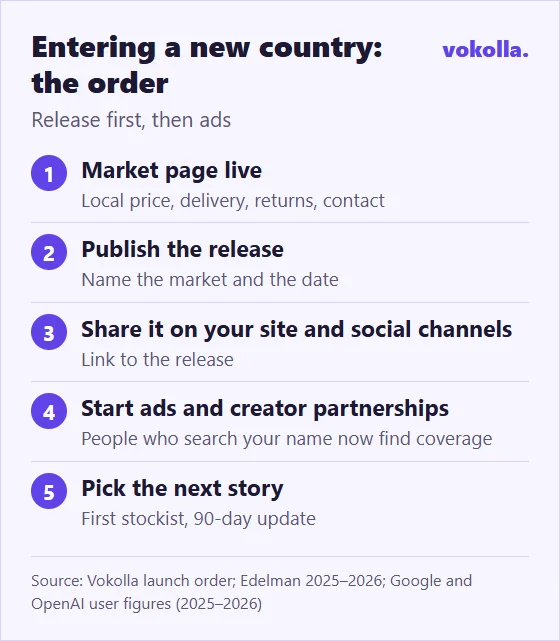
A launch order that works for most markets:
- Step 1: the market-specific product page is live, with local price, delivery, returns and contact details that work from that country.
- Step 2: publish the release, naming the market and the date the product is available there.
- Step 3: share it on your site and social channels, linking to the published release.
- Step 4: start ads and creator partnerships. People who search your name now find news coverage next to your own pages.
- Step 5: use the distribution report and search data to choose the next story, such as a first stockist or a 90-day update.
Write the release for the new market’s readers: local price and currency, availability date, where to buy, and a named person quoted on why you are entering now. Link to your site with your brand name or web address. Our guide to writing a press release walks through each step.
Give the release a page worth clicking to
A release sends readers to one link, so choose that page before you write. For a new feature it may be a product update page with a real walkthrough; for a new market, a localised service page. State what changed, who it is for, the availability date and supported markets, show a real screenshot or demonstration, and give the reader one next step: start a trial, request a demo or read the setup guide.
Then give each channel its own job and keep the facts the same everywhere. A social post can share one useful takeaway, a LinkedIn post can explain the business decision, a video can show the product working, and each points to the same page. Before you submit, decide what a useful visit looks like (a trial started, a demo requested), and use consistent campaign parameters on the links you share; Google Analytics documents utm_source, utm_medium and utm_campaign for this. Our own Premium Media release went live on USA Today 39 minutes after submission, so have tracking ready before you press submit.
A final check before launch: ask someone who has not seen the plan to read only the destination page and say what changed and what they can do next. Whatever they have to guess is the next edit.
Online sellers and brands moving off marketplaces
On a marketplace, shoppers trust the platform: they know how returns work and can read hundreds of reviews. When you open your own store or ship abroad, they are asked to trust the brand directly, often with no reviews from their country and a currency they have to convert. Edelman’s 2025 brand trust report found that, across the markets surveyed, trust in domestically headquartered brands was on average 15 points higher than in foreign brands; the gap was 30 points in Germany and 29 in Canada. For a brand entering a new country, that is the starting line.
Shoppers are also asking AI to shortlist brands. The same Edelman report found that among the 55% of people who use generative AI platforms, 91% use them for shopping in some way, such as researching brands and comparing products. Pew Research Center reported that 34% of US adults had used ChatGPT, and Adobe Analytics recorded a 693.4% year-over-year rise in generative-AI traffic to US retail sites over the 2025 holiday season, from a small base. When an assistant recommends a brand it can only use what is already public, which is why independent coverage matters most to brands that are not yet known.
What a seller can announce: launching in a new country (for example shipping to Canada with duties and taxes calculated at checkout), a new product or your own online store, a first stockist, the brand story with claims you can back up, or a certification or award. Then put the coverage to work on your own store: an “As seen on” section with links to the actual published articles, so a first-time visitor can click through and check. Logos without links can raise doubts instead of settling them. Link from the release back to your store with your brand name or web address, so the coverage works in both directions.
Exporters and B2B companies
A buyer abroad does most of the research before you hear from them. In 2025, 6sense surveyed nearly 4,000 B2B buyers in North America, EMEA and Asia-Pacific: on average they first contacted a supplier about 61% of the way through the buying process, and the supplier they already preferred before that contact won about 80% of the time. Gartner’s June 2025 survey found that 61% of B2B buyers prefer a buying experience without a sales rep. By May 2026, Gartner found, 45% of buyers had used generative AI, mainly to gather supplier and product information, yet 69% turn to sales reps to validate what it tells them. Buyers use AI for a first shortlist and then check, so the facts have to match wherever they look.
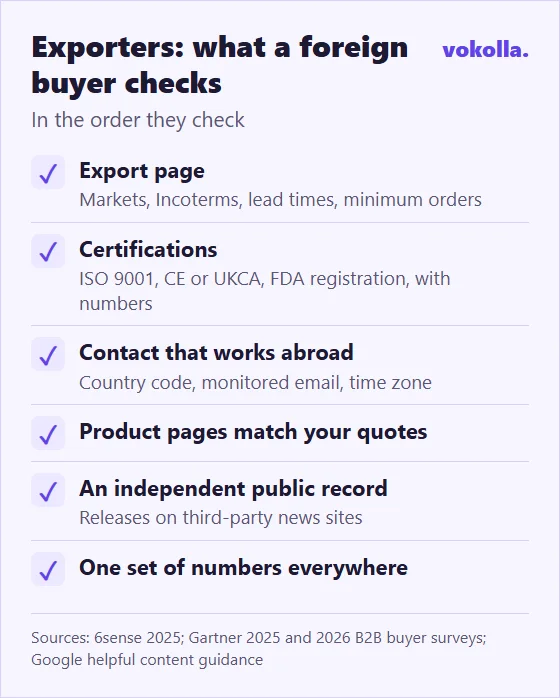
A strong reputation at home can be invisible abroad: customers know you through relationships a foreign buyer cannot see, and the website is often written for the home market, with phone numbers without a country code and prices in the home currency. Close the gap by publishing what you already know. This list follows the order in which a foreign buyer checks a new supplier:
- An export page: markets you already ship to, usual Incoterms, lead times, minimum order quantities and payment terms.
- Certifications that matter in the buyer’s market (ISO 9001, CE or UKCA marking, FDA facility registration) with numbers a buyer can verify.
- Contact details that work from abroad: country code, a monitored email address, your time zone and languages.
- Product pages whose specifications and lead times match your quotes and catalogue.
- An independent public record: releases about milestones on third-party news sites, found by searching your company name.
- One set of numbers: the same founding year, capacity and customer figures on your website, LinkedIn, catalogue and sales deck.
The best moments to publish are a new product line or certification, a trade show abroad, a new distributor or warehouse, and an export award. Use the published links in every buyer conversation: attach them to your next quote, add them to your capability statement and trade-show follow-ups, and list them on your export page. Real photos of the facility, certificate numbers a buyer can verify and specific capacity figures carry more weight than “world-class quality”.
Software and SaaS launches
For a software company the news is usually a feature, an integration, a new plan or a new market. The release should say in the first sentence what it does and for whom, give the price and availability, and link to a page where the reader can try it. We use this ourselves: we announced the launch of our AI press release agent in a release on USA Today’s press release section on 23 October 2026, and linked to the product page it describes.
Keep the claim demonstrable: a named customer or a measured result with how it was measured, rather than “innovative” or “powerful”. A quote from a founder or product lead should explain the decision (why now, why this approach), and the named person has to approve it. When ChatGPT was asked “What is Vokolla?” on 4 November 2026, it described us accurately and cited a US newspaper’s business page that carried our release: the same facts, stated once in plain words, are what an assistant can repeat.
Get started with Vokolla
Publish your first release free and see where it appears, or choose a package from US$69; the media list shows every outlet. Draft with the Vokolla AI assistant, and an editor reviews every release before it goes out.
Every page in this guide
Pages marked “Planned” are not published yet. They are listed so you can see everything this guide will cover, and they are linked here when they go live.
Published guides
- Before entering a new market, test what your product page lets customers buyCheck the page your release links to: one offer for shoppers and search systems in each market.
- From a product launch in Claude to a press releaseA worked example of drafting, revising and saving a release with the Vokolla AI assistant.
Vokolla pages for this step
- Packages →Six packages from US$69 to US$659 per release, each with a report of the live links.
- Pricing →Every package’s public price, reach and what it includes, side by side.
- Free press release →One free release every 30 days on news sites, after editor review.
- AI assistant →Connect your AI assistant to Vokolla to draft, check and save a release.
Other guides
- The complete guide to press releasesWhat a press release is, when one is worth publishing, its standard parts, and how to write one editors accept.
- How press release distribution worksNewswires, networks and named outlets, what sets the price, and how to check what you bought.
- Where your press release appearsThe news sites in each package. For now this is the media list; a page per major outlet is planned.
- Press releases and SEOHow releases help search and AI: discovery, brand search results, dofollow and nofollow links, and the right anchor text.
- Press releases and AI searchHow ChatGPT, Google and Perplexity pick sources, why releases on news sites get cited, a brand facts checklist and a monthly test.
Sources
Written and checked by the Vokolla editorial team. Vokolla provides the packages described here; prices and outlets are as published on vokolla.com on the date above, and the results quoted come from our own releases. Search rankings depend on many factors, so no distribution service can guarantee them.
- Vokolla publishing records: our own releases on USA Today and partner networks (October 2026), Google, Bing and AI-answer checks on 4 Nov 2026 (internal records; the method is described on this page) — checked 2026-11-04
- Vokolla: Press release distribution pricing (packages, prices and reach) — checked 2026-11-04
- USA Today: “Vokolla Launches an AI Press Release Agent…” (press release section, 23 Oct 2026) — checked 2026-11-04
- Google: Alphabet Q2 2025 earnings call, CEO remarks (23 Jul 2025): AI Overviews have more than 2 billion monthly users — checked 2026-11-05
- OpenAI: “GPT-6 and Intelligent UI for everyone” (7 Oct 2026): more than 1.2 billion weekly ChatGPT users — checked 2026-11-05
- Gartner: predicts search engine volume will drop 25% by 2026 due to AI chatbots and virtual agents (19 Feb 2024; a forecast) — checked 2026-11-05
- Edelman Trust Barometer 2025, special report: Brand Trust, From We to Me — checked 2026-11-05
- Edelman: Trust and Relevance Together Unlock Brand Growth in an Insular World (June 2026) — checked 2026-11-05
- Aggarwal et al.: GEO: Generative Engine Optimization (KDD 2024) — checked 2026-11-05
- Google Search Central: Creating helpful, reliable, people-first content — checked 2026-11-05
- Cision: 2025 State of the Media report (7 May 2025) — checked 2026-11-05
- Muck Rack: State of Journalism 2026 (19 Mar 2026; Muck Rack sells PR software) — checked 2026-11-05
- 6sense: The B2B Buyer Experience Report 2025 — checked 2026-11-05
- Gartner: 61% of B2B buyers prefer a rep-free buying experience (25 Jun 2025) — checked 2026-11-05
- Gartner: 69% of B2B buyers turn to sales reps to validate AI-generated insights (20 May 2026) — checked 2026-11-05
- Adobe: 2025 holiday shopping season online spending and generative AI traffic (7 Jan 2026) — checked 2026-11-05
- Pew Research Center: 34% of U.S. adults have used ChatGPT (25 Jun 2025) — checked 2026-11-05
- Google Analytics Help: Collect campaign data with custom URLs — checked 2026-11-05