
Guide · Press release basics
Press release vs news article: what is the difference?
In short
A press release is a statement of news written by or for an organisation and issued under its own name; a news article is written by a journalist or an editorial team who decide what is worth reporting and how. A release is a first-party record you control, and news sites carry it in a labelled press release section. An article is independent coverage that you can earn, but cannot order.
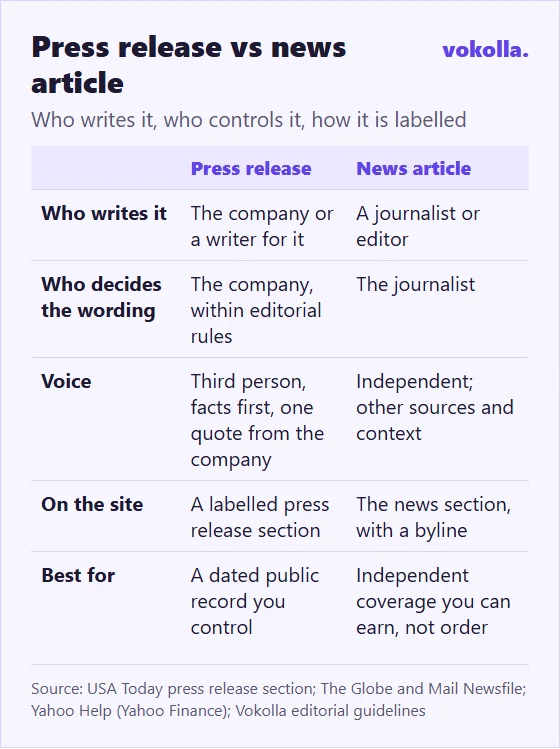
The difference in one table
The two differ in who writes them, who controls the wording and how the site labels them.
| Aspect | Press release | News article |
|---|---|---|
| Who writes it | The company, or a writer or tool working for it | A journalist or editor at the outlet |
| Who decides what it says | The company, within the outlet’s editorial rules | The journalist; the company may be quoted or may not be asked |
| Voice | Third person, facts first, a quote from a named person at the company | Independent; can include other sources, context and criticism |
| How it is labelled | In a press release section of the site, with the company as the source | In the news section, with a journalist’s byline |
| What it is good for | A dated, public record of your news that customers, buyers, search engines and AI assistants can find | Independent coverage and credibility, when a journalist chooses to write about you |
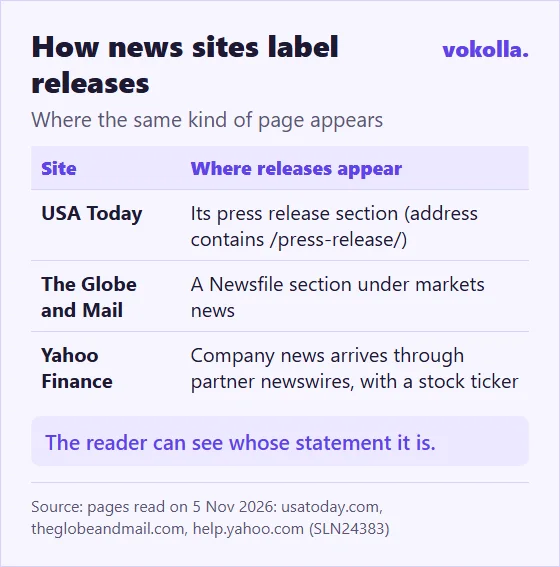
How news sites label releases
A release on a reputable news site is shown as a release. USA Today carries our own release at an address under /press-release/, in its press release section. The Globe and Mail shows releases from Newsfile in a Newsfile section under its markets news. Yahoo’s help page for Yahoo Finance says company news arrives through its partner newswires and carries a stock ticker.
This is the honest way to publish company news: the reader can see whose statement it is. It is also why a release works as a source. A buyer or an AI assistant that finds it learns what the company itself announced, on what date, on a site they already recognise.
When you want a release, and when you want an article
Use a release when you have news a reader could check and you want it on record now: a launch, a new market, a certification, a distributor, an event. It takes days, not weeks, and you decide the wording. Hope for an article when you have a story a journalist would choose on their own, such as a surprising result or a trend you can document. Journalists sometimes find news in releases, so a clear release can lead to coverage, but nobody can promise that.
The two work together. A release gives journalists, buyers and AI assistants a plain statement of the facts to check; an article, if one follows, adds an independent voice. Our editorial guidelines set out what editors look for in a release.
What this means for how you write
Write a release like a source, not like an article. State the news in the first sentence, give dates, places, prices and figures, quote a named person, and keep adjectives to the ones you can prove. Leave out opinions about competitors. If you want a journalist’s attention, send them the release and a person to talk to. See how to write a press release for the seven steps and the format and template.
Publish with Vokolla
Vokolla shows one public price per release, from US$69, with no quote, sales call or subscription. You write the release or draft it with the Vokolla AI assistant, choose the package, pay online and get a report with every live link, and an editor reviews each release before it goes out. You can try it first with one free release every 30 days; every package is on the pricing page.
Questions people ask
Is a press release a news article?
No. A press release is written by or for the company and published as a release; a news article is written by a journalist who chooses the angle. Both can appear on the same news site, in different sections.
Does a press release turn into a news article?
Sometimes a journalist uses a release as a starting point, but no distribution service can promise it. Write the release so that it stands on its own.
Do news sites show that a release is a release?
Reputable ones do: USA Today and The Globe and Mail, for example, place releases in labelled press release and Newsfile sections.
Why publish a release if it is not an article?
It gives customers, buyers, search engines and AI assistants a dated page on a news site that states what your company announced, which is useful whenever someone checks you out.
Vokolla pages for this step
- Packages →Six packages from US$69 to US$659 per release, each with a report of the live links.
- Pricing →Every package’s public price, reach and what it includes, side by side.
- Free press release →One free release every 30 days on news sites, after editor review.
- AI assistant →Connect your AI assistant to Vokolla to draft, check and save a release.
Sources
Written and checked by the Vokolla editorial team. Vokolla provides the packages described here; prices and outlets are as published on vokolla.com on the date above, and the results quoted come from our own releases. Search rankings depend on many factors, so no distribution service can guarantee them.
- USA Today: “Vokolla Launches an AI Press Release Agent…” (press release section, 23 Oct 2026) — checked 2026-11-04
- The Globe and Mail: Mubboo Flights release in the Newsfile section (19 Oct 2026) — checked 2026-11-04
- Yahoo Help: Get your company’s news and info into Yahoo Finance — checked 2026-11-04
- Vokolla: Editorial guidelines for press releases — checked 2026-11-04
- Vokolla: Press release distribution pricing (packages, prices and reach) — checked 2026-11-04