Guide · SEO
What people see when they search your brand: how to audit the first page of results
In short
A brand search is a search for your company name. The first page of results is what a customer, buyer or journalist sees when they check you out: your own site, how Google names it, its sitelinks, any knowledge panel, and third-party pages about you, such as press release pages, directories and reviews. You cannot set it directly, but you can audit it and add true, useful pages to it.
What appears, and what Google says about it
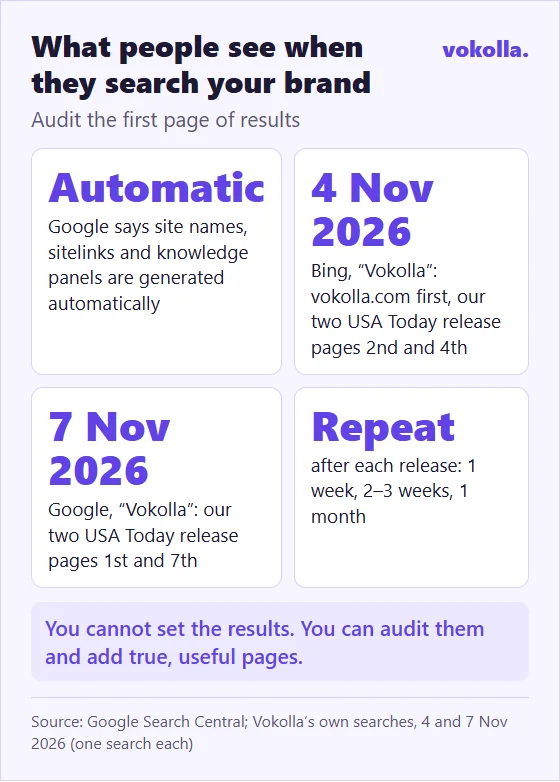
Google documents the display features and says they are automatic. The site name in results is “completely automated”, and takes into account content from a site’s home page and references to it that appear on the web; you can state a preference with WebSite structured data. Sitelinks are shown only when Google thinks they will be useful to the user. Knowledge panels are automatically generated from public information; Google does not create or delete them manually, but an owner can verify and suggest changes.
We found no Google page that explains how brand queries are ranked, so treat any promise about your brand results with caution. What a release adds is a dated third-party page that can appear next to your site.
A brand-search audit, step by step
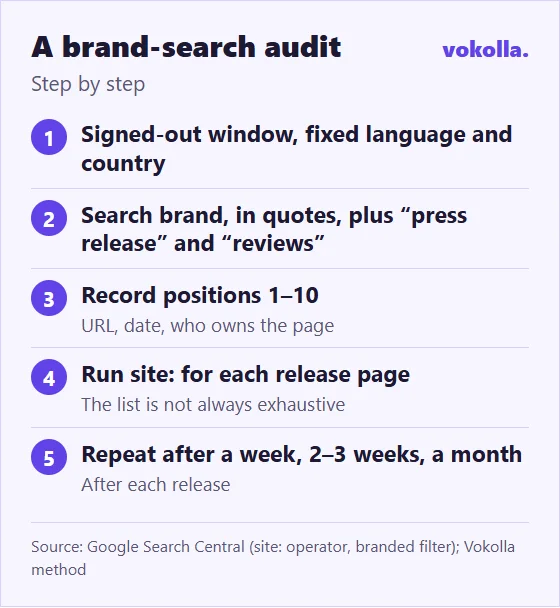
- Use a signed-out browser or private window with a fixed language and country.
- Search your brand in plain form and in quotes, then brand plus “press release”, brand plus “reviews” and brand plus each product.
- Record positions 1 to 10 with the URL, the date and who owns the page: your site, a press release page, a directory, social, news or reviews.
- Run site:yourdomain.com brand, and site:outlet.com “headline” for each release page. Google says the site: list is not always exhaustive.
- Repeat after a week, two to three weeks and a month, after each release.
- In Search Console, use the branded queries filter (introduced 20 November 2025) to split branded from non-branded queries; Google says it has no effect on ranking.
What our own checks showed
On 4 November 2026 a Bing search for “Vokolla” showed vokolla.com first and our two USA Today release pages at positions 2 and 4. On 7 November a Google search for “Vokolla” had the same two release pages at positions 1 and 7. Each is one search, with fixed settings, so read them as our results on those days; we repeat them after each release.
What you can do
Make sure your own site states who you are, with a clear home page and About page; publish true news as releases so there is something dated and third-party to find; claim your business profiles; and keep the same facts everywhere. See how a new site gets found and Google’s rules for links in releases.
Publish with Vokolla
Vokolla shows one public price per release, from US$69, with no quote, sales call or subscription. You write the release or draft it with the Vokolla AI assistant, choose the package, pay online and get a report with every live link, and an editor reviews each release before it goes out. You can try it first with one free release every 30 days; every package is on the pricing page.
Questions people ask
Can I control my brand search results?
Not directly. Google’s site names, sitelinks and knowledge panels are automatic. You can improve what it has to work with and publish true, useful pages about your company.
How do I check whether my release page is indexed?
Use site:outlet.com with the headline in quotes, knowing Google says the list is not always exhaustive, and search the exact headline.
What is the branded queries filter?
A Search Console filter, introduced 20 November 2025, that splits queries into branded and non-branded; Google says it does not affect ranking.
Will a press release rank for my brand name?
We cannot promise it. In our own checks, one search each with fixed settings, two release pages appeared on the first page for our brand name on the days we checked.
How often should I audit?
Around each release, and about once a month in between, so you notice changes you did not cause.
Vokolla pages for this step
- Packages →Six packages from US$69 to US$659 per release, each with a report of the live links.
- Pricing →Every package’s public price, reach and what it includes, side by side.
- Free press release →One free release every 30 days on news sites, after editor review.
- AI assistant →Connect your AI assistant to Vokolla to draft, check and save a release.
Sources
Written and checked by the Vokolla editorial team. Vokolla provides the packages described here; prices and outlets are as published on vokolla.com on the date above, and the results quoted come from our own releases. Search rankings depend on many factors, so no distribution service can guarantee them.
- Google Search Central: Provide a site name to Google Search (updated 10 Dec 2025): automated, from the home page and references on the web — checked 2026-11-19
- Google Search Central: Sitelinks (updated 10 Dec 2025): shown only when Google thinks they will be useful — checked 2026-11-19
- Google Knowledge Panel Help: About knowledge panels (automatically generated; Google does not manually create or delete them) — checked 2026-11-19
- Google Search Central Blog (20 Nov 2025): the branded queries filter in Search Console — checked 2026-11-19
- Google Search Central: site: search operator (updated 10 Dec 2025): the list of URLs returned is not always exhaustive — checked 2026-11-19
- Vokolla publishing records: our own releases on USA Today and partner networks (October 2026), Google, Bing and AI-answer checks on 4 and 7 Nov 2026 (internal records; the method is described on this page) — checked 2026-11-04
- Google Search Central: SEO Starter Guide (updated 2025-12-10) — checked 2026-11-04