Guide · SEO
Google’s rules for links in press releases: what the policy says and how to write links that stay within it
In short
Google’s spam policies list “links with optimized anchor text in articles, guest posts, or press releases distributed on other sites” as link spam. A press release can carry a link; what the policy targets is links built to manipulate rankings, especially keyword-optimized anchor text. Our guidelines say three or fewer links is safest; Google sets no number. Use your brand name or web address as the link text, and a qualifying attribute where payment is involved.
What the policy says
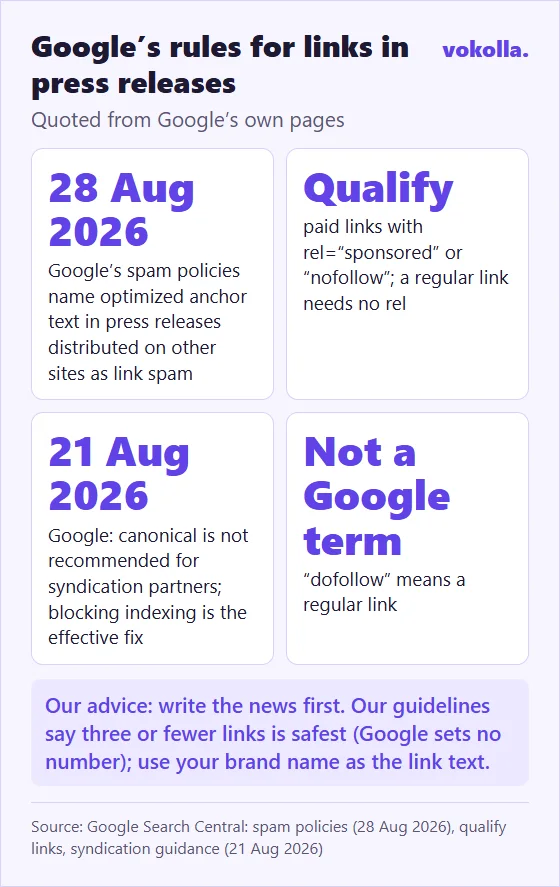
Google’s spam policies, updated on 28 August 2026, define link spam as links created primarily to manipulate search rankings. Among the examples is one that names press releases: “links with optimized anchor text in articles, guest posts, or press releases distributed on other sites”. In the same list: exchanging money for links, and links required as part of a contract without letting the other site qualify them.
The same page says buying and selling links is a normal part of the web’s economy for advertising and sponsorship, and that it is not a violation to have such links as long as they are qualified with rel=“nofollow” or rel=“sponsored”. It also lists “wire service or press release service sites” as examples that are not considered inconsistent with its separate site reputation abuse policy. The policy does not say that Google ignores links in press releases.
Qualifying a link
Google’s guide to qualifying outbound links says to mark advertisements and paid placements with rel=“sponsored”, that nofollow is still an acceptable way to flag them, and that for a regular link you expect Google to fetch and parse you do not need a rel attribute. Since September 2019 Google treats sponsored, ugc and nofollow as hints. “Dofollow” is not a Google term: in Google’s terms it is a regular link with no qualifying attribute.
How to write the links
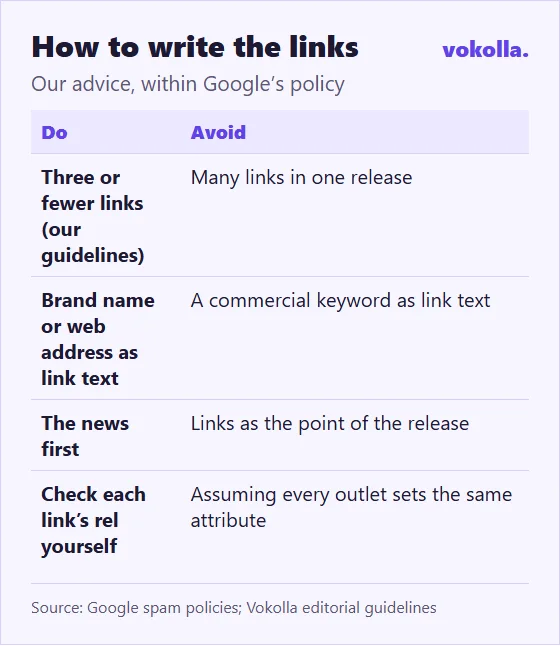
- A few links, to your website or the page the news is about. Our guidelines allow up to five in the body and say three or fewer is safest.
- Link text: your brand name, your web address or a plain description of the page. Google says good anchor text is descriptive, concise and relevant. Never use a commercial keyword such as “cheap flights”.
- Do not make links the point of the release. Write the news first.
- To see which attributes an outlet uses, look at the page itself; see dofollow and nofollow links and how to check each link yourself.
- Do not promise yourself a ranking from a release. Google guarantees nothing here and neither does any distribution service.
Publish with Vokolla
Vokolla shows one public price per release, from US$69, with no quote, sales call or subscription. You write the release or draft it with the Vokolla AI assistant, choose the package, pay online and get a report with every live link, and an editor reviews each release before it goes out. You can try it first with one free release every 30 days; every package is on the pricing page.
Questions people ask
Does Google ban links in press releases?
No. Its spam policies name links with optimized anchor text in press releases distributed on other sites, and paid links without a qualifying attribute. A plain brand link in a real news release is not what the policy describes.
Is “dofollow” a Google term?
No. In Google’s terms it is a regular link with no rel qualification.
Should press release links be nofollow?
Where money is paid for a link, Google says to qualify it with sponsored or nofollow. Outlets set their own attributes; check yours in the page source.
Does Google index syndicated releases?
That is Google’s and the outlet’s decision. Google says the most effective fix for duplication is for syndication partners to block indexing, so some pages may not appear.
How many links should a release have?
A few. Our guidelines allow up to five in the body and say three or fewer is safest.
Vokolla pages for this step
- Packages →Six packages from US$69 to US$659 per release, each with a report of the live links.
- Pricing →Every package’s public price, reach and what it includes, side by side.
- Free press release →One free release every 30 days on news sites, after editor review.
- AI assistant →Connect your AI assistant to Vokolla to draft, check and save a release.
Sources
Written and checked by the Vokolla editorial team. Vokolla provides the packages described here; prices and outlets are as published on vokolla.com on the date above, and the results quoted come from our own releases. Search rankings depend on many factors, so no distribution service can guarantee them.
- Google Search Central: Spam policies for Google web search (updated 2026-08-28) — checked 2026-11-19
- Google Search Central: Qualify your outbound links (updated 2025-12-10) — checked 2026-11-19
- Google Search Central Blog: Evolving “nofollow” – new ways to identify the nature of links (2019-09-10) — checked 2026-11-19
- Google Search Central Blog (25 May 2017): a reminder about links in large-scale article campaigns — checked 2026-11-19
- Google Search Central: Fix canonicalization issues, syndicated content (updated 21 Aug 2026): canonical is not recommended for syndication partners; blocking indexing is the effective fix — checked 2026-11-19
- Google Search Central: Link best practices (updated 10 Dec 2025): good anchor text is descriptive, concise and relevant — checked 2026-11-19
- Vokolla: Editorial guidelines for press releases — checked 2026-11-19