Guide · AI search
A monthly AI visibility test: the questions, the log and how to read the results
In short
A monthly AI visibility test asks the same fixed questions, word for word, in the same conditions each month and logs what each assistant says and cites. One run is not enough, because language models give different outputs to the same request and AI search varies between runs. Repeat each question three times on the same day, and compare month with month.
Why one run is not enough
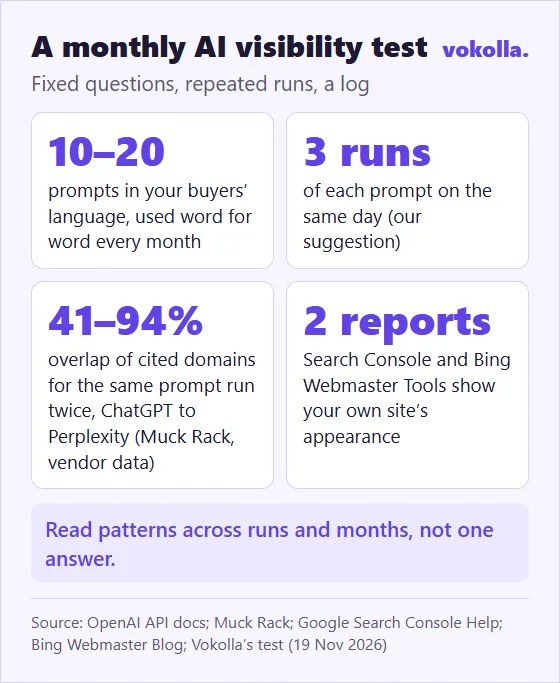
OpenAI’s API documentation says model outputs may differ from request to request, and a 2024 preprint testing five models on eight tasks over ten runs found that none gave repeatable results on every task. Those are about models, not about ChatGPT search specifically. For AI search, Muck Rack’s October 2026 report says that when it ran the same prompt twice, the cited domains overlapped between 41% (ChatGPT) and 94% (Perplexity), which is vendor data. Google’s AI Mode help says its answers can be personalised. So record conditions, repeat, and read patterns, not single answers.
Build a fixed prompt set
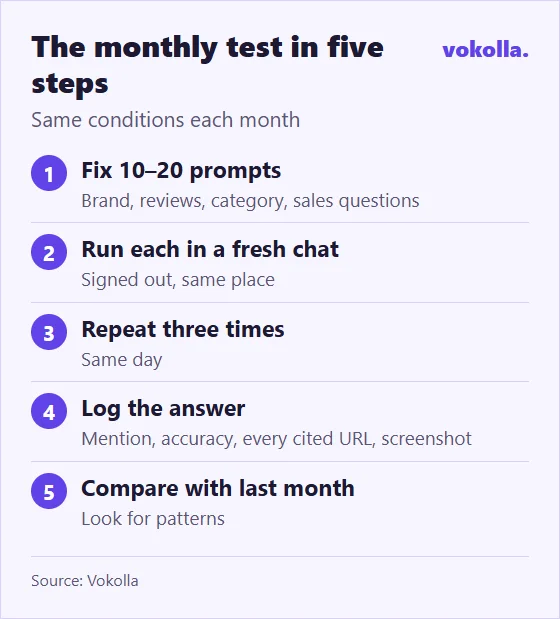
- About 10 to 20 prompts in the language your buyers use: your brand name; your brand plus “reviews” or “is it good”; your category (“best [what you sell] for [who]”); and two or three questions your sales team hears.
- Use them word for word every month. Change a prompt only by adding a new one, so the series stays comparable.
- Run each in a fresh chat, signed out where possible, from the same place. Our fixed set has 12 English and 8 Chinese prompts.
- Repeat each prompt three times on the same day (our suggestion, based on the variation above).
What to log
| Column | What to write |
|---|---|
| Date, time and time zone; tester location | Answers can differ by place |
| Engine and mode | Signed in or out, search on or off, model shown |
| Prompt ID and exact text | The fixed wording |
| Brand mentioned | Yes or no, and where: list, recommendation, or citation only |
| Accuracy | Correct, wrong or missing, with the quoted line |
| Every cited URL, in order | Your own pages, third-party pages, competitors’ |
| Competitors named | For context |
| Screenshot file and run number | Evidence for each run |
In our first run on 4 November 2026, from Sydney, ChatGPT localised some answers, so we now note the location. A reader in the US may see different names.
Reports built into the webmaster tools you may already use
Search Console has a generative AI performance report with impressions in AI Overviews and AI Mode. Bing Webmaster Tools has AI Performance, which shows how your content appears across Microsoft Copilot and AI summaries in Bing, with total citations, cited pages and grounding queries; Bing launched it as a public preview on 10 February 2026 and says the grounding-query data is a sample. They show your own site’s appearance; the manual test shows what a customer asking a question sees.
What our first run looked like
On 4 November 2026, a signed-out ChatGPT search for “What is Vokolla?” gave an accurate description and cited vokolla.com and a US newspaper business page carrying our release of 25 October; “Is Vokolla a good press release distribution service?” listed our public prices from US$69, the free release and the outlets in each package. For a question about press release services in 2026, Perplexity cited a third party’s release syndicated on Yahoo Finance. Each was a single run, so we treat them as a baseline to compare against.
How to read it
- Look at patterns across the three runs and across months, not one answer.
- A wrong statement is a task: correct it at the source.
- A missing mention is information about what to publish next, not a failure.
- Do not change the prompt set to flatter the results.
Publish with Vokolla
Vokolla shows one public price per release, from US$69, with no quote, sales call or subscription. You write the release or draft it with the Vokolla AI assistant, choose the package, pay online and get a report with every live link, and an editor reviews each release before it goes out. You can try it first with one free release every 30 days; every package is on the pricing page.
Questions people ask
How often should I test?
Monthly is enough for most brands; test again after a release or a site change.
Why repeat each question three times?
Outputs vary between runs; Muck Rack’s October 2026 report gives 41% to 94% overlap in cited domains for the same prompt run twice (vendor data).
Which assistants should I test?
The ones your buyers use, for example ChatGPT, Google AI features and Perplexity for overseas buyers, and Doubao, DeepSeek and Kimi for China.
Are there built-in tools?
Search Console’s generative AI performance report and Bing Webmaster Tools’ AI Performance show your site’s appearance.
What should I log?
Date, location, engine, prompt, whether you are mentioned, accuracy, every cited URL, competitors and a screenshot.
Vokolla pages for this step
- Packages →Six packages from US$69 to US$659 per release, each with a report of the live links.
- Pricing →Every package’s public price, reach and what it includes, side by side.
- Free press release →One free release every 30 days on news sites, after editor review.
- AI assistant →Connect your AI assistant to Vokolla to draft, check and save a release.
Sources
Written and checked by the Vokolla editorial team. Vokolla provides the packages described here; prices and outlets are as published on vokolla.com on the date above, and the results quoted come from our own releases. Search rankings depend on many factors, so no distribution service can guarantee them.
- OpenAI API docs: Advanced usage (outputs “may differ from request to request”; this is the API, not ChatGPT search) — checked 2026-11-05
- Atil et al.: Non-Determinism of “Deterministic” LLM Settings (arXiv 2408.04667, 2024; preprint) — checked 2026-11-05
- Muck Rack: “Generative Pulse: Earned Media Still Drives More Than 84% of AI Citations” (What Is AI Reading?, 28 Oct 2026 edition; Muck Rack sells PR software) — checked 2026-11-05
- Google Search Help: AI Mode (thumbs up or down on each response; personalization) — checked 2026-11-05
- Google Search Console Help: Generative AI performance report (impressions in AI Overviews and AI Mode) — checked 2026-11-05
- Microsoft Bing Webmaster Blog: AI Performance public preview (10 Feb 2026) — checked 2026-11-06
- Vokolla publishing records: our own releases on USA Today and partner networks (October 2026), Google, Bing and AI-answer checks on 4 and 7 Nov 2026 (internal records; the method is described on this page) — checked 2026-11-04
- Vokolla: Editorial guidelines for press releases — checked 2026-11-04