Guide · AI search
Which sources AI assistants cite, what each vendor says and where a press release fits
In short
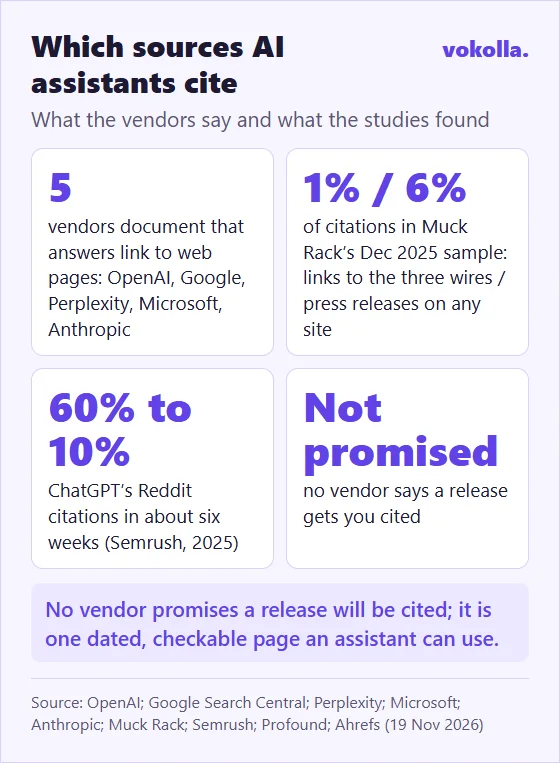
AI assistants that search the web show links to the pages they used, and each vendor documents that in its own words, Chinese assistants such as Doubao and Kimi included. Studies by SEO and PR software vendors find that citations spread over many kinds of sites, with Reddit, YouTube, Wikipedia and news sites prominent. Press releases are a small share: Muck Rack’s December 2025 report found 1% of citations went to the three main wires, and about 6% counting press releases on any site. No vendor promises a release will be cited; it gives you one dated, checkable page an assistant can use.
What each vendor documents
Every assistant below says its answers can link to the web pages they came from. None of the pages we read explains how it ranks sources.
| Assistant | What is documented |
|---|---|
| ChatGPT search (OpenAI) | Chats include links to sources such as news articles and blog posts, opened from a Sources button (launch post, 31 Oct 2024) |
| Google AI Overviews and AI Mode | Show links to supporting pages; a page must be indexed and eligible to be shown in Search with a snippet, and there are no additional requirements |
| Perplexity | Each response includes citations and links to original sources, sourced from the web in real time |
| Microsoft Copilot | Provides references for where the information originated (Microsoft 365 Copilot Chat FAQ) |
| Claude (Anthropic API) | Citations are always enabled for the web search tool; this is the developer documentation, not the consumer app |
Google’s July 2026 guide adds that you do not need new machine-readable files, AI text files or markup to appear in Google Search, and that seeking inauthentic “mentions” across the web is not as helpful as it might seem.
What studies of cited domains found
All four are by software vendors or researchers, each with its own sample and date, and the results differ because the samples differ.
| Study | Sample | What it found |
|---|---|---|
| Semrush, 10 Nov 2025 | 230,000 prompts, ChatGPT search, Google AI Mode, Perplexity, 14 Jul to 12 Oct 2025; over 100 million citations | Reddit and LinkedIn among the five most-cited domains on all three; after a mid-September change, PR Newswire, Forbes and Medium were ChatGPT’s biggest winners |
| Profound, 5 Jun 2025 | 680 million citations, Aug 2024 to Jun 2025 | ChatGPT: Wikipedia 7.8%, Reddit 1.8%, Forbes 1.1%; Google AI Overviews: Reddit 2.2%, YouTube 1.9%; Perplexity: Reddit 6.6%, YouTube 2.0% |
| Ahrefs, 3 Nov 2026 | Over 3 million US queries in Google AI Overviews; share among the top 50 sources | YouTube 24.5%, Reddit 18.1%, Facebook 12.4% |
| Tow Center, 6 Mar 2025 | 1,600 queries to eight AI search engines, asking for the source of a news article | Collectively they gave incorrect answers to more than 60% of queries; it tests retrieval of news articles, not brand questions |
The same Semrush study found ChatGPT’s citations of Reddit fell from close to 60% of responses in early August 2025 to around 10% by mid-September, so a list like this is a snapshot.
Where press releases appear
Muck Rack’s December 2025 report, which analysed over a million links from AI responses between July and December 2025, found press releases at 1% of citations (counting links to the three main wires), up from 0.2% in July; its body text puts press releases overall at about 6%. Its October 2026 edition reports that more than 84% of AI citations come from earned and third-party sources, which is a different category from press releases. Muck Rack sells PR software, so read these as vendor data.
In our first monthly check, on 4 November 2026, ChatGPT search cited a US newspaper business page carrying our release (the full run).
What a release cannot do
A release does not make an assistant cite you, and none of the vendors says it does. Wikipedia, which Profound found was ChatGPT’s most-cited domain (7.8%), does not consider press releases independent sources. A release is useful because it is a dated, public statement of verifiable facts on a page that others can open and compare.
Chinese assistants label their web sources too
Mainland China is the other large market for AI answers. As reported by Sina Tech on 29 September 2026, CNNIC’s 2026 report puts generative AI users in China above 700 million in the first half of 2026, with penetration above 50% and 76% of users turning to these products to get answers. CNNIC’s 2025 report had counted 515 million users as of June 2025, 36.5% of the population, 80.9% of whom used them to answer questions.
The Chinese assistants describe their web search in their developer documentation. ByteDance’s Volcano Engine documents a Doubao assistant API that brings the Doubao app’s abilities, web search among them, to other applications, and says its web search labels the sources of what it retrieves. Kimi’s documentation says its web search API returns an authority level for each source and keeps the title, link and site of each snippet. DeepSeek’s API documentation lists web search among its application APIs.
The rules come from the Interim Measures for the Management of Generative AI Services, in force since 15 August 2023 for services offered to the public in mainland China. They ask providers to make their services more transparent, to improve the accuracy and reliability of generated content and to train on data of lawful origin. They do not list which websites an assistant may cite, so the work for a brand is the same as overseas: clear, consistent facts on pages an assistant can find.
A brand selling in both markets keeps one set of facts in two languages: English pages where overseas assistants find them, on its own site and in releases on news sites, and Chinese pages where Chinese buyers and assistants look. Then test each market with its own questions in its own language, using the monthly test.
What to do with this
See the pillar page, how press releases and AI search work together.
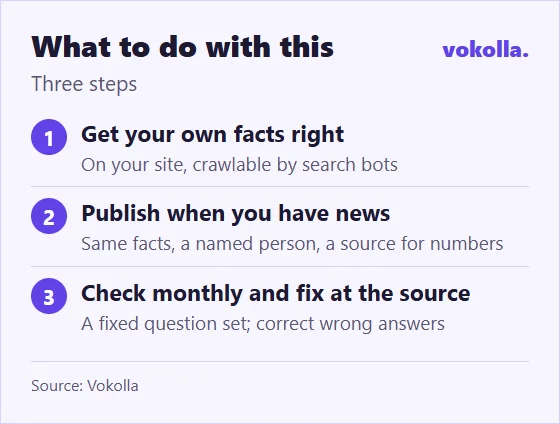
- Make the facts on your own site correct and crawlable first (robots.txt for AI crawlers).
- Publish a release when you have news, with the same facts as your site, a named person and a source for numbers.
- Check what assistants say every month (a monthly test) and correct wrong answers at the source (how).
Publish with Vokolla
Vokolla shows one public price per release, from US$69, with no quote, sales call or subscription. You write the release or draft it with the Vokolla AI assistant, choose the package, pay online and get a report with every live link, and an editor reviews each release before it goes out. You can try it first with one free release every 30 days; every package is on the pricing page.
Questions people ask
Do ChatGPT, Gemini and Perplexity show their sources?
Yes. Each vendor documents that its answers can include links to the web pages used; none of the pages we read explains how it ranks them.
Which domains do AI assistants cite most?
It depends on the study and the date: Reddit, YouTube, Wikipedia and news sites appear in the vendor studies we read.
How often are press releases cited?
Muck Rack’s December 2025 report found 1% of citations in its sample, counting links to the three main wires.
Will a press release get me cited by AI?
No vendor promises it. A release gives you one dated, checkable page an assistant can use.
Does Google need an llms.txt file?
No. Google’s July 2026 guide says Google Search ignores llms.txt.
How many people in China use generative AI?
Over 700 million in the first half of 2026, as Sina Tech reports CNNIC’s 2026 figure; CNNIC counted 515 million as of June 2025.
Do Doubao, DeepSeek and Kimi show their sources?
Doubao’s and Kimi’s developer documentation says their web search results carry source details, Kimi’s with an authority level for each source; DeepSeek’s lists a web search API.
Vokolla pages for this step
- Packages →Six packages from US$69 to US$659 per release, each with a report of the live links.
- Pricing →Every package’s public price, reach and what it includes, side by side.
- Free press release →One free release every 30 days on news sites, after editor review.
- AI assistant →Connect your AI assistant to Vokolla to draft, check and save a release.
Sources
Written and checked by the Vokolla editorial team. Vokolla provides the packages described here; prices and outlets are as published on vokolla.com on the date above, and the results quoted come from our own releases. Search rankings depend on many factors, so no distribution service can guarantee them.
- OpenAI: Introducing ChatGPT search (31 Oct 2024; sources button, links to sources) — checked 2026-11-05
- Google Search Central: AI features and your website (updated 2025-12-10) — checked 2026-11-04
- Google Search Central: Optimizing your website for generative AI features (updated 10 Jul 2026): no new files needed; llms.txt ignored; inauthentic mentions are not helpful — checked 2026-11-05
- Perplexity Help Center: What is Perplexity? (each response includes citations and links to original sources) — checked 2026-11-05
- Microsoft Support: Frequently asked questions about Microsoft 365 Copilot Chat (references; thumbs-down feedback) — checked 2026-11-05
- Anthropic developer docs: Web search tool (citations are always enabled; this is the API, not the consumer app) — checked 2026-11-05
- Muck Rack: What Is AI Reading? (Dec 2025 report, 1,000,000+ links; press releases 1% of citations to the three wires, about 6% overall; Muck Rack sells PR software) — checked 2026-11-05
- Muck Rack: “Generative Pulse: Earned Media Still Drives More Than 84% of AI Citations” (What Is AI Reading?, 28 Oct 2026 edition; Muck Rack sells PR software) — checked 2026-11-05
- Semrush: The Most-Cited Domains in AI, a 3-month study (10 Nov 2025; 230K prompts, 100M+ citations) — checked 2026-11-05
- Profound: AI Platform Citation Patterns (5 Jun 2025; 680 million citations) — checked 2026-11-05
- Ahrefs: Most-cited domains in Google AI Overviews (updated 3 Nov 2026; 3 million+ US queries; top-50 mention share) — checked 2026-11-05
- Columbia Journalism Review, Tow Center: We compared eight AI search engines (6 Mar 2025; 1,600 queries; incorrect answers to more than 60%) — checked 2026-11-05
- Wikipedia: Notability (advertising, press releases and the subject’s website are not considered independent) — checked 2026-11-05
- Sina Tech, 29 Sep 2026: report on CNNIC’s 2026 generative AI report (over 700 million users, over 50%; 76% use it to get answers); primary CNNIC page not confirmed — checked 2026-11-05
- CNNIC: Generative AI Application Development Report 2025 (as of June 2025: 515 million users, 36.5%; 80.9% use it to answer questions) — checked 2026-11-05
- Volcano Engine (ByteDance) Ark docs: Doubao assistant API (brings the Doubao app’s abilities, including web search, to other apps; web search labels its sources; developer API, not the consumer app) — checked 2026-11-19
- Kimi API Open Platform: web search best practices (the API returns source authority levels; this is the developer API, not the consumer app) — checked 2026-11-05
- DeepSeek API docs: the full suite of application APIs includes web search, file input and URL reading (site banner) — checked 2026-11-05
- Interim Measures for the Management of Generative AI Services (effective 15 Aug 2023), gov.cn: applies to services provided to the public in mainland China — checked 2026-11-05
- Vokolla publishing records: our own releases on USA Today and partner networks (October 2026), Google, Bing and AI-answer checks on 4 and 7 Nov 2026 (internal records; the method is described on this page) — checked 2026-11-04
- Vokolla: Editorial guidelines for press releases — checked 2026-11-04