Guide · Press release basics
Press release template and five real 2026 examples, annotated part by part
In short
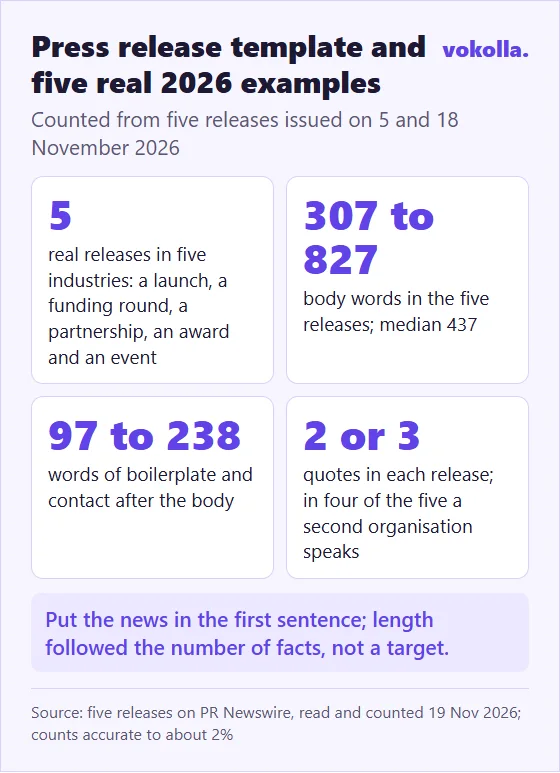
A press release template is a fixed order of parts: headline, summary, dateline, a lead that gives the news in one or two sentences, one or two quotes from named people, details, a call to action, an “About” boilerplate and a contact. We took apart five real releases from 5 and 18 November 2026, in five industries: their bodies run from 307 to 827 words, each has two or three quotes, and boilerplate plus contact add 97 to 238 words. The fill-in template below follows what those releases and the US government and university guides have in common. A release built this way is easier for editors to approve and for customers, journalists and AI tools to quote, because the facts sit in the first lines.
The template: what goes where
Copy this table into Word or Google Docs and replace the brackets. The order is the one all five real releases below use and the one the guides agree on. Put the news in the first sentence: the University of Illinois Extension’s guide gives the reason for the inverted pyramid, that editors can then cut from the bottom.
| Part | What to write | Size and notes |
|---|---|---|
| Headline | [Company] [verb] [what] [for whom, or with what number]. State the news, no slogan. | One line. The SBA guide says 100 characters or less. |
| Summary line | One or two sentences with the detail the headline had no room for. | All five carry a one-line summary, of 13 to 45 words. |
| Dateline | [CITY, State] – [Month D, YYYY] – | Punctuation varies between guides; follow the outlet’s style. |
| Lead | [Company], [what it is, in a few words], today announced [the news] [for whom] [availability or date]. | One or two sentences. The Pennsylvania health department template keeps the first paragraph under 30 words. |
| Quote 1 | “[Why this matters, in the speaker’s own words],” said [Full name], [title] at [Company]. | Two or three sentences, from a named person with a title. |
| Body | Two to four short paragraphs: what it is, who it is for, how it works, one figure you can back up, price and availability. | Most important first, so the end can be cut. |
| Quote 2 (optional) | A customer, partner or investor saying something the first quote does not. | In four of the five examples a second organisation speaks: a customer, investors, a co-issuing partner or the ranking body. |
| Call to action | For more information, visit [your brand name or web address]. | One or two links in the whole release. |
| Boilerplate | About [Company]: [two or three sentences, the same every time]. [Web address] | In the examples, boilerplate and contact together take 97 to 238 words. |
| Contact | [Name], [title], [email], [phone that works after hours] | A named person. The federal IMLS template asks for a number that works after hours. |
| End mark | ### | The IMLS, Pennsylvania and Rutgers guides all close with ### (Pennsylvania also allows “End”). |
Length: Vokolla accepts a body of 300 to 1,200 words, and our editorial guidelines recommend 400 or more.
Each part has its own guide: headlines, datelines, the full press release format and the pillar, the complete guide to press releases.
What US government and university guides ask for
The five structure guides are free, public and written by communications staff at US agencies and universities. Only the SBA post prints a date (3 June 2019), so read them as stable structure advice, not current style rules.
| Guide | What it asks for | What is distinctive |
|---|---|---|
| US Institute of Museum and Library Services (federal agency), template, 2 pages | FOR IMMEDIATE RELEASE with the date; the organisation; a media contact with a number that works after hours; a one-line headline; a one-sentence subhead; a “City, State:” lead; quotes in the second paragraph and background in the third; a short boilerplate; ### at the end; one page, 8th-grade language | Its advice on the lead: “Don’t bury the lead”. It also has a separate event layout that lists What, Where, When and Who under the subhead. |
| US Small Business Administration, 3 June 2019 | A headline of 100 characters or less; subhead; dateline; the five W’s and the company name in the first paragraph; one or two quotes with full name and title; call to action; boilerplate; contact; one to two pages | Warns that too many links can get a release flagged as spam by distribution sites and search engines. |
| Pennsylvania Department of Health, guide with template | First paragraph under 30 words; a quote from an official early on; boilerplate before the end mark; two pages at most; sixth- to eighth-grade reading level | Its one-line rule: “Keep the news release brief.” |
| University of Illinois Extension | Inverted pyramid; an opening paragraph of two or three sentences; a “CITY, Ill. -” dateline; sentence-case headlines; the official boilerplate in every release | Write the opening from the reader’s side: how their lives improve. |
| Rutgers SEBS/NJAES communications office | Headline, optional subhead, dateline, a one-sentence lead, inverted pyramid, a quote, boilerplate, a centred ###, contact details; AP style; one or two pages | Allows the contact in the letterhead as well as at the end. |
The five guides differ on the headline limit, on where the contact sits (letterhead or after the body) and on dateline punctuation, so follow the outlet’s own style when it has one.
Five real releases from November 2026
We read five releases in full on 19 November 2026, each on the PR Newswire site, which carries the issuer’s release. We chose one for each common type: a product launch, a funding round, a partnership, an award and an event. All were issued in the previous two weeks. We counted words from the dateline to the first “About” or “Media Contact” heading (the body), and from there to the end of the release (boilerplate and contact).
| Release | Type | Issued | Body words | Boilerplate and contact words |
|---|---|---|---|---|
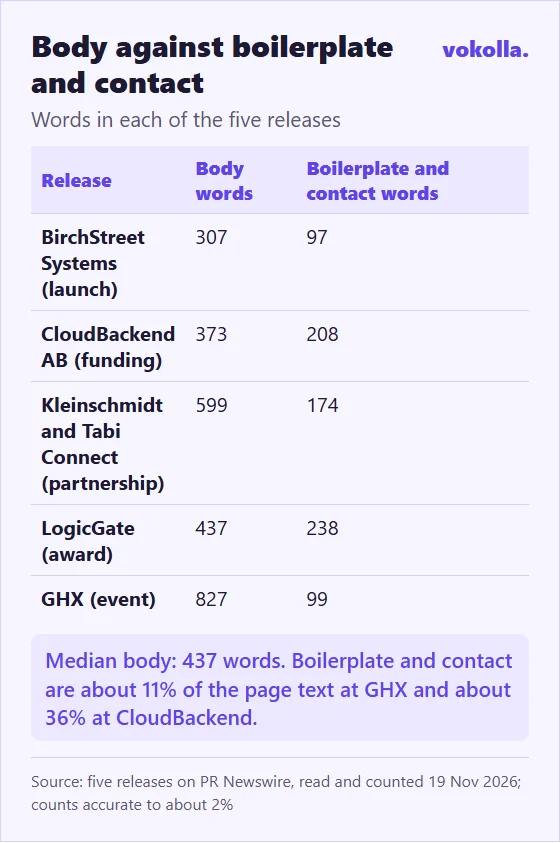
| BirchStreet Systems, Smart Inventory | Product launch, hospitality software | 18 Nov 2026 | 307 | 97 |
| CloudBackend AB, EUR 6.6 million round | Funding, AI infrastructure (Sweden) | 18 Nov 2026 | 373 | 208 |
| Kleinschmidt and Tabi Connect, partnership phase two | Partnership, freight logistics | 18 Nov 2026 | 599 | 174 |
| LogicGate, Deloitte Technology Fast 500 | Award, enterprise software | 18 Nov 2026 | 437 | 238 |
| GHX, Summit 2027 registration and awards | Event, healthcare supply chain | 5 Nov 2026 | 827 | 99 |
For contrast, Apple’s own newsroom ran a release on 13 October 2026 for the same type of news as BirchStreet’s, a product launch. Its body text runs to about 1,800 words, nearly six times BirchStreet’s body, followed by footnotes and a named press contact. Most issuers need a fraction of that.
How the leads open
In every release in the table, the lead puts the news ahead of the company’s history. One short phrase from each, in the release’s own words, shows the shape.
| Release | What the lead carries | A phrase from it |
|---|---|---|
| BirchStreet (launch) | One sentence: the company, the launch and what it does. Availability gets its own line straight after. | “Smart Inventory is now generally available to BirchStreet customers.” |
| CloudBackend (funding) | The company and what it does, the amount, who led, and that an existing investor raised its stake. | “raised €6.6 million in a financing round” |
| Kleinschmidt and Tabi Connect (partnership) | Ties the story to an earlier release: a second phase of a partnership first announced in September 2026. | “a significant expansion of their strategic partnership” |
| LogicGate (award) | The award, the body that gives it, the metric (revenue growth of more than 100% over three years) and the streak, fifth year running. | “named to the 2026 Deloitte Technology Fast 500” |
| GHX (event) | The first sentence gives the organiser and what opened; the second gives the dates and venue city. | “today opened early registration for its flagship annual event” |
| Apple (launch, own newsroom) | Two sentences: the product, the two partners (LG Electronics and Schneider Electric) and what the customer gets. | “Apple today announced Apple Home Collection, a new lineup of smart home accessories” |
Read in a row, the leads follow the guides: who, what and when first, background later. Kleinschmidt and Tabi Connect stands out because its lead points back to a release from September 2026, which suits news that arrives in stages. Around the lead, the examples add structure worth copying: label-led bullets for features (BirchStreet), a concrete date for the use of funds (CloudBackend), six named breakout tracks and a nomination deadline in its own sentence (GHX).
Quotes: who speaks, and what each adds
The quotes in the five releases are paraphrased here, not copied: the point is who speaks and what job each quote does.
| Release | Quotes | Who speaks and what each says |
|---|---|---|
| BirchStreet | 2 | A customer (an SVP at Crescent Hotels & Resorts) on before and after; then BirchStreet’s SVP of Product Management. |
| CloudBackend | 3 | The founder and CEO on the problem; the lead investor’s CEO on why it led; an existing investor’s CEO on why it backed the company again. |
| Kleinschmidt and Tabi Connect | 2 | One CEO from each side, each saying what his company brings. |
| LogicGate | 2 | The company’s CEO; a Deloitte partner speaking about the ranking, a third-party voice. |
| GHX | 2 | Both from the CEO: one on the summit, one on the awards. |
| Apple | 3 | Apple’s vice president of Hardware Engineering, an executive vice president at LG Electronics and the CEO of Schneider Electric. |
In four of the five PR Newswire releases a second organisation speaks: a customer, investors, a co-issuing partner or the ranking body. That gives the release a voice that is not only the issuer’s. How to write one: quotes in a press release.
After the body: boilerplate and contact
Every release in the table closes with boilerplate and contact details after the body; the table shows what each one carries and how many words it takes.
| Release | Words after the body | What is there |
|---|---|---|
| BirchStreet | 97 | One “About” paragraph (company founded in 2002); a named chief marketing officer with an email address. |
| CloudBackend | 208 | Six “About” blocks: the company, two investors and three named people; an agency contact with name, title, email and phone, plus a press email. |
| Kleinschmidt and Tabi Connect | 174 | Two “About” blocks, one per partner; no media contact line in the page text. |
| LogicGate | 238 | An “About” block on the Deloitte ranking, including its eligibility rules, and one on the company; no media contact line in the page text. |
| GHX | 99 | One “About” paragraph; an agency contact labelled “Media Contact”. |
| Apple | not counted | “About Apple”, legal footnotes, then “Press Contacts” with a named contact and a media helpline address. |
Two of the five (Kleinschmidt and Tabi Connect, LogicGate) show no media contact in the page text. The guides above all ask for one, so the template puts a named contact last. More on the “About” paragraph: the boilerplate.
Length: bodies of 307 to 827 words, median 437
The five bodies run from 307 to 827 words, with a median of 437. Boilerplate and contact take between about 11% of the page text (GHX) and about 36% (CloudBackend, which describes two investors and three named people as well as itself). The longest, GHX, covers six breakout tracks and an awards programme; the shortest is a single product launch. Length followed the number of facts, not a target. The guides ask for one or two pages, and Vokolla accepts bodies of 300 to 1,200 words, recommending 400 or more.
Word, Google Docs or PDF, free
The press release template above is plain text, so paste it into Word or Google Docs. Other free starting points, as their pages describe them: the federal IMLS template is a two-page PDF; Prezly offers a free template in Word, PDF and Google Docs formats; the IMLS template comes from a federal agency and Prezly is a software vendor.
How our own releases follow it
Two Vokolla releases were published on USA Today’s press release section and went live about 67 minutes (submitted 15 October 2026) and about 39 minutes (23 October 2026) after submission; both pages were in Google’s index when we checked on 4 and 7 November 2026. The text we submitted for the earlier one had a dateline, a 140-character summary and three descriptive links. USA Today’s package asks for 400 to 500 words and a summary of 150 characters or fewer. Our step-by-step walk-through is in how to write a press release. You can publish a release of your own from US$69 or try the free release; the outlets in each package are on the media list.
How we checked this guide
Vokolla’s editorial team read the five releases in full on 19 November 2026 on the PR Newswire site, plus Apple’s own newsroom release for contrast, and the structure guides from the IMLS, the SBA, the Pennsylvania Department of Health, the University of Illinois Extension and Rutgers. Word counts are ours, counted from the dateline to the first “About” or “Media Contact” heading and from there to the end of the release.
Check before you submit
A release is ready to submit when these seven checks pass.
- The first sentence says what happened and for whom; the company history lives in the boilerplate.
- Every quote has a full name and a title, and says something the body does not.
- One or two links, with your brand name or web address as the link text.
- The boilerplate is word for word the same in every release you issue.
- A named contact with an email and a number that works after hours.
- Written in English. Vokolla’s editors review releases written in English; if your notes are in another language, the “Write for me” option in the editor drafts an English first version.
- Inside the package limits: a body of 300 to 1,200 words, up to 3 images and up to 5 links (3 recommended).
Publish with Vokolla
Vokolla shows one public price per release, from US$69, with no quote, sales call or subscription. You write the release or draft it with the Vokolla AI assistant, choose the package, pay online and get a report with every live link, and an editor reviews each release before it goes out. You can try it first with one free release every 30 days; every package is on the pricing page.
Questions people ask
How long should a press release be?
The five November 2026 examples have bodies of 307 to 827 words. The guides ask for one or two pages, and Vokolla accepts 300 to 1,200 words and recommends 400 or more.
How many quotes does a press release need?
The five real examples carry two or three. In four of them a second organisation speaks, such as a customer, a partner or investors.
Do I need a boilerplate and a contact?
Yes: the government and university guides ask for both. In the five examples, boilerplate and contact take 97 to 238 words; two of the pages show no media contact in their text.
Is there a free press release template for Word or Google Docs?
Yes. The table above can be pasted into either. The federal IMLS template is a free PDF, and Prezly offers one in Word, PDF and Google Docs formats.
Can I write the release in Chinese?
Vokolla releases are written and published in English. You can start from notes in Chinese and have the assistant draft an English first version, then edit it.
Vokolla pages for this step
- Packages →Six packages from US$69 to US$659 per release, each with a report of the live links.
- Pricing →Every package’s public price, reach and what it includes, side by side.
- Free press release →One free release every 30 days on news sites, after editor review.
- AI assistant →Connect your AI assistant to Vokolla to draft, check and save a release.
Sources
Written and checked by the Vokolla editorial team. Vokolla provides the packages described here; prices and outlets are as published on vokolla.com on the date above, and the results quoted come from our own releases. Search rankings depend on many factors, so no distribution service can guarantee them.
- PR Newswire: BirchStreet Launches Smart Inventory to Give Hospitality Operators Real-Time Stock Control (18 Nov 2026; 307 body words) — checked 2026-11-19
- PR Newswire: CloudBackend Raises €6.6 million Led by Carl-Henric Svanberg’s Family Office (18 Nov 2026; 373 body words) — checked 2026-11-19
- PR Newswire: Kleinschmidt and Tabi Connect Launch Phase Two of Partnership to Advance Freight Pricing and Capacity Intelligence (18 Nov 2026; 599 body words) — checked 2026-11-19
- PR Newswire: LogicGate Named to the 2026 Deloitte Technology Fast 500™ List for the Fifth Consecutive Year (18 Nov 2026; 437 body words) — checked 2026-11-19
- PR Newswire: GHX Opens Early Registration for GHX Summit 2027 and Nominations for GHXcellence Awards (5 Nov 2026; 827 body words) — checked 2026-11-19
- Apple Newsroom: Introducing Apple Home Collection, a new lineup of smart home accessories (press release, 13 Oct 2026; about 1,800 words of body text) — checked 2026-11-19
- US Institute of Museum and Library Services: Template Press Release (PDF, 2 pages; no date shown) — checked 2026-11-19
- US Small Business Administration: How to Write a Press Release That Gets Results (3 Jun 2019) — checked 2026-11-19
- Pennsylvania Department of Health: How to Write a Press Release (PDF with template; no date shown) — checked 2026-11-19
- University of Illinois Extension: Press Releases and Media Relations (no date shown) — checked 2026-11-19
- Rutgers SEBS/NJAES Office of Public Outreach and Communication: Press Release Basics (no date shown) — checked 2026-11-19
- Prezly: Free press release template (Word, PDF and Google Docs; a software vendor) — checked 2026-11-19
- Vokolla publishing records: our own releases on USA Today and partner networks (October 2026), Google, Bing and AI-answer checks on 4 and 7 Nov 2026 (internal records; the method is described on this page) — checked 2026-11-04
- USA Today: “Vokolla Launches an AI Press Release Agent…” (press release section, 23 Oct 2026) — checked 2026-11-04
- Vokolla: Editorial guidelines for press releases — checked 2026-11-04
- Vokolla: Press release distribution pricing (packages, prices and reach) — checked 2026-11-04