Guide · SEO
Press release anchor text: what to use, what Google says and how to check your links
In short
Anchor text is the clickable words of a link. In a press release the safest choice is your brand name: Google’s spam policy lists links with optimized anchor text in press releases distributed on other sites among its link-spam examples, while its link guidance asks for text that is descriptive, concise and relevant to the page it points to. Vokolla’s guidelines ask for your brand name, your web address or a plain description as link text, never a commercial keyword, with up to five links allowed and three or fewer safest.
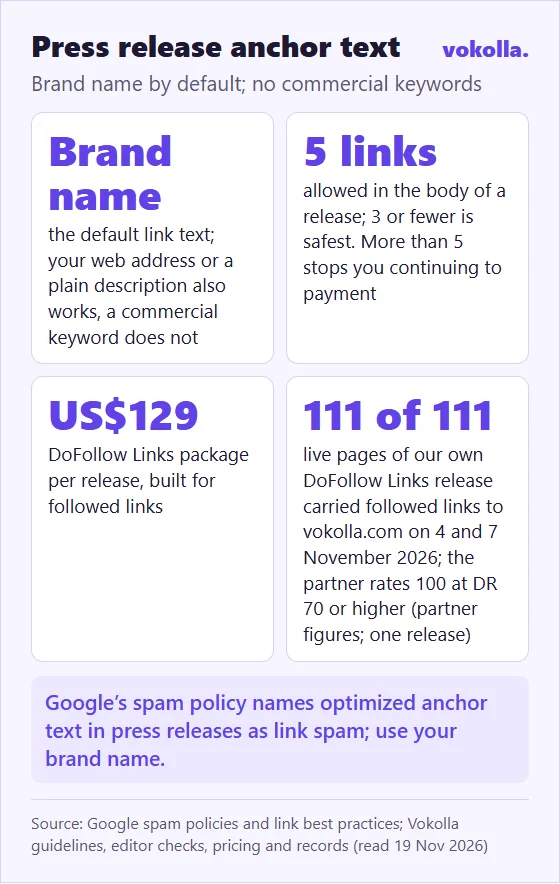
Use your brand name as link text, then choose by what the link points to
Use your brand name. It is what a reader of the release already knows you by, it is concise and says what the page is, and it works on every outlet, including the ones with stricter rules. After that, choose by what the link points to.
| The link points to | Link text to use | Why |
|---|---|---|
| Your website, in the body or the About paragraph | Your brand name, for example Vokolla | A name is short and descriptive. Google’s improved example links only the shop’s name and a short phrase. |
| A specific page: a launch page, a report, a product page | The brand name plus a short plain phrase, or a plain description of the page, for example “full report and methodology” | Descriptive and short. Premium Media’s USA Today asks for descriptive link text. |
| Your web address | As visible text beside a named link, or in the About paragraph | Vokolla’s guidelines accept the address as link text. USA Today expects descriptive link text and not a bare web address, so pair the address with a name. |
| A product category, service or place you would like to be found for | Do not use it as link text | A commercial keyword as link text is the pattern Google’s policy names. Use the words in the headline and body as ordinary words and link the brand. |
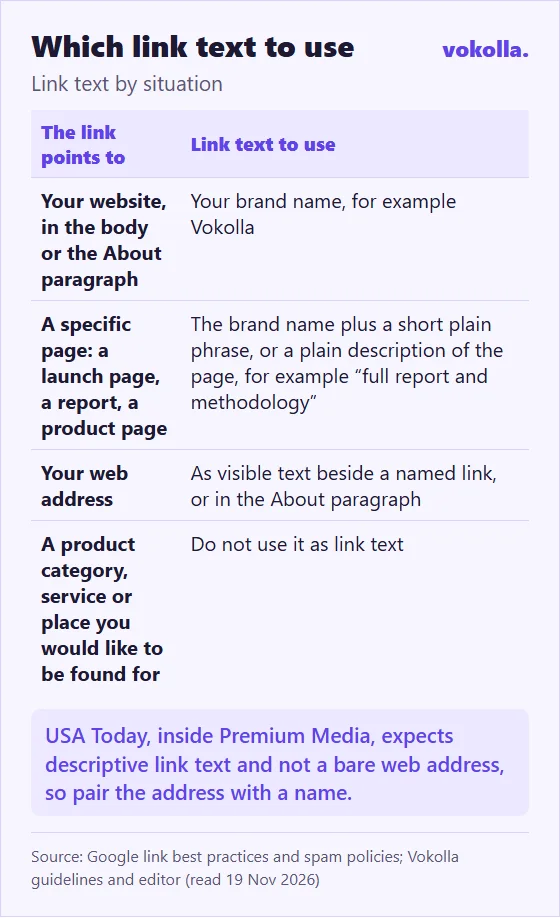
At Vokolla, the brand name is the default link text and the web address is a visible companion to it; the full link rules are in the editorial guidelines.
What Google says about anchor text
Two Google pages bear on press release anchor text. The spam policies (updated 28 August 2026) define link spam as links created mainly to manipulate rankings. Among its link-spam examples, the policy lists “links with optimized anchor text in articles, guest posts, or press releases distributed on other sites”. Each outlet sets its own link markup; Google’s rules for links in press releases covers the rest of the policy.
The link best practices page (updated 10 December 2025) says what good looks like, in Google’s words: “Good anchor text is descriptive, reasonably concise, and relevant to the page that it's on and to the page it links to.” It also lists what is weak.
| Anchor text | What Google says | Why |
|---|---|---|
| “Click here”, “read more”, “website”, “article” | Too generic | The words say nothing about the page they lead to. |
| A whole sentence as the link | Too long | Google’s better version links only the shop’s name and a short phrase. |
| Many keywords crammed into the link text | “If it feels like you're forcing keywords into the anchor text, then it's probably too much.” | Keyword stuffing is a spam-policy violation. |
| Several links chained next to each other | Avoid it | The words around a link give it context. |
| An image link with no alt text | Bad: empty link text and empty alt | For an image link Google uses the image’s alt text as the anchor text. |
What over-optimised anchors look like, and why they are not worth it
Google illustrates link spam with one paragraph in which many words are links: a generic phrase about wedding rings, a different ring keyword, “best ring”, “buy flowers” and “wedding dress”. Nothing in that text needs so many links. Each one is a commercial phrase pointing at a page someone wants to rank, which is what the policy describes. A release shows the same tell when several commercial phrases are links in running text instead of one name.
Some sellers advise the opposite. PressCable, a press release distributor, recommends in a July 2026 post one to three links with consistent anchor text that builds keyword associations over time, and says the anchor should “mirror the language a real person would use in a Google search”. iPR Software, a PR software vendor, gave similar advice in a 2011 post. These are vendor claims, and they describe keyword anchors, the pattern Google’s policy lists, so we do not follow them.
Google’s December 2022 link spam update says SpamBrain “can now detect both sites buying links, and sites used for the purpose of passing outgoing links”, and that “any credit passed by these unnatural links are lost”.
What your anchor becomes on the outlet’s page
Each outlet publishes the release on its own page and sets its own link markup; Google’s guidance on qualifying links puts the rel attribute in the publisher’s hands (see our media list for the outlets). The anchor you write is the text you submit, and the live page is where you confirm it.
Vokolla’s guidelines ask for your website in the About paragraph as a link; writing the address out next to the named link keeps it visible in any copy.
One outlet in our network has its own rule: USA Today, inside Premium Media, expects descriptive link text and not a raw web address, and the editor warns if any link text starts with http, https or www. “Full report and methodology” is the kind of text it asks for.
How the DoFollow Links package and the editor handle anchors
The DoFollow Links package (US$129 per release, on the pricing page) is built for followed links, and its guideline is one line: use your brand name, the URL or a plain description as link text, never a commercial keyword such as “cheap flights”. In Google’s terms a followed link is a regular link with no rel attribute (dofollow and nofollow). Which outlets carry them, and the numbers, are on the package page; Google’s policy is on Google’s rules for links in press releases. This page covers the anchor side.
Vokolla allows up to five links in the body and recommends three or fewer; each outlet may add its own rule.
| Check | Rule | What happens |
|---|---|---|
| Links in the body | Up to 5 allowed; 3 or fewer is safest | More than 5 is an error and stops you continuing to payment; more than 3 is a warning |
| No links | A release of 300 words or more with no link | Warning |
| Link address | A valid http or https address | Error if the address is not valid |
| Summary | No web address in the summary | Error |
| Link text | The guidelines ask for a brand name, a web address or a plain description, not a commercial keyword | The optional AI review is given each link’s text and address to read against the guidelines |
| Premium Media (USA Today) | Descriptive link text, not a raw web address | Warning if link text starts with http, https or www |
On our own DoFollow Links release, all 111 live pages carried followed links to vokolla.com on 4 and 7 November 2026, and the partner rates 100 of those pages at DR 70 or higher (partner figures; DR is a third-party estimate). The DoFollow Links package is sold for followed links on the sites it lists, and the report shows what was found.
How to check the anchors that point at your site
Search Console shows the link text other sites use for yours. Open the Links report, then External links, then Top linking text. Duplicates are combined when they match exactly, ignoring case; links with no text, such as image links, appear as “(empty)”; the table can be exported. Google’s stated use for the report is to confirm that the link text is what you expect and not spammy.
- Export Top linking text and look for your brand name and web address near the top. After a release goes live, expect new rows that match what you submitted.
- A commercial keyword you never wrote, or text you do not recognise, is the thing to look into. Top linking sites shows which site it comes from.
- To learn a link’s type, open the page, view the source, find your link and read its rel attribute (how to check).
What a named link gives your business
A release puts a dated page about your news on an independent site, and the link in it takes a reader to your own page. A name reads naturally there and tells the reader where they are going. Google’s own page says “No one can guarantee a #1 ranking on Google”.
What a release can add is something to read when someone searches your name (what people see when they search your brand). In our check on 7 November 2026, our two USA Today release pages were both in Google’s index (a site: search). The pillar guide on how releases help search and AI is press releases and SEO.
How we checked this guide
Vokolla’s editorial team read Google’s spam policies, link best practices and the Search Console Links report help on 19 November 2026, with the Chinese editions of the same pages where they exist, and checked the link limits in Vokolla’s editor and guidelines the same day. The DoFollow Links figures come from our own release, checked on 4 and 7 November 2026.
Publish with Vokolla
Vokolla shows one public price per release, from US$69, with no quote, sales call or subscription. You write the release or draft it with the Vokolla AI assistant, choose the package, pay online and get a report with every live link, and an editor reviews each release before it goes out. You can try it first with one free release every 30 days; every package is on the pricing page.
Questions people ask
What anchor text should a press release use?
Your brand name by default. Your web address or a plain description of the page also works; a commercial keyword does not. Google’s spam policy names optimized anchor text in press releases as link spam.
Can I use my web address as the link text?
Vokolla’s guidelines accept it. USA Today, inside Premium Media, expects descriptive text and not a raw address, so pair the address with a name.
Does Google ban keyword anchors in press releases?
Google’s spam policy names keyword-optimized anchor text in distributed press releases as link spam: among its link-spam examples it lists “links with optimized anchor text in articles, guest posts, or press releases distributed on other sites”. It is a policy about manipulating rankings, and it names the pattern, not a particular outlet.
How many links should a release have?
Vokolla allows up to five in the body and says three or fewer is safest; each outlet may add its own rule.
How do I see the anchor text pointing at my site?
In Search Console, open Links, then External links, then Top linking text. To learn a link’s type, open the page and read its rel attribute.
Vokolla pages for this step
- Packages →Six packages from US$69 to US$659 per release, each with a report of the live links.
- Pricing →Every package’s public price, reach and what it includes, side by side.
- Free press release →One free release every 30 days on news sites, after editor review.
- AI assistant →Connect your AI assistant to Vokolla to draft, check and save a release.
Sources
Written and checked by the Vokolla editorial team. Vokolla provides the packages described here; prices and outlets are as published on vokolla.com on the date above, and the results quoted come from our own releases. Search rankings depend on many factors, so no distribution service can guarantee them.
- Google Search Central: Spam policies for Google web search (updated 2026-08-28) — checked 2026-11-19
- Google Search Central: Link best practices (updated 10 Dec 2025): good anchor text is descriptive, reasonably concise and relevant; examples of weak anchors — checked 2026-11-19
- Google Search Central: Qualify your outbound links (updated 2025-12-10) — checked 2026-11-19
- Search Console Help: Links report (Top linked pages, Top linking sites, Top linking text; the page shows no date) — checked 2026-11-19
- Google Search Central: Do you need an SEO? (updated 5 Jun 2026): no one can guarantee a #1 ranking; avoid link popularity schemes — checked 2026-11-19
- PressCable (a press release distributor): How to Use Links in a Press Release (2 Jul 2026); vendor claims — checked 2026-11-19
- iPR Software (PR software vendor): best practices for including links, images and video in press releases (11 Mar 2011); vendor claims — checked 2026-11-19
- Google Search Central Blog (14 Dec 2022): December 2022 link spam update (SpamBrain; all languages; about two weeks to roll out) — checked 2026-11-19
- Vokolla: Editorial guidelines for press releases — checked 2026-11-19
- Vokolla: the editor’s link checks and the AI review in the account (limits as built into the product, read 19 Nov 2026) (internal records; the method is described on this page) — checked 2026-11-19
- Vokolla: Press release distribution pricing (packages, prices and reach) — checked 2026-11-19
- Vokolla: Media list by package (Domain Rating and monthly visits are third-party estimates, October 2026) — checked 2026-11-19
- Vokolla publishing records: our own releases on USA Today and partner networks (October 2026), Google, Bing and AI-answer checks on 4 and 7 Nov 2026 (internal records; the method is described on this page) — checked 2026-11-19