Guide · SEO
Backlinks for an independent online store: what they are, what Google says and what is safe to do
In short
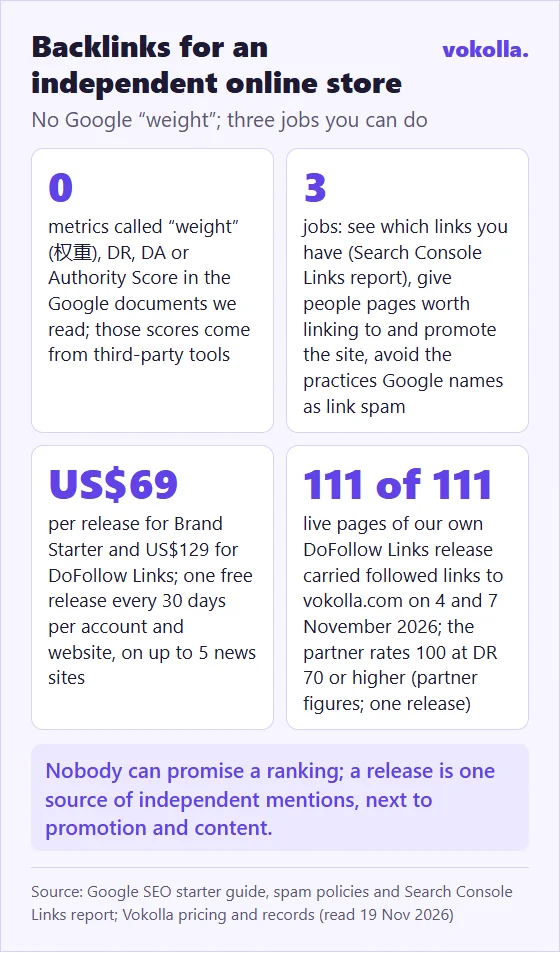
For an independent store (your own website, as opposed to a marketplace such as Amazon; 独立站 in Chinese), a backlink is a link from another website to yours. Google finds pages through links and uses links to learn what pages are about, but it says PageRank is one signal among many, and it has no metric called “weight” (权重 in Chinese); scores such as DR come from third-party tools. The safe route is to be mentioned and linked by real sites for real reasons, and to avoid the practices Google names as link spam. Press release distribution adds independent mentions that work alongside content, promotion and partners.
What a backlink is, and how it differs from an internal link
A backlink, called an external link in Chinese (外链), is a link on someone else’s website that points to your store. A trade magazine that writes about your product and links your brand name to your home page has given you one. An internal link is the opposite: a link from one page of your own site to another, such as home page to product page. This page is about the first kind.
Google’s SEO starter guide says there is much more to Google Search than links: “We have many ranking signals, and PageRank is just one of those.” Its ranking systems guide says PageRank continues to be part of the core ranking systems and that link analysis systems help determine what pages are about and which are helpful. Links matter, and they are not everything. Google’s advice on link text applies to both kinds: descriptive, concise and relevant to the page it points to.
There is no Google metric called “weight”
Sellers and agencies often talk about raising a site’s weight (权重, or “domain authority”). In the Google documents we read, there is no metric with that name and none called DR, DA or Authority Score. When Google writes about content quality it uses the term E-E-A-T, and says that E-E-A-T itself is not a specific ranking factor.
The scores in SEO tools come from the tool companies. Ahrefs describes its Domain Rating as the strength of a site’s backlink profile on a 100-point scale, relative to other sites, and says not to judge a site on it alone; Semrush’s Authority Score is its own compound score, best used for comparing domains. In Google’s words, “Third-party tools don't have access to our internal ranking data.” Use scores as a comparison, never as the target; Domain Rating and other authority scores shows how to read them.
So “how do I raise my weight” turns into three jobs you can do: see which links you have now (the Search Console Links report), give people pages worth linking to and promote the site, and avoid the link practices Google names. Nobody can promise a ranking. Google’s own page says “No one can guarantee a #1 ranking on Google”, and warns against SEOs who talk about “link popularity schemes”.
Which link-building practices are safe, which need qualifying and which to avoid
Google’s SEO starter guide says “Other sites linking to you is something that happens naturally over time”, and that you can encourage it by promoting your site. The methods it lists are social media, community engagement, online and offline advertising and word of mouth: “One of the most effective and lasting ways is word of mouth”; it also warns that over-promotion can look like manipulation.
Guest articles are a common tactic. Google’s 2017 post says they are not discouraged when they inform users; what it targets is building links in a large-scale way, with keyword-rich links and the same content across many sites. It advises focusing on your site’s content, with links following.
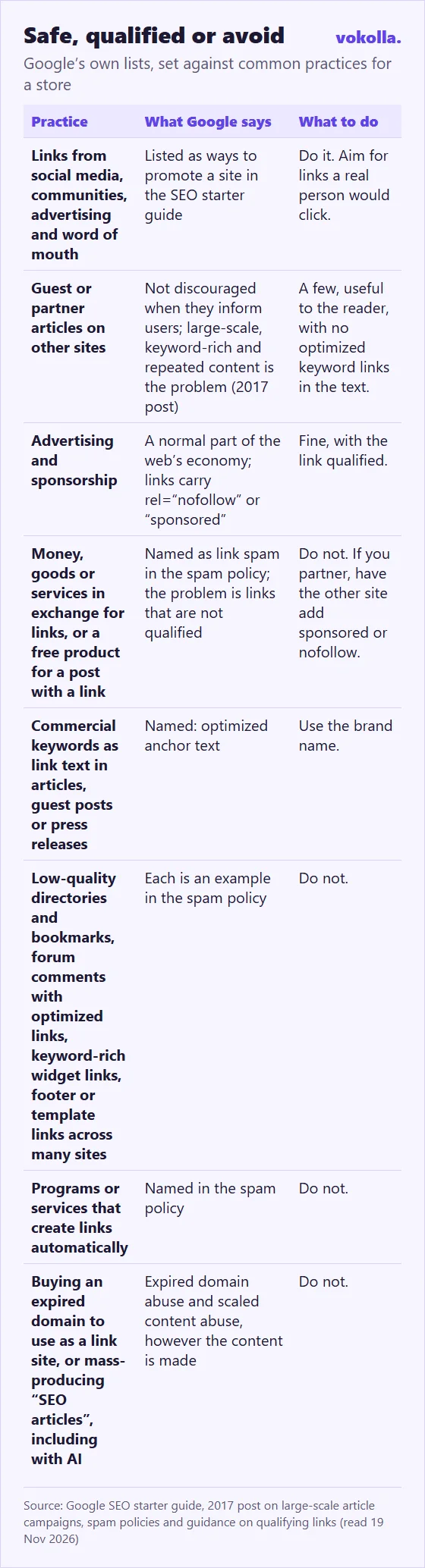
| Practice | What Google says | What to do |
|---|---|---|
| Links that come from social media, communities, advertising and word of mouth | Listed as ways to promote a site in the SEO starter guide | Do it. Aim for links a real person would click. |
| Guest or partner articles on other sites | Not discouraged when they inform users; large-scale, keyword-rich and repeated content is the problem (2017 post) | A few, useful to the reader, with no optimized keyword links in the text. |
| Advertising and sponsorship | A normal part of the web’s economy; Google’s rule is that links carry rel=“nofollow” or “sponsored” | Fine, with the link qualified. |
| Money, goods or services in exchange for links, or a free product for a post with a link | Named as link spam in the spam policy; the problem is links that are not qualified | Do not. If you partner, have the other site add sponsored or nofollow. |
| Commercial keywords as link text in articles, guest posts or press releases | Named: optimized anchor text | Use the brand name ([anchor text in press releases](/guides/seo/anchor-text)). |
| Low-quality directories and bookmarks, forum comments with optimized links, keyword-rich widget links, footer or template links spread across many sites | Each is an example in the spam policy | Do not. |
| Programs or services that create links automatically | Named in the spam policy | Do not. |
| Buying an expired domain to use as a link site, or mass-producing “SEO articles”, including with AI | Expired domain abuse and scaled content abuse: aimed at ranking manipulation with low-value content, however the content is made | Do not. |
What happens when link-building goes wrong
Google’s December 2022 link spam update says SpamBrain “can now detect both sites buying links, and sites used for the purpose of passing outgoing links”, and that “any credit passed by these unnatural links are lost”. The update applied to all languages and took about two weeks to roll out.
A manual action is the heavier outcome. Google’s Manual Actions documentation says buying links or taking part in link schemes can lead to a manual action on some or all of a site. Its recovery steps are to download your links from Search Console, remove them or ask the other site to qualify them (nofollow or a more specific attribute), disavow what cannot be removed and request a review with documentation. A blanket disavow, Google says, is not a good-faith effort.
Disavow is an advanced tool, and Google says most sites will not need it: it is for sites with many spammy or artificial links that have caused or are likely to cause a manual action. Google also says it works hard so that actions on third-party sites do not negatively affect a site.
How to see which links you have now
The free route is Search Console. Open the Links report and go to External links, where three tables matter: Top linked pages, Top linking sites and Top linking text.
- Top linking sites: confirm that you recognise them. For a spammy one Google suggests asking the site to remove the link first and, if all else fails, disavowing.
- Top linking text: the link text other sites use for you. Google’s use for it is to confirm the text is what you expect and not spammy, and that other sites describe your site accurately. Links with no text, such as image links, show as “(empty)”.
- Check whether the sites that matter to you link to you: Google’s example is a restaurant that wants to be named on food blogs and review sites.
- To learn a link’s type, open that page, view the source and read the rel attribute (dofollow and nofollow).
Where news distribution fits
A release on news and finance sites adds independent pages that name your brand, and a page can carry a link. The outlet decides the link attribute, so a release works best alongside promotion, content and partners.
Our own DoFollow Links release carried followed links on all 111 live pages we checked on 4 and 7 November 2026 (one release; the package explained).
Prices are public on the pricing page: from US$69 per release (Brand Starter) and US$129 for the DoFollow Links package, which is built for followed links. Each account and website can publish one free release every 30 days, on up to 5 news sites, with editor review. Releases are written and published in English. Read what a release can do for links in backlinks from news sites; the outlets in each package are on the media list.
A sensible order for a new store
The order below is Vokolla’s judgement, built on the Google pages above; the pillar guide is press releases and SEO.
- First make sure Google can find and index your home page and key pages (getting a new website indexed).
- Read the Links report once and note which links and link texts you already have.
- Make a few pages worth linking to: data, buying guides, size or specification tables, real customer stories with permission.
- Use the promotion channels Google lists: social media, communities, advertising and customers’ word of mouth.
- Add a press release when you have news: a launch, a new market, a partnership. If you sell on Amazon and are building your own brand, see Amazon sellers building a brand and an independent site (Chinese).
- Come back to the Links report after each release.
How we checked this guide
Vokolla’s editorial team read Google’s SEO starter guide, ranking systems guide, spam policies, link best practices, the Manual Actions and disavow help pages and the Search Console Links report help on 19 November 2026, using the Chinese editions’ own terms and dates where they exist, together with Ahrefs’ and Semrush’s own definitions of their scores. Our own numbers come from releases checked on 4 and 7 November 2026.
Publish with Vokolla
Vokolla shows one public price per release, from US$69, with no quote, sales call or subscription. You write the release or draft it with the Vokolla AI assistant, choose the package, pay online and get a report with every live link, and an editor reviews each release before it goes out. You can try it first with one free release every 30 days; every package is on the pricing page.
Questions people ask
What is a backlink for an independent online store?
A backlink to an independent store is links on other websites that point to your own website. An internal link is a link between pages of your own site.
How do I raise my site’s “weight”?
Google has no metric called weight. Third-party scores such as DR are the tool vendors’ own estimates. Work on what you can do: see your links in Search Console, publish pages worth linking to, promote the site and avoid the practices Google names as link spam.
What does Google say about paid links?
Google says buying and selling links is a normal part of advertising and sponsorship, and that links carrying nofollow or sponsored are not a violation. Its spam policy lists exchanging money for links among the link-spam examples where the links are not qualified.
Do press releases give an independent store backlinks?
Yes, a release can put a page that names your brand, with a link, on news sites; the outlet decides the link attribute. It works alongside content, promotion and partners.
How do I check my backlinks for free?
In Search Console, open the Links report and look at External links: Top linking sites and Top linking text. To learn a link’s type, open the page and read its rel attribute.
Vokolla pages for this step
- Packages →Six packages from US$69 to US$659 per release, each with a report of the live links.
- Pricing →Every package’s public price, reach and what it includes, side by side.
- Free press release →One free release every 30 days on news sites, after editor review.
- AI assistant →Connect your AI assistant to Vokolla to draft, check and save a release.
Sources
Written and checked by the Vokolla editorial team. Vokolla provides the packages described here; prices and outlets are as published on vokolla.com on the date above, and the results quoted come from our own releases. Search rankings depend on many factors, so no distribution service can guarantee them.
- Google Search Central: Spam policies for Google web search (updated 2026-08-28) — checked 2026-11-19
- Google Search Central: SEO Starter Guide (updated 2025-12-10) — checked 2026-11-19
- Google Search Central: A guide to Google Search ranking systems (updated 10 Dec 2025): PageRank continues to be part of the core ranking systems — checked 2026-11-19
- Google Search Central: Guidance on third-party SEO tools and advice (updated 5 Jun 2026): such tools do not have access to Google’s internal ranking data — checked 2026-11-19
- Google Search Central: Creating helpful, reliable, people-first content (updated 5 Oct 2026): E-E-A-T is not itself a specific ranking factor — checked 2026-11-19
- Google Search Central: Link best practices (updated 10 Dec 2025): good anchor text is descriptive, reasonably concise and relevant; examples of weak anchors — checked 2026-11-19
- Google Search Central: Do you need an SEO? (updated 5 Jun 2026): no one can guarantee a #1 ranking; avoid link popularity schemes — checked 2026-11-19
- Google Search Central Blog (25 May 2017): a reminder about links in large-scale article campaigns — checked 2026-11-19
- Google Search Central: Qualify your outbound links (updated 2025-12-10) — checked 2026-11-19
- Search Console Help: Links report (Top linked pages, Top linking sites, Top linking text; the page shows no date) — checked 2026-11-19
- Search Console Help: Manual Actions report, “Unnatural links to your site” (no date shown) — checked 2026-11-19
- Search Console Help: Disavow links to your site (no date shown): an advanced tool; most sites will not need it — checked 2026-11-19
- Google Search Central Blog (14 Dec 2022): December 2022 link spam update (SpamBrain; all languages; about two weeks to roll out) — checked 2026-11-19
- Ahrefs Help Center: What is Domain Rating (DR)? (3 Sep 2026): the strength of a site’s backlink profile on a 100-point scale; relative; do not judge a site on it alone (a vendor metric) — checked 2026-11-19
- Semrush Knowledge Base: What is Authority Score? (Semrush’s own compound score, best used for domain comparison; a vendor metric) — checked 2026-11-19
- Vokolla: Press release distribution pricing (packages, prices and reach) — checked 2026-11-19
- Vokolla publishing records: our own releases on USA Today and partner networks (October 2026), Google, Bing and AI-answer checks on 4 and 7 Nov 2026 (internal records; the method is described on this page) — checked 2026-11-19
- Vokolla: Free press release (one release every 30 days) — checked 2026-11-19