Guide · Use cases
Press release for a certification or an award: what to say, what not to say and when to publish
In short
A certification or award press release is a dated public statement that a named body has certified your product or system, or that an organiser has given you an award, with the standard, the scope and the date. Its value to a buyer is that it can be checked: who certified, to what, covering what, and where to look it up. Publish it once the certificate or result can be verified, in wording that matches what the issuer actually says.
Why a release helps when you win a certificate or an award
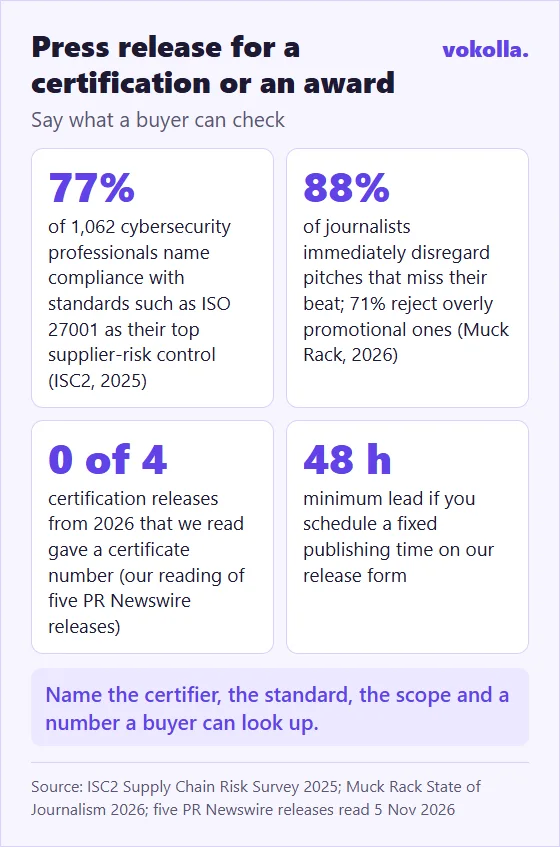
Buyers check certificates. In ISC2’s 2025 survey of 1,062 cybersecurity professionals, 77% named compliance with standards such as ISO 27001, NIST or SOC 2 as their top control requirement for supply-chain and vendor risk. That is a security-industry sample, not every buyer, but the habit is the same wherever a purchase carries risk: ask what standard, from whom, and for what scope.
A certificate on your site is your own statement. A release is a dated page on a news site that names the standard, the certifying body and the scope, and that a buyer, a journalist or an AI assistant can find when they search your company name. Journalists are not impressed by a bare “we won”: in Muck Rack’s 2026 survey, 88% immediately disregard pitches that do not match their coverage area and 71% reject overly promotional ones, and in Cision’s survey 53% delete pitches as too promotional or sales-focused (both companies sell PR software). Specifics are what pass: the standard, the scope, the date, what it lets you sell and where.
What to write, and what to avoid
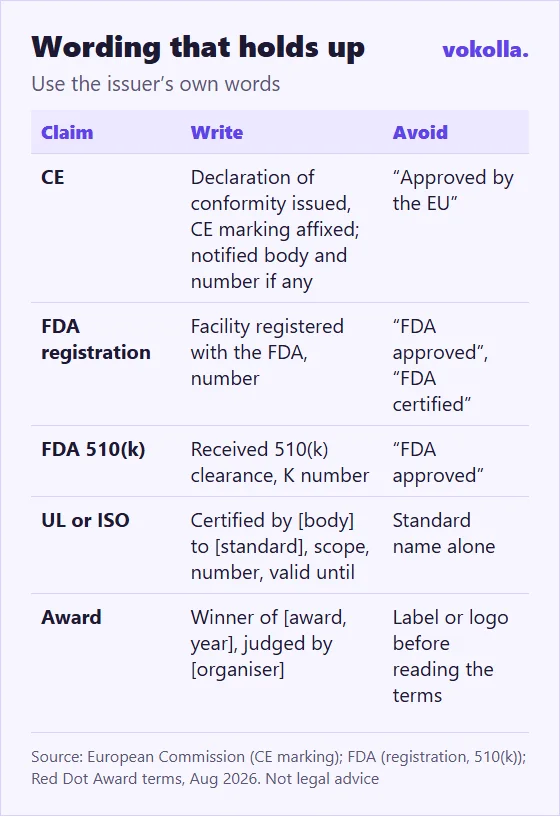
Use the issuer’s own words. The European Commission says that for CE marking the manufacturer issues the EU declaration of conformity and affixes the mark, and that CE does not indicate approval as safe by the EU or any other authority. The FDA says it does not issue registration certificates to medical device facilities and that registration does not denote approval, clearance or authorization of the facility or its devices; a 510(k) clearance means the device was found substantially equivalent to a predicate, which is not the same as “approved”. IAF CertSearch holds only accredited certifications, so a certificate missing from it is not proof of a fake, but one that appears in it is easy for a buyer to confirm.
We read five 2026 releases on PR Newswire, four certifications and one award: Lectron (UL 2252, 18 February), Cyngn (ISO 27001, 30 September), Envision Energy (UL Solutions certifications for Europe and Australia, 29 September), HPQ Silicon (UL 1642, 8 January) and Bradley (Red Dot Product Design Award, 6 May). Four of the five put the standard or the award in the headline (Envision’s names the certifier), all stated the scope, and all included a company quote. None of the four certification releases gave a certificate number, and Lectron, HPQ Silicon and Cyngn did not name the certifying body in the text we read. Envision, a wind-turbine maker, named UL Solutions and included a quote from the head of UL Solutions’ DEWIOCC unit. That is our reading of five releases, not a statistic, but it shows where a release can be more verifiable than most: name the certifier, the standard, the scope and a number a buyer can look up. A standard number is not a certifier: “UL 2252” names the standard, so say which laboratory or certification body issued the certificate.
| Claim | Write | Avoid |
|---|---|---|
| CE marking | The manufacturer has issued an EU declaration of conformity and affixed the CE marking; name the notified body and certificate number if one was involved. | “Approved by the EU”, “EU certified” |
| FDA facility registration | The facility is registered with the FDA (registration number). | “FDA approved”, “FDA certified”: the FDA says registration is not approval |
| FDA 510(k) | The device has received 510(k) clearance (K number). | “FDA approved” for a cleared device |
| UL or ISO certification | Certified by [body] to [standard], scope [products or systems], certificate number, valid until [date]. | A standard name with no body, scope or number |
| An award | Winner of [award, category, year], judged by [organiser], with the number of entries if the organiser published it. | Using a logo or label before reading the organiser’s terms |
Awards come with rules. Red Dot’s August 2026 terms (for the 2027 competition) let winners communicate the award but not publish the organiser’s result notification, and they charge EUR 200,000 plus Swiss VAT for using the winner label without a licence. Read the terms of any award you enter before you use its name, label or logo in a release.
When to publish
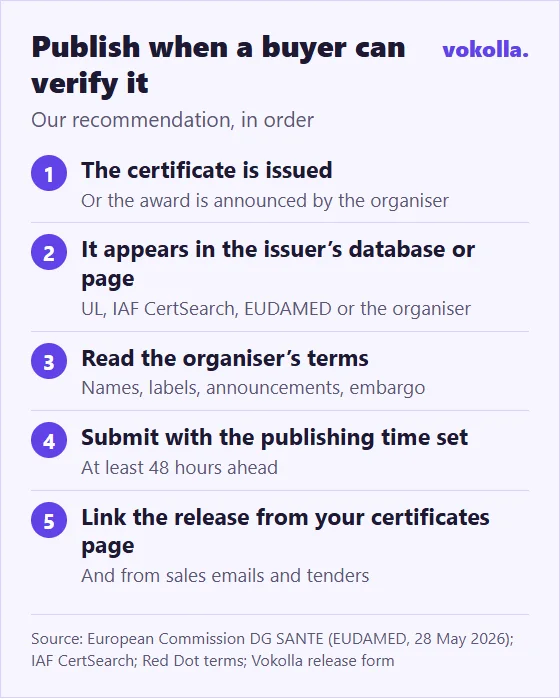
We found no neutral study of the best moment to announce a certificate or an award; the advice that exists comes from distribution services. Our recommendation follows from what a buyer will do after reading it: publish when they can verify it. That means the certificate has been issued, it appears in the issuer’s database where one exists (for example the certifying body’s own certificate page, IAF CertSearch for accredited management-system certificates, or EUDAMED for medical devices, whose Notified Bodies & Certificates module became mandatory on 28 May 2026), and any embargo or terms from an award organiser have been met. Do not wait for a database that does not yet list an older certificate; link to the issuer’s own certificate page instead.
If you need a fixed date, our release form lets you schedule the release at least 48 hours after you submit; editors review first and then schedule it. Otherwise the release goes out after editor review, so you can submit once the issuer’s page is live and schedule it for the organiser’s date.
Which package to choose, and why
A certificate matters most to the buyer who is already checking you. Brand Starter at US$69 puts the release on 300+ outlets, including openPR and 25 city news sites, so a search for your company name can show a dated, sourced statement beside your own site. Premium Media at US$379 adds AP News, USA Today, Barchart and StreetInsider for a certificate that lets you sell in a market such as the US. Global Reach at US$129 adds newspaper and TV-station finance pages. For a certificate that opens several markets at once, Global Impact at US$659 reaches 20+ high-traffic outlets.
Every price is on the pricing page; the media list names the outlets in each package; and our comparison reads other services’ published prices and dates.
How to use the release afterwards
A certificate is used in sales and tenders, so the release belongs next to it.
- A Certifications or Quality page on your website with the certificate number, the certifying body’s lookup link and the release link.
- The sales email, the tender or RFQ response and the supplier questionnaire: one line with what you hold, from whom, and the release link.
- LinkedIn, from the company page and from the person quoted; ask the certifier or the award organiser whether they will share it too.
- schema.org defines `hasCertification` and `award` properties; Google’s Organization documentation does not list them, so add them if they are useful to you and do not expect a ranking effect.
- Link text: your brand name or web address. Google’s spam policies list keyword-optimized anchor text in press releases distributed on other sites as link spam.
The checklist
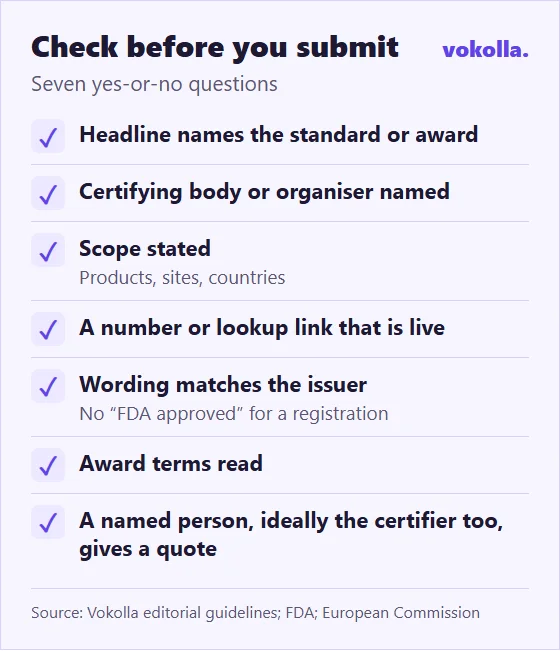
Before you submit, check these seven points. How to write a press release covers the structure.
- Does the headline name the standard or the award, and the first sentence the product or system and the date?
- Is the certifying body or organiser named?
- Is the scope stated: which products, sites or systems, and which countries it lets you sell in?
- Is there a number or lookup link a buyer can check, and is it live?
- Does the wording match what the issuer says (not “FDA approved” for a registration)?
- Have you read the award’s terms for names, labels and announcements?
- Does a named person, ideally the certifier too, give a quote that says something?
What our own releases show
A certificate release is checked the same way as any release, so here is what our own releases did in October 2026. Our release was live on USA Today 39 minutes after submission on 23 October, and by 4 November both of our USA Today release pages were in Google’s index. Searching Bing for “Vokolla” that day showed them second and fourth, and 98% of the pages we could check from nine paid English releases were still online 9 to 27 days after publication. Each of these is one search or one check, so read them as what happened to us. See how long distribution takes.
Publish with Vokolla
Vokolla shows one public price per release, from US$69, with no quote, sales call or subscription. You write the release or draft it with the Vokolla AI assistant, choose the package, pay online and get a report with every live link, and an editor reviews each release before it goes out. You can try it first with one free release every 30 days; every package is on the pricing page.
Questions people ask
Can I say “FDA approved” if my facility is registered?
No. The FDA says registration does not denote approval, clearance or authorization. Write that the facility is registered with the FDA, with the registration number; for a cleared device, write that it has 510(k) clearance.
Does CE marking mean the EU approved my product?
No. The European Commission says the manufacturer issues the declaration of conformity and affixes the mark, and that CE does not indicate approval by the EU or another authority. Name the notified body and certificate number if one was involved.
Should I wait before announcing an award?
Follow the organiser’s terms first. Some, such as Red Dot, restrict the result notification and the use of the label. After that, publish when the result can be checked on the organiser’s own page.
What makes a certification release convincing?
The certifying body, the standard, the scope, the date and a number or link a buyer can look up, in the issuer’s own wording.
Do I need a quote from the certifier?
It helps. Envision Energy’s UL Solutions release carried a quote from the head of a UL Solutions unit, which gives readers a second voice; ask the certifier whether they will provide one.
Vokolla pages for this step
- Packages →Six packages from US$69 to US$659 per release, each with a report of the live links.
- Pricing →Every package’s public price, reach and what it includes, side by side.
- Free press release →One free release every 30 days on news sites, after editor review.
- AI assistant →Connect your AI assistant to Vokolla to draft, check and save a release.
Sources
Written and checked by the Vokolla editorial team. Vokolla provides the packages described here; prices and outlets are as published on vokolla.com on the date above, and the results quoted come from our own releases. Search rankings depend on many factors, so no distribution service can guarantee them.
- European Commission: CE marking (the manufacturer issues the EU declaration of conformity and affixes the mark; it is not an approval by the EU) — checked 2026-11-05
- European Commission, DG SANTE: EUDAMED, four first modules mandatory from 28 May 2026 (medical devices; includes Notified Bodies & Certificates) — checked 2026-11-05
- IAF CertSearch FAQ: the database contains only accredited certifications — checked 2026-11-05
- FDA: Are there FDA registered or FDA certified medical devices? (the FDA does not issue registration certificates; registration does not denote approval) — checked 2026-11-05
- FDA: Is it really “FDA approved”? (consumer update, content current as of 4 May 2026) — checked 2026-11-05
- Red Dot Award: Product Design, terms and conditions (version of August 2026) — checked 2026-11-05
- ISC2: 2025 Supply Chain Risk Survey (1,062 cybersecurity professionals, 12–28 Aug 2025; published 19 Nov 2025) — checked 2026-11-05
- PR Newswire: Lectron adapters achieve UL 2252 certification (18 Feb 2026) — checked 2026-11-05
- PR Newswire: HPQ Silicon secures UL 1642 certification for its lithium-ion cells (8 Jan 2026) — checked 2026-11-05
- PR Newswire: Cyngn achieves ISO 27001 certification (30 Sep 2026) — checked 2026-11-05
- PR Newswire: Envision Energy, UL Solutions certifications in Europe and Australia (29 Sep 2026) — checked 2026-11-05
- PR Newswire: Bradley’s Elvari collection wins the Red Dot Product Design Award 2026 (6 May 2026) — checked 2026-11-05
- Muck Rack: State of Journalism 2026 (897 journalists analysed, surveyed 30 Jan – 2 Mar 2026; Muck Rack sells PR software) — checked 2026-11-05
- Cision: 2026 State of the Media (1,899 journalists, January–February 2026; Cision owns PR Newswire) — checked 2026-11-05
- Google Search Central: Spam policies for Google web search (updated 2026-08-28) — checked 2026-11-04
- Vokolla publishing records: our own releases on USA Today and partner networks (October 2026), Google, Bing and AI-answer checks on 4 Nov 2026 (internal records; the method is described on this page) — checked 2026-11-04
- USA Today: “Vokolla Launches an AI Press Release Agent…” (press release section, 23 Oct 2026) — checked 2026-11-04
- Business Insider Markets: Mubboo Flights release (19 Oct 2026) — checked 2026-11-04
- Vokolla: Press release distribution pricing (packages, prices and reach) — checked 2026-11-04
- Vokolla: Media list by package (Domain Rating and monthly visits are third-party estimates, October 2026) — checked 2026-11-04
- Vokolla: Editorial guidelines for press releases — checked 2026-11-04