Guide · Use cases
Press release for a funding announcement: what to say, what to leave out and when to publish
In short
A funding press release is a dated public statement that a company has raised money: how much, from whom, in what round, and what it will do with it. It tells customers, candidates and partners that the company is backed, and it gives journalists a fact they can check. Publish it once the round has closed, in facts and not forecasts, and have the lead investor approve the wording and the quote.
Who reads a funding release, and why it helps
A round changes what people ask about you. Customers want to know whether you will be around next year, candidates look at who backs you, partners check who you are, and other investors notice who led. A release gives all of them one dated page that states the amount, the lead investor and what the money is for, on a news site, with the founder’s and the investor’s names on it.
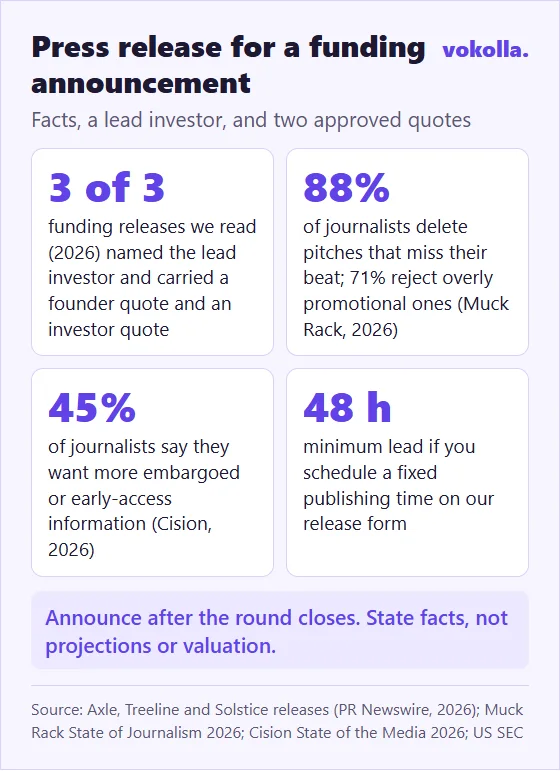
Journalists use releases for story ideas: in Cision’s 2026 survey of 1,899 journalists, 66% rely on PR-provided content (releases, pitches and media kits). Both Cision and Muck Rack sell PR software, and neither survey asks about funding news, so we use their numbers for what journalists say about pitches in general. In Muck Rack’s 2026 survey, 88% delete pitches that miss their beat and 71% reject ones that feel overly promotional or advertorial; asked what they want from PR, 47% of Cision’s journalists said data or research and 45% said embargoed or early-access information. For a funding story, our reading is: the facts of the round, a number you can document about the business, and an early look for the one reporter you want.
What to write: what three real releases include
We read three 2026 funding releases on PR Newswire: Axle (11 August, US$17.5M Series A), Treeline (31 March, US$25 million) and Solstice (28 May, Series A). All three put the amount, the round and the lead investor in the first sentence. All three said what the money is for (hiring, product, a market), included a quote from the founder or chief executive and one from a partner at the lead investor, carried a customer quote, and ended with a company description and a media contact. We found no forward-looking-statements disclaimer in any of the three. That is our reading of three venture-backed US companies, not a statistic.
The examples below use a fictional company, Brightleaf Labs. They show the shape, and the figures are invented.
| Part | Example |
|---|---|
| Headline | Brightleaf Labs Raises US$6M Seed Round Led by Northgate Ventures to Bring Its Inventory Software to Retailers in Europe |
| First sentence | Brightleaf Labs, which makes inventory software for independent retailers, today announced it has raised US$6 million in seed funding led by Northgate Ventures. |
| Founder quote | “Retailers told us they spend two days a week counting stock, so the money goes to the team that removes that work,” said Ana Ruiz, co-founder and chief executive of Brightleaf Labs. |
| Investor quote | “Brightleaf’s customers reorder because the numbers match their shelves,” said Sam Patel, partner at Northgate Ventures. |
| Use of proceeds | Hiring in engineering and customer success, and opening support in three European countries. |
What to leave out while a private round is open
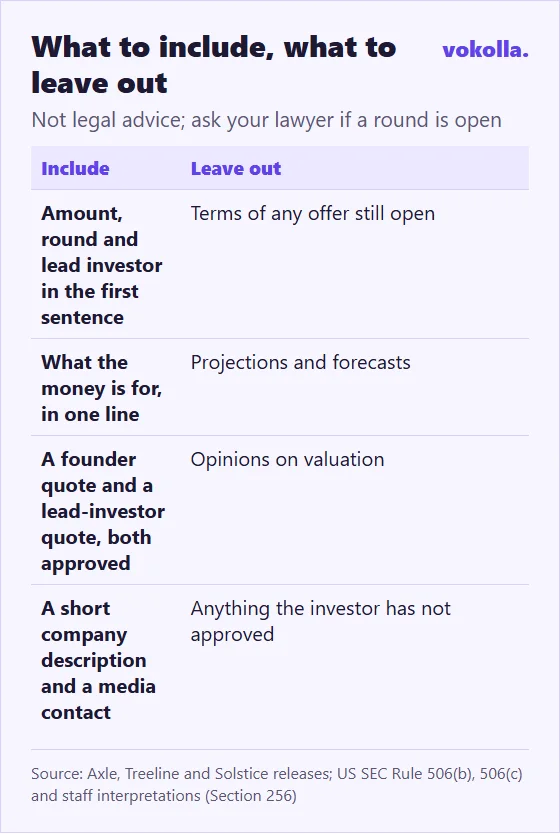
This is not legal advice; ask your lawyer before you publish if any part of the round is still open. In the US, the SEC says a Rule 506(b) private placement allows no general solicitation or advertising, and that Rule 506(c) allows general solicitation only if all purchasers are accredited investors and the company takes reasonable steps to verify it. The SEC staff’s interpretations say that information that does not involve an offer of securities may be disseminated widely, and describe “factual business information” as typically about the issuer, its business and its products or services, generally excluding predictions, projections, forecasts and opinions on valuation. Even factual news can be general solicitation if it is used to build interest in an offering that is still open, so keep the release to a closed round and have counsel review it.
In practice: announce the round after it has closed, state facts about the company and the money raised, and leave out the terms of any offer still open, projections and valuation opinions. Rule 135c, which allows a limited notice of an unregistered offering, applies to Exchange Act reporting issuers and certain exempt foreign issuers, so it is not available to most private startups. In the UK, the Financial Conduct Authority’s financial promotion restriction (section 21 of the Financial Services and Markets Act 2000) can apply to communications that invite investment.
When to publish
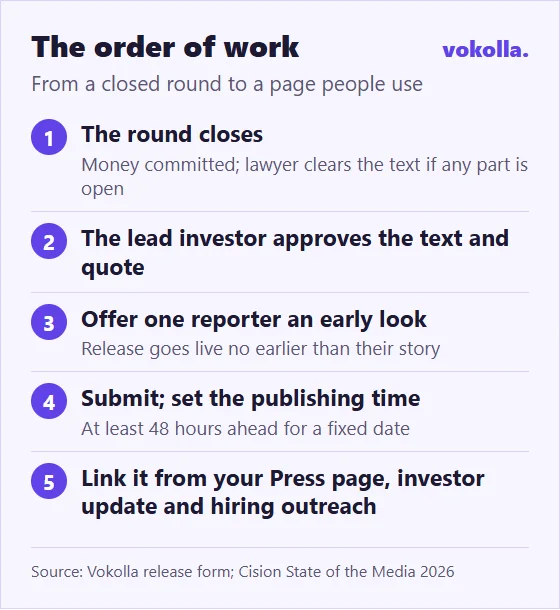
Our rule: publish when the round has closed and the money is committed, after the lead investor has approved the text and their quote. If you offer one reporter an exclusive or an embargoed early look, which 45% of Cision’s journalists say they want more of, set the release to go live no earlier than their story.
If you need a fixed date, our release form lets you schedule the release at least 48 hours after you submit; editors review first and then schedule it, so to lift an embargo at a set time, submit at least 48 hours before it. Without a set time it goes out after editor review. If you brief journalists, 78% in Muck Rack’s survey want pitches before noon, and 69% prefer under 200 words.
Which package to choose, and why
Choose by who needs to see it. For a seed round where customers and candidates are the audience, Brand Starter at US$69 distributes the release to 300+ outlets, including openPR and 25 city news sites. Global Reach at US$129 adds newspaper and TV-station finance pages. When investors and journalists will search for the round, Premium Media at US$379 adds AP News, USA Today, Barchart and StreetInsider, and for a round with an international story, Global Impact at US$659 reaches 20+ high-traffic outlets.
Every price is on the pricing page, the media list names the outlets in each package, and our comparison reads other services’ own published prices and dates.
How to use the release afterwards
The release is a page you can send people to.
- A Press or News page on your website with the release link and the date, and a line in your careers page about who backs you.
- The investor update and the email to customers and partners: one paragraph and the link.
- LinkedIn, from the company page, the founder and the investor who is quoted.
- Sales and hiring outreach for the next weeks: one line with the round and the link.
- Link text: your brand name or web address, not a keyword phrase; Google’s spam policies list keyword-optimized anchor text in press releases distributed on other sites as link spam.
The checklist
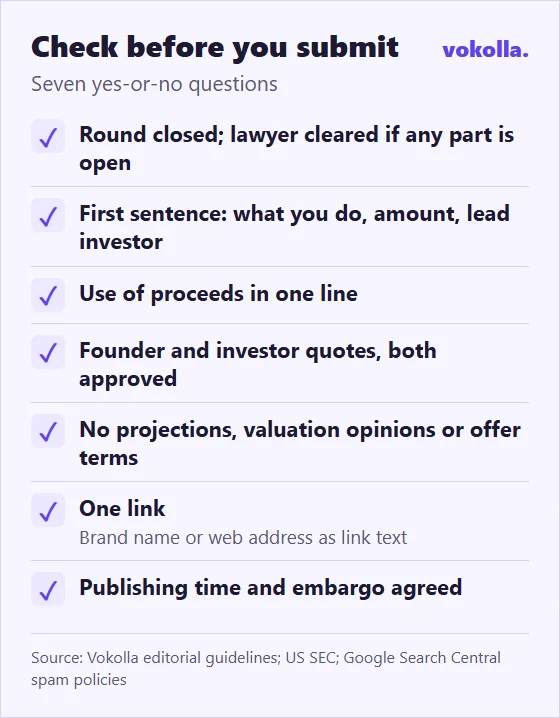
Before you submit, check these seven points. How to write a press release covers the structure.
- Has the round closed, and has your lawyer cleared the text if any part is open?
- Does the first sentence say what the company does, the amount and the lead investor?
- Is the use of proceeds stated in one line?
- Is there a quote from the founder and one from the lead investor, both approved?
- Are projections, valuation opinions and offer terms left out?
- Is there one link, with your brand name or web address as the link text?
- Are the publishing time and any embargo agreed with the reporter and the investor?
What our own releases show
A Global Impact release for Mubboo Flights, a travel site in our own group, appeared on Yahoo Finance, Business Insider’s markets site, The Globe and Mail and Barchart on 19 October 2026, and all four pages were still online 16 days later. Our own release was live on USA Today 39 minutes after submission on 23 October. Each is one check, so read them as what happened to us. See how long distribution takes.
Publish with Vokolla
Vokolla shows one public price per release, from US$69, with no quote, sales call or subscription. You write the release or draft it with the Vokolla AI assistant, choose the package, pay online and get a report with every live link, and an editor reviews each release before it goes out. You can try it first with one free release every 30 days; every package is on the pricing page.
Questions people ask
When should I announce a funding round?
After the round has closed and the money is committed, once the lead investor has approved the text and their quote.
What does a funding press release include?
The amount, the round, the lead investor, what the money is for, a quote from the founder and one from the investor, a short company description and a media contact. The three 2026 releases we read all did.
Can I announce a round that is still open?
Be careful. The SEC says a Rule 506(b) offering allows no general solicitation or advertising, and Rule 506(c) allows it only if all purchasers are accredited and verified. Ask your lawyer before you publish.
Should I include a valuation or projections?
Leave them out. SEC staff describe factual business information as generally excluding predictions, projections, forecasts and opinions on valuation.
Does a grant or a loan need a release?
It can, if it is news your customers or partners will check: name the funder, the amount, the purpose and the date. We read no grant or loan release for this guide, so there is no example here.
Vokolla pages for this step
- Packages →Six packages from US$69 to US$659 per release, each with a report of the live links.
- Pricing →Every package’s public price, reach and what it includes, side by side.
- Free press release →One free release every 30 days on news sites, after editor review.
- AI assistant →Connect your AI assistant to Vokolla to draft, check and save a release.
Sources
Written and checked by the Vokolla editorial team. Vokolla provides the packages described here; prices and outlets are as published on vokolla.com on the date above, and the results quoted come from our own releases. Search rankings depend on many factors, so no distribution service can guarantee them.
- US SEC: Private placements, Rule 506(b) (no general solicitation or advertising) — checked 2026-11-05
- US SEC: General solicitation, Rule 506(c) (allowed if all purchasers are accredited and verified) — checked 2026-11-05
- US SEC Division of Corporation Finance: Securities Act Rules, compliance and disclosure interpretations, Section 256 (factual business information vs general solicitation) — checked 2026-11-05
- US Government Publishing Office: 17 CFR 230.135c, notice of unregistered offerings (reporting issuers), 2025 edition — checked 2026-11-05
- UK Financial Conduct Authority: Financial promotions (section 21 restriction; updated 28 May 2024) — checked 2026-11-05
- PR Newswire: Axle raises US$17.5M Series A (11 Aug 2026) — checked 2026-11-05
- PR Newswire: Treeline raises US$25 million (31 Mar 2026) — checked 2026-11-05
- PR Newswire: Solstice raises Series A (28 May 2026) — checked 2026-11-05
- Muck Rack: State of Journalism 2026 (897 journalists analysed, surveyed 30 Jan – 2 Mar 2026; Muck Rack sells PR software) — checked 2026-11-05
- Cision: 2026 State of the Media (1,899 journalists, January–February 2026; Cision owns PR Newswire) — checked 2026-11-05
- Google Search Central: Spam policies for Google web search (updated 2026-08-28) — checked 2026-11-04
- Vokolla publishing records: our own releases on USA Today and partner networks (October 2026), Google, Bing and AI-answer checks on 4 Nov 2026 (internal records; the method is described on this page) — checked 2026-11-04
- USA Today: “Vokolla Launches an AI Press Release Agent…” (press release section, 23 Oct 2026) — checked 2026-11-04
- Business Insider Markets: Mubboo Flights release (19 Oct 2026) — checked 2026-11-04
- Vokolla: Press release distribution pricing (packages, prices and reach) — checked 2026-11-04
- Vokolla: Media list by package (Domain Rating and monthly visits are third-party estimates, October 2026) — checked 2026-11-04
- Vokolla: Editorial guidelines for press releases — checked 2026-11-04