Guide · Use cases
Press release for a product launch: when to publish, what to write and how to use it afterwards
In short
A product launch press release is a dated public statement that a product exists and where to get it: what it is, who it is for, what it costs, and when and where it is available. Two groups read it: journalists and reviewers deciding whether to cover you, and buyers who check the company before they buy. Publish it when the product page is live, link it to that page, and keep it as the record of what you announced.
Why a new product needs a release
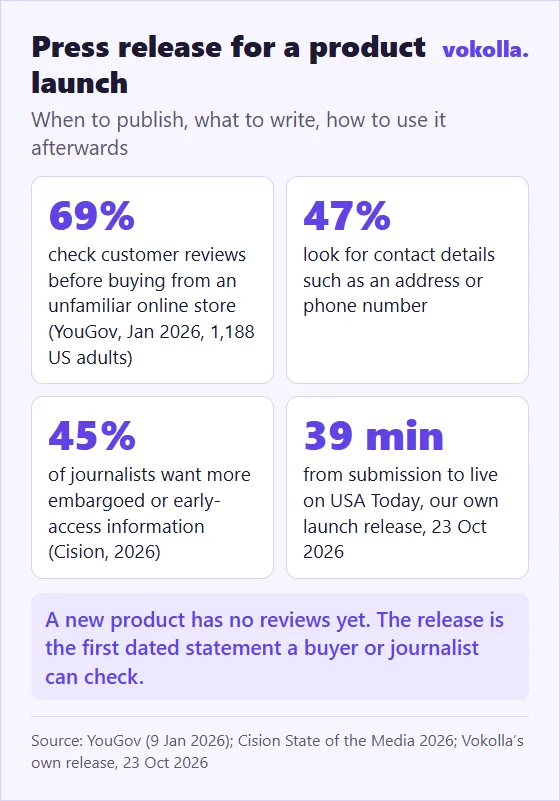
A new product has no reviews and a new brand has no history, and buyers look for both. YouGov asked 1,188 US adults how they check an unfamiliar online store in December 2025: 69% check customer reviews, 65% look for secure payment options, and 47% look for contact details such as an address or phone number; 34% check the seller’s own website. Two thirds (67%) would stop if the reviews were mostly negative. In Clutch’s April 2026 survey of 408 US consumers, 43% of those actively looking for something new start with Google or another search engine.
Where the company is from matters too. Edelman’s 2025 brand-trust report, as reported by O’Dwyer’s, found that across 15 countries 75% of people trust domestic brands and 60% trust foreign brands. A shopper deciding whether to trust you is looking for something checkable, and a launch release is a dated statement from a named company, with a named person and a contact, on a news site. Our view: reviews take time to arrive, so the release gives buyers and journalists a dated public record to check, with your contact details.
Journalists use releases too. Cision’s 2026 survey of 1,899 journalists found that 66% use PR-provided content for story ideas. Asked what they want more of, they put data or research (47%), embargoed or early-access information (45%) and access to experts (42%) first. Cision sells PR software, so read the numbers as its own survey. We take the practical lesson: put your documented data in the release, name an expert who can be interviewed, and offer early access to the people who review products.
When to publish: from the product page to a month after
No survey gives a number of days before a launch. The advice on lead times comes from agencies and platform documentation, so treat the timeline as our recommendation. Airfoil, a PR agency, says to pre-brief the media at least a week ahead, and a month ahead for a major event. Google says crawling a new page can take anywhere from a few days to a few weeks, which is why the product page goes up first.
For apps the platforms set the clock: Apple says to nominate an app for featuring up to three months ahead and gives at least two weeks’ notice as the minimum, pre-orders can be opened two to 180 days before release, and promo codes let press and influencers use an app early. Google Play pre-registration campaigns last at most 90 days. Product Hunt lets you schedule a launch up to one month ahead and gives 12:01am Pacific time as a rule of thumb for makers with no constraints.
| When | What to do | Why |
|---|---|---|
| Apps: up to 3 months before | Nominate the app for App Store featuring (Apple asks for at least two weeks’ notice). Open pre-orders, or a Google Play pre-registration campaign (90 days at most). | Apple and Google Play documentation; the platforms set this clock. |
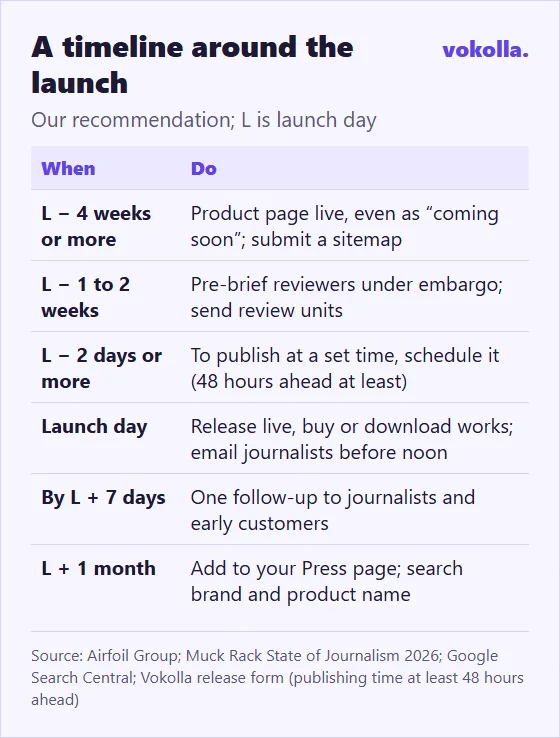
| L minus 4 weeks or more | Put the product page live, even as “coming soon” with the specification, price range and a contact. Submit a sitemap. | Google says crawling takes a few days to a few weeks and does not guarantee inclusion. |
| L minus 1 to 2 weeks | Pre-brief reviewers and journalists under an agreed embargo; send review units. | Airfoil: pre-brief at least a week ahead. 45% of journalists want more embargoed or early-access information (Cision). |
| L minus 2 days or more | To publish at a set time, schedule the release with the time and time zone of your embargo. | A scheduled time must be at least 48 hours after you submit; editors review first and then schedule it. Without a set time, ours went live 39 minutes after submission. |
| Launch day | The release goes live; the buy or download button works; email journalists in the morning with the link from the first live page. | 78% of journalists want pitches before noon; 69% prefer under 200 words (Muck Rack). |
| By L plus 7 days | One follow-up to journalists and early customers, with the release link. | 50% of journalists say one follow-up is ideal; 51% say it should come within 3–7 days (Muck Rack). |
| L plus 1 month | Add the release to a Press section on your site; search your brand and product name; update the page. | The release is the dated record of what you announced. |
What to write: facts, a number and a named person
Say what the product is, who it is for, what it costs and where and when it is available, in the first two sentences. Then give one figure you can document, such as a test result, a capacity or an independent rating, with the method and the date. A named person with a title gives one quote that says something a spec sheet does not.
Real releases show the range. XPENG’s 17 September 2026 release on PR Newswire put the product, the market and the date of the next step in the headline, quoted its chairman and chief executive and gave a press email for its Paris event. 1MORE’s 14 October 2026 release for its HQ60 headphones said in the lead that they were available worldwide and used headed sections for product and availability, which suits a spec-heavy product; it has no executive quote, which is why our checklist asks for one.
The examples below use two fictional companies, Cedarline Bikes and Tallybook. They are illustrations; the figures are invented.
| Product | Headline | Quote |
|---|---|---|
| A physical product | Cedarline Bikes Launches the Trail 2 Electric Bike in 12 Countries, From US$1,899 | “Riders told us the battery was the first thing they check, so we publish the test method with the range,” said Ana Ruiz, chief executive of Cedarline Bikes. |
| A software product or app | Tallybook Launches Expense App for Freelancers on iOS and Android, Free for the First 100 Invoices | “Freelancers do not want a finance system, they want to know what they are owed,” said Sam Patel, founder of Tallybook. |
Which package to choose, and why
Choose by where your buyers and reviewers look. For a first product from a small brand, Brand Starter at US$69 puts the release on 300+ outlets, including openPR and 25 city news sites. Global Reach at US$129 adds newspaper and TV-station finance pages, which suits a local or regional launch. DoFollow Links at US$129 places the release on 100+ news and finance sites, so people searching for the product find a dated announcement that links to your product page; each site sets its own link attributes. If journalists and buyers will search for the launch itself in the United States, Premium Media at US$379 adds AP News, USA Today, Barchart and StreetInsider. For a launch in several markets, Global Impact at US$659 reaches 20+ high-traffic outlets.
Every price is on the pricing page and the media list names the outlets in each package. If you are comparing services, our comparison reads each company’s own published price and date.
How to use the release after launch day
The release page helps only when people reach it. These are the places we would put the link.
- A Press section on the product site, with the release link, the date and the outlet. Anyone who reaches the site from a search, an ad or an app store listing sees it.
- The email to retailers, distributors and early customers: one line saying what was announced and where it is published.
- LinkedIn, from the company page and from the person quoted.
- The follow-up to journalists within three to seven days of launch: the link is enough.
- A check one week and one month later: search the brand name and the product name and save the results with the dates. On 4 November 2026 ChatGPT answered “What is Vokolla?” by citing a newspaper page that carried our release; see press releases and AI search.
- Link text: use your brand name or web address, not a keyword phrase. Google’s spam policies list keyword-optimized anchor text in press releases distributed on other sites as a violation; see dofollow and nofollow links.
The checklist
Before you submit, check these six points. How to write a press release covers each, and the format and template shows an accepted release part by part.
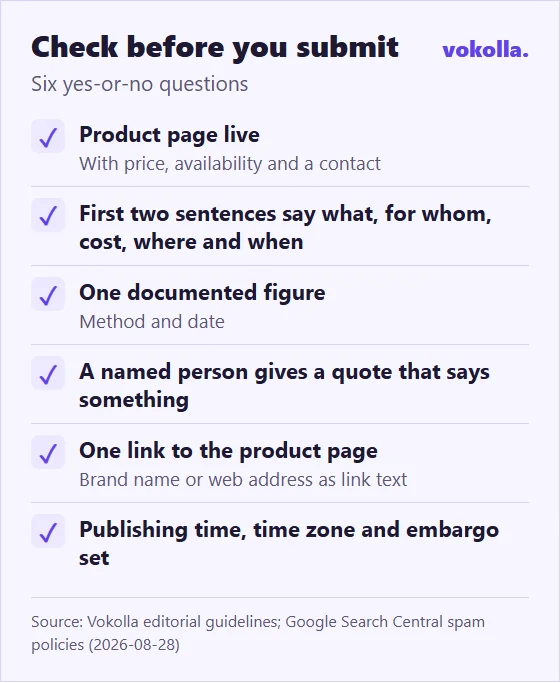
- Is the product page live, with price, availability and a contact?
- Do the first two sentences say what it is, who it is for, the price and when and where it is available?
- Is there one figure you can document, with the method and the date?
- Does a named person with a title give a quote that says something?
- Is there one link, to the product page, with your brand name or web address as the link text?
- Are the publishing time, the time zone and any embargo set?
A launch of our own
On 23 October 2026 we published our own launch release, “Vokolla Launches an AI Press Release Agent…”, in USA Today’s press release section. It was live 39 minutes after submission. By 4 November both of our USA Today release pages were in Google’s index, and a Bing search for “Vokolla” showed them second and fourth, right after our website. That day ChatGPT, asked what Vokolla is, answered accurately and cited a newspaper page that carried a release of ours from ten days earlier. Each result is one search or one answer, so read them as what happened to us, not as a promise.
Across nine of our paid English releases in October 2026, 98% of the pages we could check were still online 9 to 27 days after publication. A Brand Starter release for Mubboo Flights, a travel site in our own group, was online on 325 pages, including openPR and all 25 NEWSnet city news sites. See how long distribution takes.
Publish with Vokolla
Vokolla shows one public price per release, from US$69, with no quote, sales call or subscription. You write the release or draft it with the Vokolla AI assistant, choose the package, pay online and get a report with every live link, and an editor reviews each release before it goes out. You can try it first with one free release every 30 days; every package is on the pricing page.
Questions people ask
When should I publish a press release for a product launch?
We suggest the moment the product can be bought or downloaded, with the product page live weeks earlier. To publish at a set time, schedule the release at least 48 hours ahead; outlets then publish on their own schedules, so send journalists the link from the first live page.
What should the headline of a product launch release say?
The product, the market or customer, and the date or price, in one line. A real example: XPENG’s release named the product, the market and the date of the next step.
Do I need a release if I am launching on an app store or Product Hunt?
The listing reaches people who are already browsing there. A release is a dated page on a news site for the buyers and journalists who check the company before or after.
How far ahead should I tell journalists about a launch?
No survey gives a number. Airfoil, a PR agency, advises at least a week for an embargoed pre-briefing, and a month for a major event.
Can the same release be used for a new website launch?
Yes, if the news is the launch itself: what the site sells, to whom, in which countries, from what date. Link to the live site with your brand name as the link text.
Vokolla pages for this step
- Packages →Six packages from US$69 to US$659 per release, each with a report of the live links.
- Pricing →Every package’s public price, reach and what it includes, side by side.
- Free press release →One free release every 30 days on news sites, after editor review.
- AI assistant →Connect your AI assistant to Vokolla to draft, check and save a release.
Sources
Written and checked by the Vokolla editorial team. Vokolla provides the packages described here; prices and outlets are as published on vokolla.com on the date above, and the results quoted come from our own releases. Search rankings depend on many factors, so no distribution service can guarantee them.
- YouGov: How do American consumers verify online retailers before purchasing? (9 Jan 2026; 1,188 US adults, fieldwork 29–30 Dec 2025) — checked 2026-11-05
- Clutch: Modern brand discovery (updated 17 Aug 2026; 408 US consumers surveyed April 2026; Clutch sells services to agencies) — checked 2026-11-05
- Edelman Trust Barometer Special Report: Brand Trust, From We to Me (2025), as reported by O’Dwyer’s, 19 Jun 2025 (75% trust domestic brands, 60% foreign brands; 15 countries) — checked 2026-11-05
- Muck Rack: State of Journalism 2026 (897 journalists analysed, surveyed 30 Jan – 2 Mar 2026; Muck Rack sells PR software) — checked 2026-11-05
- Cision: 2026 State of the Media (1,899 journalists, January–February 2026; Cision owns PR Newswire) — checked 2026-11-05
- Airfoil Group (a PR agency): Everything you need to know about product-launch embargoes (undated) — checked 2026-11-05
- Apple Developer: Getting featured on the App Store (nominate up to three months ahead; at least two weeks’ notice) — checked 2026-11-05
- Apple Developer: Promote your app (pre-orders 2 to 180 days ahead; promo codes give press early access) — checked 2026-11-05
- Google Play Console Help: Pre-registration (campaigns last at most 90 days) — checked 2026-11-05
- Product Hunt: Preparing for launch (schedule up to one month ahead; 12:01am PST rule of thumb) — checked 2026-11-05
- PR Newswire: XPENG release on the G9L launch in China and the global launch date (17 Sep 2026) — checked 2026-11-05
- PR Newswire: 1MORE SonoFlow Max HQ60 headphones release (14 Oct 2026) — checked 2026-11-05
- Google Search Central: Ask Google to recrawl your URLs (updated 2025-12-10) — checked 2026-11-05
- Google Search Central: Learn about sitemaps (updated 2025-12-10) — checked 2026-11-05
- Google Search Central: Spam policies for Google web search (updated 2026-08-28) — checked 2026-11-04
- Vokolla publishing records: our own releases on USA Today and partner networks (October 2026), Google, Bing and AI-answer checks on 4 Nov 2026 (internal records; the method is described on this page) — checked 2026-11-04
- USA Today: “Vokolla Launches an AI Press Release Agent…” (press release section, 23 Oct 2026) — checked 2026-11-04
- Vokolla: Press release distribution pricing (packages, prices and reach) — checked 2026-11-04
- Vokolla: Media list by package (Domain Rating and monthly visits are third-party estimates, October 2026) — checked 2026-11-04
- Vokolla: Editorial guidelines for press releases — checked 2026-11-04