Guide · Use cases
Press release for a partnership or distribution agreement: what to say, who approves it and when to publish
In short
A partnership or distribution press release is a dated public statement, agreed by both sides, that two named companies have signed an agreement: who, for which products, in which territory, from what date, in what role. It is read by each side’s customers and by buyers checking either company. Publish it once both sides have approved the text in writing, and leave out any term the contract does not allow you to publish.
Why announce a signing
Both sides of a signing get checked. The US International Trade Administration tells exporters to do due diligence on potential local agents and distributors, and its checklist asks about the representative’s track record, other principals and key accounts. The same checking runs the other way: a distributor, and the distributor’s customers, look at who you are.
A signing release gives each side’s customers a dated, public record that names both companies, the territory and the products. It helps a distributor’s salespeople say “we now carry this” with a link, and it lets your own buyers check that you have a channel in their country. Journalists use releases for story ideas too: in Cision’s 2026 survey of 1,899 journalists, 66% use PR-provided content (Cision sells PR software).
Who approves it, and what to leave out
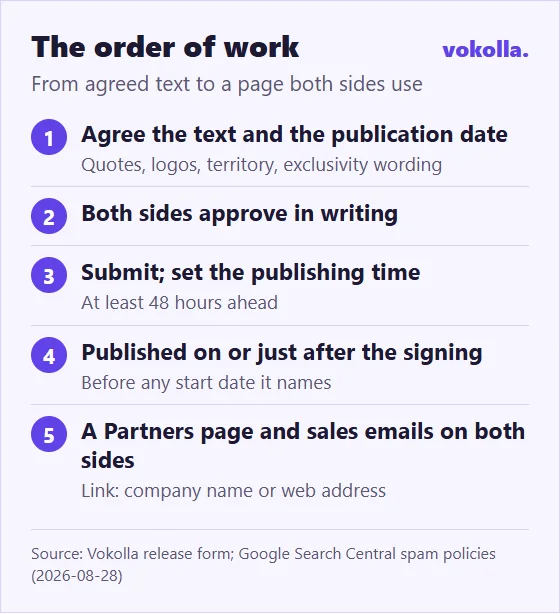
We found no law or regulator that says who must approve a joint release between private companies, so this is practice, not a rule: both sides approve the final text in writing before it goes out, including the quotes, the logos, the territory and any wording about exclusivity. Each side supplies its own quote and its own About paragraph; the real releases we read did the same.
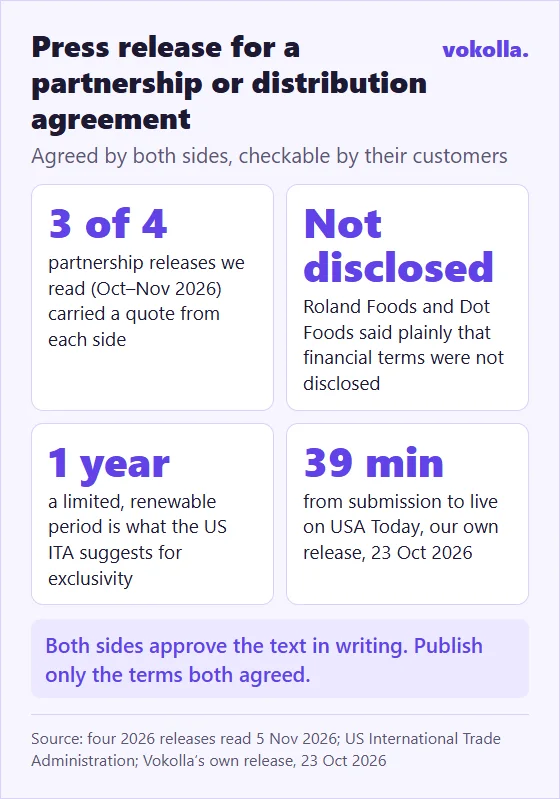
State only what both sides agreed in writing: the parties, the territory, the products, the start date, the role (distributor, agent or partner) and whether it is exclusive. Leave out prices, minimums, volumes, term length and termination rights unless both agree to publish them. Use “authorised” or “exclusive” only if the contract says so. The ITA advises against granting exclusivity until the representative has proven itself, and suggests a limited, defined period such as one year, renewable, so an exclusive appointment is a statement worth getting right.
If either company is listed, the rules are stricter and a lawyer should clear the text. SEC Form 8-K Item 1.01 covers a “material definitive agreement not made in the ordinary course of business” and is due within four business days, and Regulation FD requires a US-listed company that gives material non-public information to analysts or investors to disclose it publicly at the same time, with exceptions for people bound by confidentiality. These are US rules; companies listed elsewhere follow their own exchange’s. Whether a distribution agreement is material is a legal call; we found no default rule.
What to write: four real examples
We read four 2026 releases about partnerships and distribution agreements: Roland Foods and Dot Foods (PR Newswire, 2 October), GMG and Brenntag (GMG’s own site, 4 November), cBrain and Carahsoft (2 November, read as a copy) and Nexalin and Inovanexa (1 October, read as an SEC exhibit). GMG’s headline names both companies, says the agreement is binding and exclusive, and gives the region; cBrain’s names both companies too; Nexalin’s names only itself. Roland and Dot is an acquisition with an equity stake rather than a plain distribution deal, so we use it for one thing: it said plainly that financial terms were not disclosed. Three of the four carried a quote from each side; cBrain’s had none. Nexalin, a listed company, disclosed a ten-year initial term, the initial order size, minimum-revenue conditions for exclusivity and royalty terms, but no dollar prices; a listed company may have to disclose more than a private one. That is our reading of four releases, not a statistic.
The fictional examples below use two invented companies, Cedarline Bikes and Alpine Cycle Distribution. They illustrate the shape; the details are made up.
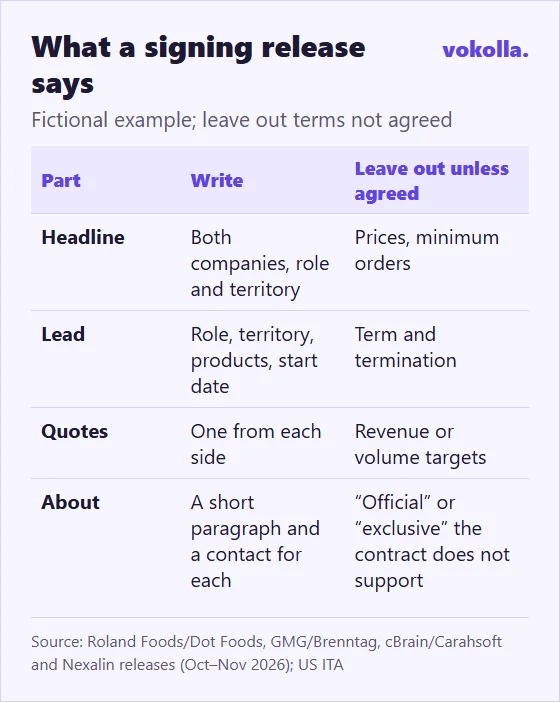
| Part | Write | Leave out unless agreed |
|---|---|---|
| Headline | Cedarline Bikes Signs Alpine Cycle Distribution as Exclusive Distributor for Switzerland and Austria | Prices, minimum orders |
| Lead | Names both companies, the role, the territory, the products and the start date (1 January 2027). | Contract term and termination rights |
| Quotes | “Alpine already supplies 120 dealers in the Alps, so riders can test the bikes close to home,” said Ana Ruiz, chief executive of Cedarline Bikes. A second quote from Alpine’s managing director. | Revenue or volume targets |
| About | One short paragraph for each company, and a contact for each. | Any word like “official” or “exclusive” the contract does not support |
When to publish
We found no source on the best moment to announce a signing. GMG announced on its commencement date, 4 November; Nexalin announced nine days after signing. Our recommendation: agree a publication date with the other side when you agree the text, and publish on or just after the signing. If a release names a start date, publish it before that date.
If you need a fixed date, our release form lets you schedule the release at least 48 hours after you submit; editors review first and then schedule it. If you want it out on signing day, submit without a set time once both sides have approved: after editor review it goes out (ours was live 39 minutes after submission). If you brief journalists early under an embargo, set the release to go live no earlier than the embargo time. If you brief journalists, 78% in Muck Rack’s 2026 survey want pitches before noon, and 69% prefer under 200 words (Muck Rack sells PR software).
Links: do not make them part of the bargain
Partners like to link to each other, and this is where Google’s spam policies matter. They list “excessive link exchanges” and “partner pages exclusively for the sake of cross-linking”, requiring a link in a contract without letting the other site qualify it, and links with optimized anchor text in press releases distributed on other sites. So: put one plain link in the release to each partner’s website, with the company name or web address as the link text. Do not make a reciprocal link a term of the contract. A partner page on your site is fine when it tells real customers who your partner is and where to buy.
Which package to choose, and why
Choose by who needs to see it. For a distributor appointment where the people who matter are in one market, Brand Starter at US$69 puts the release on 300+ outlets, including openPR and 25 city news sites. Global Reach at US$129 adds newspaper and TV-station finance pages. When the partner’s customers read AP News, USA Today or StreetInsider, Premium Media at US$379 adds them, and for a signing across several countries, Global Impact at US$659 reaches 20+ high-traffic outlets.
Every price is on the pricing page, the media list names the outlets in each package, and our comparison reads other services’ own published prices and dates.
How to use the release afterwards
Both sides can use the same page.
- A Partners or Where to buy page on each website, with the release link and the date.
- The distributor’s sales team: send the link so every sales email can say who now carries the product and where.
- LinkedIn from both company pages and from each person quoted.
- Tenders, supplier questionnaires and trade show handouts: one line with the partner’s name and the release link.
- A check a week and a month later: search each company name and save the results with the dates.
The checklist
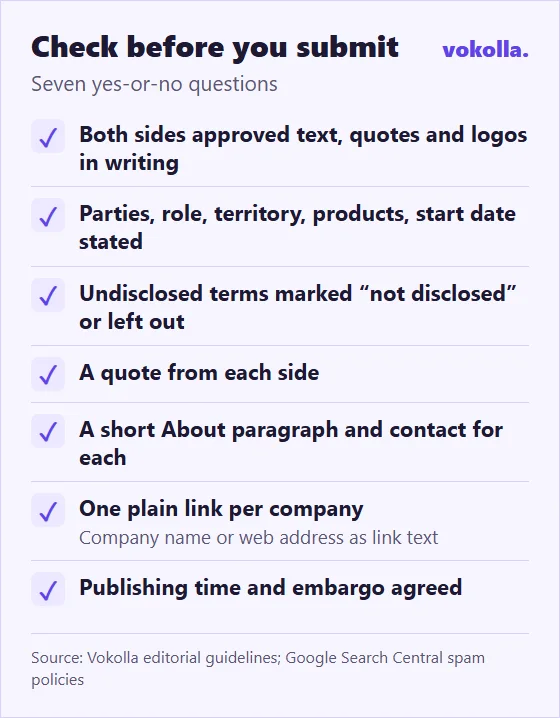
Before you submit, check these seven points. How to write a press release covers the structure.
- Have both sides approved the final text, quotes and logos in writing?
- Are the parties, role, territory, products and start date stated?
- Does it say which terms are not disclosed, or leave them out?
- Is there a quote from each side?
- Does each company have its own short About paragraph and a contact?
- Is there one plain link per company, with the company name or web address as the link text?
- Is the publishing time, and any embargo, agreed with the other side?
What our own releases show
Here is what our own October 2026 releases did. Of the pages we could check from nine paid English releases, 98% were still online 9 to 27 days after publication. A Brand Starter release for Mubboo Flights, a travel site in our own group, was online on 325 pages, including openPR and all 25 NEWSnet city news sites. Our releases ran on the finance pages of 21 local TV stations and 14 newspapers. Our own release was live on USA Today 39 minutes after submission. See how long distribution takes.
Publish with Vokolla
Vokolla shows one public price per release, from US$69, with no quote, sales call or subscription. You write the release or draft it with the Vokolla AI assistant, choose the package, pay online and get a report with every live link, and an editor reviews each release before it goes out. You can try it first with one free release every 30 days; every package is on the pricing page.
Questions people ask
Who has to approve a joint press release?
No rule we found says so for private companies. Practice is that both sides approve the final text, including quotes, logos, territory and exclusivity wording, in writing before it goes out.
Should I publish the price or the contract term?
Only if both sides agree. The releases we read either said financial terms were not disclosed or left them out; one listed company disclosed its term and structure without dollar amounts.
Can I call a distributor “exclusive” or “official”?
Only if the contract says so. The ITA advises against granting exclusivity until a representative has proven itself, so check that wording with the other side.
Can we link to each other?
One plain link to each partner’s site in the release is normal. Google’s spam policies list excessive link exchanges and partner pages made only for cross-linking, so do not make a reciprocal link a contract term.
What if one of us is a listed company?
Have a lawyer clear the text. SEC Form 8-K Item 1.01 covers material definitive agreements and Regulation FD governs selective disclosure; whether an agreement is material is a legal decision.
Vokolla pages for this step
- Packages →Six packages from US$69 to US$659 per release, each with a report of the live links.
- Pricing →Every package’s public price, reach and what it includes, side by side.
- Free press release →One free release every 30 days on news sites, after editor review.
- AI assistant →Connect your AI assistant to Vokolla to draft, check and save a release.
Sources
Written and checked by the Vokolla editorial team. Vokolla provides the packages described here; prices and outlets are as published on vokolla.com on the date above, and the results quoted come from our own releases. Search rankings depend on many factors, so no distribution service can guarantee them.
- US International Trade Administration: Choosing a foreign representative (checklist of track record, other principals and key accounts) — checked 2026-11-05
- US International Trade Administration: Negotiating an agreement with a foreign representative (do not grant exclusivity until the representative has proven itself) — checked 2026-11-05
- US International Trade Administration: Vietnam country commercial guide, distribution and sales channels (last published 23 Apr 2026): due diligence on agents and distributors — checked 2026-11-05
- US SEC: Form 8-K, Item 1.01 material definitive agreements (report within four business days) — checked 2026-11-05
- US eCFR: Regulation FD, 17 CFR 243.100 (selective disclosure) — checked 2026-11-05
- PR Newswire: Roland Foods and Dot Foods announce strategic partnership (2 Oct 2026) — checked 2026-11-05
- GMG (company site): binding distribution agreement with Brenntag for exclusive European distribution (4 Nov 2026) — checked 2026-11-05
- cBrain: partnership with Carahsoft Technology (2 Nov 2026), read as a copy on Inderes — checked 2026-11-05
- Nexalin Technology: exclusive distribution and local manufacturing agreement for Brazil and South America (1 Oct 2026; SEC exhibit 99.1) — checked 2026-11-05
- Muck Rack: State of Journalism 2026 (897 journalists analysed, surveyed 30 Jan – 2 Mar 2026; Muck Rack sells PR software) — checked 2026-11-05
- Cision: 2026 State of the Media (1,899 journalists, January–February 2026; Cision owns PR Newswire) — checked 2026-11-05
- Google Search Central: Spam policies for Google web search (updated 2026-08-28) — checked 2026-11-04
- Vokolla publishing records: our own releases on USA Today and partner networks (October 2026), Google, Bing and AI-answer checks on 4 Nov 2026 (internal records; the method is described on this page) — checked 2026-11-04
- USA Today: “Vokolla Launches an AI Press Release Agent…” (press release section, 23 Oct 2026) — checked 2026-11-04
- Business Insider Markets: Mubboo Flights release (19 Oct 2026) — checked 2026-11-04
- Vokolla: Press release distribution pricing (packages, prices and reach) — checked 2026-11-04
- Vokolla: Media list by package (Domain Rating and monthly visits are third-party estimates, October 2026) — checked 2026-11-04
- Vokolla: Editorial guidelines for press releases — checked 2026-11-04