Guide · Use cases
Press release for an ecommerce brand: what to say, where to link it and where not to
In short
An ecommerce brand press release is a dated public statement about your store: a new site, a new line, a move beyond a marketplace, a new identity. It gives shoppers who check an unfamiliar store a dated page on a news site with your name, your contact and what you announced. Publish it when the store page it describes is live, and link it from your own channels, not from places a marketplace forbids.
Why an online brand needs a public record
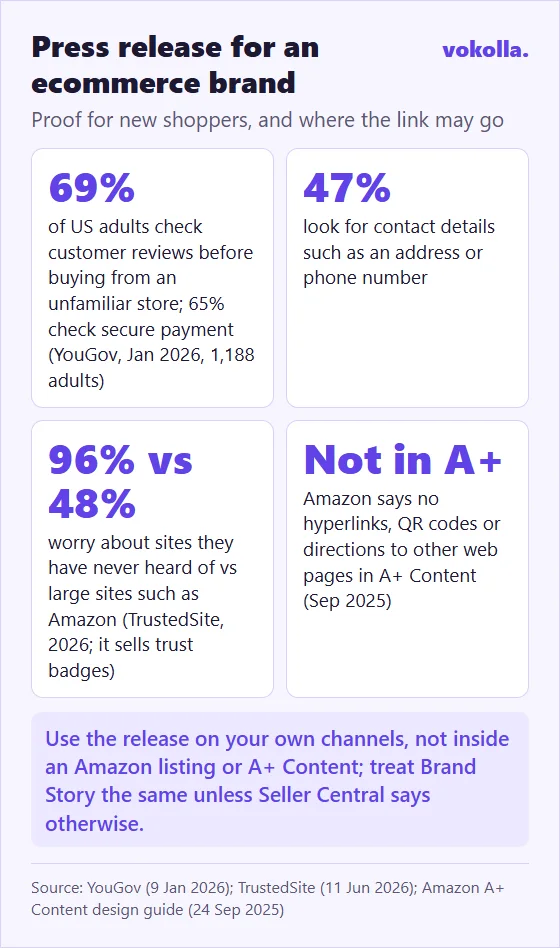
Shoppers check an unfamiliar store before they pay. In YouGov’s December 2025 survey of 1,188 US adults, 69% check customer reviews, 65% check for secure payment options and 47% look for contact details such as an address or phone number. Where do they look for reviews? 53% on marketplaces such as Amazon and eBay, 51% on Google reviews, and 34% on the seller’s own website. Two thirds (67%) would stop if the reviews were mostly negative.
TrustedSite’s 2026 survey of 1,295 US consumers, run by a company that sells trust badges, found that 96% are concerned about sites they have never heard of, against 48% for large established sites such as Amazon, and that business legitimacy was the top reason for abandoning a purchase (51%). Baymard’s list of checkout abandonment reasons has 19% of abandoners saying they did not trust the site with their card details. YouGov and TrustedSite point the same way, and Baymard adds that 19% of abandoners did not trust the site with their card details: before a new brand has reviews, shoppers look for proof that a real business stands behind the store.
A release gives that proof one more place to be: a dated page on a news site with your company name, a named person, a contact and what you announced. Our view: it does not replace reviews, it covers the first question a new shopper asks. In Cision’s 2026 survey of 1,899 journalists, 66% use PR-provided content, including pitches, releases and media kits, for story ideas (Cision sells PR software).
Where the link can go, and where it cannot: Amazon’s rules
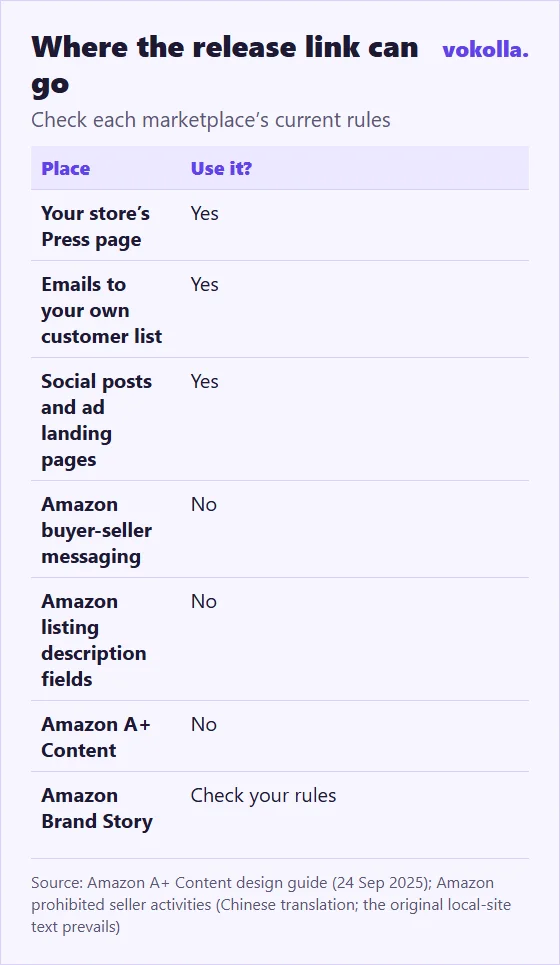
If you sell on Amazon, check this before you use a release. Amazon’s guide to A+ Content (US site) says not to include QR codes, hyperlinks, directions to other web pages or contact information. Amazon Global Selling China’s page on prohibited seller activities, a Chinese translation of a 2017 version that says the original local-site text prevails, bans diverting Amazon users to another website, including putting URLs in a listing’s description fields and in emails to buyers. Seller Central’s English rules require a login; check the current text in your account.
In practice: do not put the release link, a QR code or your store address inside a listing or A+ Content. The pages we read do not mention Brand Story, so treat it the same unless your Seller Central rules say otherwise. Use the release where those rules do not reach: your own website’s Press page, emails to customers who bought from your own store or subscribed to your list (not messages sent through Amazon’s buyer-seller messaging), social posts, and your ads’ landing pages. Amazon’s Brand Registry is free and needs a pending or registered trademark from the trademark office of a country with a matching Amazon store, plus a logo that includes your brand name permanently affixed to products or packaging. It protects your brand on Amazon; a release is independent evidence that sits outside the platform.
What to announce, with two real releases and a fictional example
Announce something a shopper could act on: a new store or site (what it sells, where it ships, from when), a new product line (names, prices, where to buy), a move beyond a marketplace, or a new identity with a date for the rollout. We read two 2026 releases on PR Newswire. VALITIC’s 8 October release said its products were now available at its own site, with a subheadline about expanding the brand beyond Amazon, mentioned its established presence on Amazon and thousands of customer reviews, and carried quotes from two chief executives, one at the brand’s parent company and one at its subsidiary. Curology’s 27 October release listed four named products with one-line descriptions and a starting price of US$12 and said where they were available from that day. VALITIC’s is written for investors, so it carries more financial boilerplate than a typical DTC brand needs.
The fictional examples below use an invented brand, Cedarline Bikes. The details are made up.
| Announcement | Headline | Quote |
|---|---|---|
| A store beyond a marketplace | Cedarline Bikes Opens Its Own Online Store, Shipping to 12 Countries With a 30-Day Return Policy | “Customers asked to see our address and returns terms before they pay, so we put them on the first page,” said Ana Ruiz, chief executive of Cedarline Bikes. |
| A new line | Cedarline Bikes Launches the Trail 2 Electric Bike, From US$1,899 | “Riders told us the battery is the first thing they check, so we publish the test method with the range,” said Ana Ruiz. |
When to publish
Publish when the page the release describes is live: the store open, the products available, the returns policy and contact details on the site. A release that sends shoppers to a store with no contact page undoes its own point. For a holiday launch, publish early enough that the page is findable, and agree any embargo with a reporter first.
If you need a fixed date, our release form lets you schedule the release at least 48 hours after you submit; editors review first and then schedule it. Without a set time it goes out after editor review. If you brief journalists, 78% in Muck Rack’s 2026 survey want pitches before noon and 69% prefer under 200 words (Muck Rack sells PR software), and 71% reject pitches that feel overly promotional.
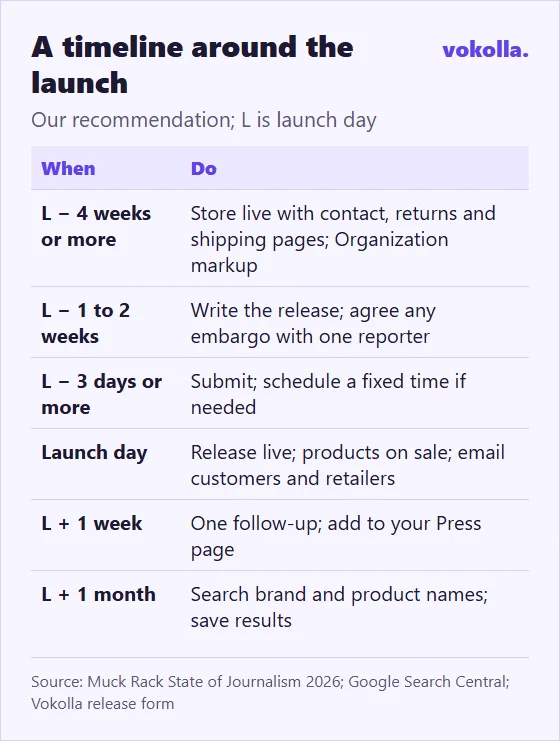
| When | What to do |
|---|---|
| L minus 4 weeks or more | Store live with contact details, returns and shipping pages; add Organization structured data to the home page. |
| L minus 1 to 2 weeks | Write the release; agree any embargo with one reporter or creator. |
| L minus 3 days or more | Submit; schedule a fixed time if you need one. |
| Launch day | Release live; products on sale; email customers and retailers. |
| L plus 1 week | One follow-up; add the release to your Press page. |
| L plus 1 month | Search your brand name and the product names; save the results with the dates. |
Which package to choose, and why
For a brand with a first store or a small line, Brand Starter at US$69 distributes the release to 300+ outlets, including openPR and 25 city news sites. Global Reach at US$129 adds newspaper and TV-station finance pages. When shoppers and creators in the US will search for the launch, Premium Media at US$379 adds AP News, USA Today, Barchart and StreetInsider; for a launch in several markets, Global Impact at US$659 reaches 20+ high-traffic outlets.
Every price is on the pricing page, the media list names the outlets in each package, and our comparison reads other services’ own published prices and dates.
How to use the release afterwards
Use it on the channels you own.
- A Press page on your store, with the release link and date, linked from the footer next to About and Contact, so shoppers can see who is behind the store.
- Emails to customers who bought from your own store or subscribed to your list, and to retailers and creators: one line with what you announced and where it is published. Not through Amazon’s buyer-seller messaging.
- Social posts and ad landing pages, from the company account and the person quoted.
- Organization structured data on your home page helps Google disambiguate your company in results; it does not guarantee a knowledge panel.
- Not in Amazon listings or A+ Content, and treat Brand Story the same unless your Seller Central rules say otherwise (see above).
- Link text: your brand name or web address, not a keyword phrase; Google’s spam policies list keyword-optimized anchor text in press releases distributed on other sites as link spam.
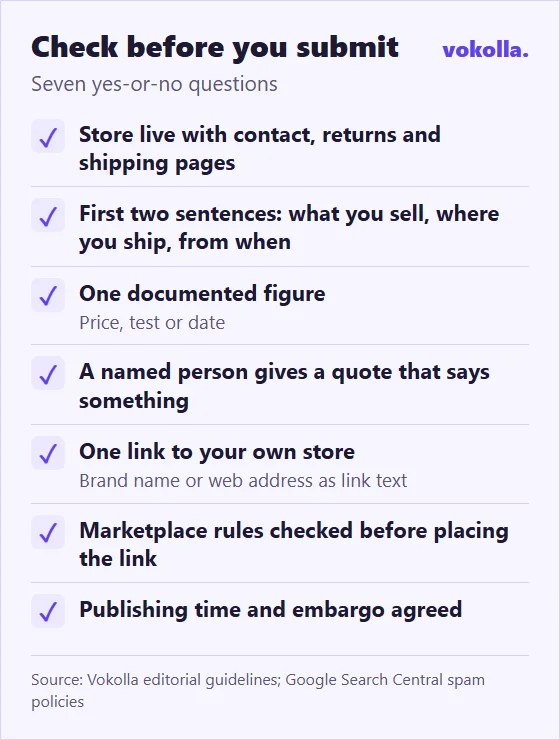
The checklist
Before you submit, check these seven points. How to write a press release covers the structure.
- Is the store live, with contact details, returns and shipping pages?
- Do the first two sentences say what you sell, where you ship and from when?
- Is there one figure you can document, such as a price, a test or a date?
- Does a named person give a quote that says something?
- Is there one link, to your own store, with your brand name or web address as the link text?
- Have you checked each marketplace’s rules before placing the release link anywhere on it?
- Is the publishing time, and any embargo, agreed?
What our own releases show
Here is what our own October 2026 releases did. Our release was live on USA Today 39 minutes after submission on 23 October (unscheduled), and 98% of the pages we could check from nine paid English releases were still online 9 to 27 days after publication. These are our October 2026 results. See how long distribution takes.
Publish with Vokolla
Vokolla shows one public price per release, from US$69, with no quote, sales call or subscription. You write the release or draft it with the Vokolla AI assistant, choose the package, pay online and get a report with every live link, and an editor reviews each release before it goes out. You can try it first with one free release every 30 days; every package is on the pricing page.
Questions people ask
Can I put the press release link on my Amazon listing?
Do not. Amazon’s A+ Content guide says not to include hyperlinks, QR codes or directions to other web pages, and its prohibited-activities page bans diverting Amazon users to another website, including URLs in description fields. Check the current English rules in Seller Central; for Brand Story, treat it the same unless they say otherwise.
What do shoppers check before buying from a new store?
In YouGov’s December 2025 survey, 69% check customer reviews, 65% check for secure payment options and 47% look for contact details.
Does a press release replace reviews?
No. Reviews take time; a release is a dated public page naming your company, a person and a contact, which covers the first question a new shopper asks.
When should an ecommerce brand publish a release?
When the store or the products it describes are live, with contact and returns pages in place. Submit at least 48 hours ahead if you want a fixed publishing time.
Do I need Amazon Brand Registry first?
No, a release does not depend on it. Brand Registry is free and needs a pending or registered trademark from the office of a country with a matching Amazon store; it protects your brand on Amazon, while a release is evidence outside the platform.
Vokolla pages for this step
- Packages →Six packages from US$69 to US$659 per release, each with a report of the live links.
- Pricing →Every package’s public price, reach and what it includes, side by side.
- Free press release →One free release every 30 days on news sites, after editor review.
- AI assistant →Connect your AI assistant to Vokolla to draft, check and save a release.
Sources
Written and checked by the Vokolla editorial team. Vokolla provides the packages described here; prices and outlets are as published on vokolla.com on the date above, and the results quoted come from our own releases. Search rankings depend on many factors, so no distribution service can guarantee them.
- YouGov: How do American consumers verify online retailers before purchasing? (9 Jan 2026; 1,188 US adults, fieldwork 29–30 Dec 2025) — checked 2026-11-05
- TrustedSite: State of ecommerce trust in 2026 (11 Jun 2026; 1,295 US consumers; TrustedSite sells trust badges) — checked 2026-11-05
- Baymard Institute: Cart abandonment rate statistics (last updated 22 Sep 2025) — checked 2026-11-05
- Amazon (sell.amazon.com blog, 24 Sep 2025): A+ Content design guide; do not include QR codes, hyperlinks or directions to other web pages — checked 2026-11-05
- Amazon Global Selling China: prohibited seller activities (Chinese translation, version of 6 Apr 2017; the original local-site text prevails): no diverting Amazon users to another website, including URLs in listing description fields — checked 2026-11-05
- Amazon: Brand Registry (free; needs a pending or registered trademark and a logo or brand name on the product) — checked 2026-11-05
- Google Search Central: Organization structured data (updated 8 Sep 2026) — checked 2026-11-05
- PR Newswire: VALITIC Launches Direct-to-Consumer Website, Laying Groundwork for U.S. Holiday Campaign (8 Oct 2026) — checked 2026-11-05
- PR Newswire: Dove Cameron and Curology Partner to Launch New Skincare Line (27 Oct 2026) — checked 2026-11-05
- Muck Rack: State of Journalism 2026 (897 journalists analysed, surveyed 30 Jan – 2 Mar 2026; Muck Rack sells PR software) — checked 2026-11-05
- Cision: 2026 State of the Media (1,899 journalists, January–February 2026; Cision owns PR Newswire) — checked 2026-11-05
- Google Search Central: Spam policies for Google web search (updated 2026-08-28) — checked 2026-11-04
- Vokolla publishing records: our own releases on USA Today and partner networks (October 2026), Google, Bing and AI-answer checks on 4 Nov 2026 (internal records; the method is described on this page) — checked 2026-11-04
- USA Today: “Vokolla Launches an AI Press Release Agent…” (press release section, 23 Oct 2026) — checked 2026-11-04
- Vokolla: Press release distribution pricing (packages, prices and reach) — checked 2026-11-04
- Vokolla: Media list by package (Domain Rating and monthly visits are third-party estimates, October 2026) — checked 2026-11-04
- Vokolla: Editorial guidelines for press releases — checked 2026-11-04