Guide · Use cases
Press release for a startup or small business: your first release and a public record from zero
In short
A first press release is a dated public statement from a new company: who the founders are, what the company does, where it is, and what is new today. Its job is to give a new name a page that can be checked, so that someone who searches your name has a dated page to find once search engines pick it up. Say only what you can show, and put your address, your website and a named contact in it.
Why a first release matters
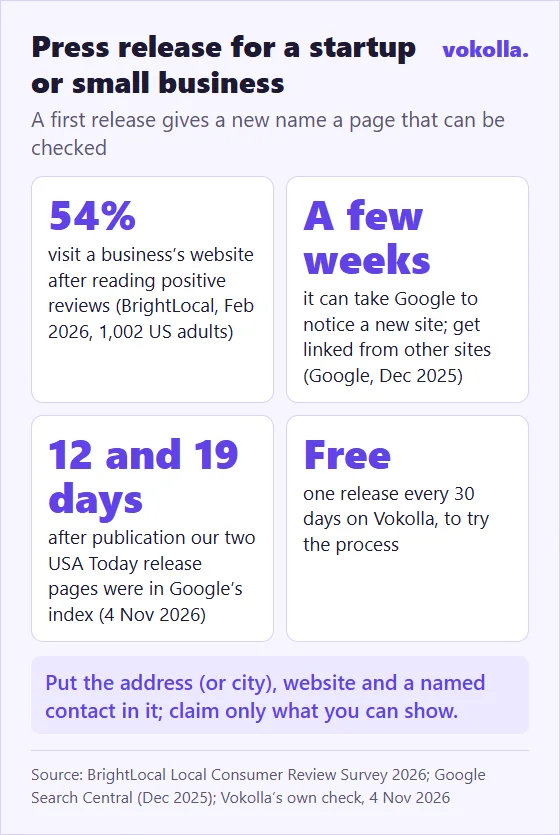
A new business is invisible. Google says it can take a few weeks to notice a new site, and that links from other sites help it find you. BrightLocal’s 2026 survey of 1,002 US adults, from a company that sells local SEO software, found that 66% do further research after reading a positive review and 54% visit the business’s website, so a business’s website is where many shoppers go next.
A release is one such page: a dated, public statement on a news site with your name, your location and your contact. The US Small Business Administration, in a 2019 blog post, advised small businesses that press releases are still useful because they are distributed online and might turn up in search results, and to keep a News Room page on your own site. That advice is older, so we cite it as an SBA blog post and not as current policy.
What a founder can credibly announce
Announce something that happened and that a reader can check: the business opens, a first product ships, a first location or an own site goes live, a partnership is signed, a documented result. Put the founders’ names and what they did before if it is relevant and true, the street address if customers visit you (if you work from home, give a city and a contact instead), the opening days, the website and social pages, and a named contact.
A real example: on 25 November 2025 a coffee roaster issued a release on PR Newswire about a shop in Amherst, Ohio, that reopened under a new name and new owners. It gave the street address, the owners’ names, the previous name and that the owners had bought the business earlier that year, the menu, a named local supplier, that it opens seven days a week, and the web and social pages. It was issued by the supplier, not the shop, and it is a reopening, not a company starting from nothing; some background claims in it are self-reported.
Claim only what you can show. “First”, “only” and “leading” need proof; a new company can instead say what it does, for whom and how it works. Leave out revenue, customer numbers and funding unless you can document them; the funding guide covers money.
The fictional example below uses an invented company, Cedarline Bikes. The details are made up.
| Part | Example |
|---|---|
| Headline | Cedarline Bikes Opens Bike Repair and Rental Shop on Harbor Street in Cleveland |
| First sentence | Cedarline Bikes, founded by Ana Ruiz and Sam Patel, opened on 1 December 2026 at 12 Harbor Street, Cleveland, Ohio, offering repairs and electric bike rentals seven days a week. |
| Founder quote | “We both repaired bikes for years before opening a shop; we want customers to see the price before we start,” said Ana Ruiz. |
| Facts a reader can check | Address, opening days, website, phone and email, the founders’ names. |
Build a public record from zero
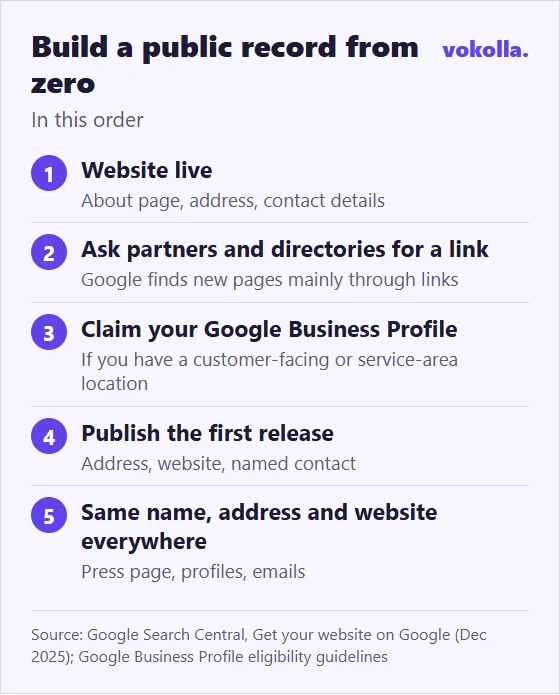
A release is one part of a public record. Google advises you to consider claiming your Business Profile, and its eligibility guidelines say that P.O. boxes and mailboxes at remote locations are not acceptable, so a business with no customer-facing or service-area location may not qualify. Put your site live first, with an About page, your address and contact details, and ask partners, suppliers and directories you belong to for a link; Google says it primarily finds new pages through links from other pages. Our guide to getting a new website indexed has the checklist.
When to publish
Publish when the site is live and the business can be reached: the day you open or ship, or a few days before. If you can, send a short note to one local reporter or blogger first. If you need a fixed date, our release form lets you schedule the release at least 48 hours after you submit; editors review first and then schedule it. Without a set time it goes out after editor review.
Which package to choose, and why
Start small. You can try the process with one free release every 30 days. For a first paid release, Brand Starter at US$69 distributes the release to 300+ outlets, including openPR and 25 city news sites. Global Reach at US$129 adds newspaper and TV-station finance pages; Premium Media at US$379 adds AP News, USA Today, Barchart and StreetInsider when the news is bigger than a local opening.
Every price is on the pricing page, the media list names the outlets in each package, and our comparison reads other services’ own published prices and dates.
How to use the release afterwards
Make it a page people can reach.
- A Press or News page on your website with the release link and date, and an About page with the same facts.
- Your Google Business Profile and social profiles: the same name, address and website everywhere.
- Emails to suppliers, landlords and first customers: one line and the link.
- LinkedIn and local groups, from the founders’ accounts.
- A check after a month: search your business name and save the results with the dates.
- Link text: your business name or web address, not a keyword phrase.
The checklist
Before you submit, check these seven points. How to write a press release covers the structure.
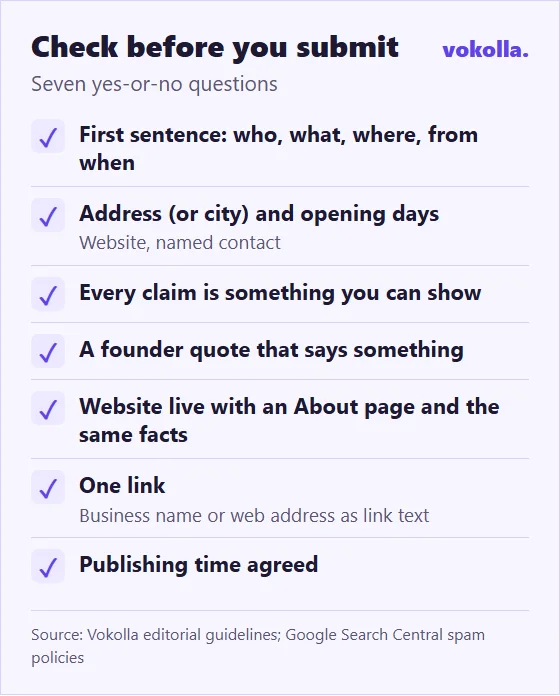
- Does the first sentence say who you are, what you do, where and from when?
- Are the street address, opening days, website and a named contact in the release?
- Is every claim something you can show?
- Is there a quote from a founder that says something?
- Is the website live, with an About page and the same facts?
- Is there one link, with your business name or web address as the link text?
- Is the publishing time, and any note to a reporter, agreed?
What our own releases show
A new name starts with no search results, so here is how our own October 2026 releases did. A Brand Starter release for Mubboo Flights, a travel site in our own group, was online on 325 pages, including openPR and all 25 NEWSnet city news sites, and our own USA Today release pages were in Google’s index 12 and 19 days after publication. Each is one check, so read them as what happened to us. See how long distribution takes.
Publish with Vokolla
Vokolla shows one public price per release, from US$69, with no quote, sales call or subscription. You write the release or draft it with the Vokolla AI assistant, choose the package, pay online and get a report with every live link, and an editor reviews each release before it goes out. You can try it first with one free release every 30 days; every package is on the pricing page.
Questions people ask
Does a tiny new business need a press release?
It helps when you want a dated public page that a customer, supplier or journalist can check: your address, your website and what is new. You can try one free release every 30 days.
What should a first release say?
Who the founders are, what the business does, where it is and from when, with the street address, opening days, website and a named contact.
Can I call my business “the first” or “the leading”?
Only with proof. A new company can say what it does, for whom and how it works instead.
Should I claim a Google Business Profile?
Google advises considering it. Its guidelines say P.O. boxes and remote mailboxes are not acceptable, so a business with no customer-facing or service-area location may not qualify.
How soon will the release show in search?
We cannot promise a time. Google says a new site can take a few weeks to be noticed; our own releases were in Google’s index 12 and 19 days after publication.
Vokolla pages for this step
- Packages →Six packages from US$69 to US$659 per release, each with a report of the live links.
- Pricing →Every package’s public price, reach and what it includes, side by side.
- Free press release →One free release every 30 days on news sites, after editor review.
- AI assistant →Connect your AI assistant to Vokolla to draft, check and save a release.
Sources
Written and checked by the Vokolla editorial team. Vokolla provides the packages described here; prices and outlets are as published on vokolla.com on the date above, and the results quoted come from our own releases. Search rankings depend on many factors, so no distribution service can guarantee them.
- Google Search Central: Get your website on Google (updated 10 Dec 2025): a new site can take a few weeks; links from other sites; claim your Business Profile — checked 2026-11-05
- Google Business Profile Help: verify your business; eligibility guidelines (P.O. boxes and remote mailboxes are not acceptable) — checked 2026-11-05
- BrightLocal: Local Consumer Review Survey 2026 (11 Feb 2026; 1,002 US adults; BrightLocal sells local SEO software) — checked 2026-11-05
- US Small Business Administration blog (3 Jun 2019): how to write a press release that gets results; keep a News Room page on your own site — checked 2026-11-05
- PR Newswire: Commando Coffee Co. opens downtown with support from Crimson Cup (25 Nov 2025) — checked 2026-11-05
- Vokolla: Free press release (one release every 30 days) — checked 2026-11-05
- Muck Rack: State of Journalism 2026 (897 journalists analysed, surveyed 30 Jan – 2 Mar 2026; Muck Rack sells PR software) — checked 2026-11-05
- Google Search Central: Spam policies for Google web search (updated 2026-08-28) — checked 2026-11-04
- Vokolla publishing records: our own releases on USA Today and partner networks (October 2026), Google, Bing and AI-answer checks on 4 Nov 2026 (internal records; the method is described on this page) — checked 2026-11-04
- USA Today: “Vokolla Launches an AI Press Release Agent…” (press release section, 23 Oct 2026) — checked 2026-11-04
- Vokolla: Press release distribution pricing (packages, prices and reach) — checked 2026-11-04
- Vokolla: Media list by package (Domain Rating and monthly visits are third-party estimates, October 2026) — checked 2026-11-04
- Vokolla: Editorial guidelines for press releases — checked 2026-11-04