Guide · Use cases
Press release for a trade show: what to announce, when to publish and how to use it afterwards
In short
A trade show press release is a dated, public statement of one piece of news that you are bringing to a show: a product shown for the first time, a partner signed, an award, a result you can document. It does its work in the weeks around the show, when buyers and journalists decide whom to see and, afterwards, check who they met. Publish it when the press arrives, link it from everything you hand out, and keep it as the record of what you announced.
Why a release around a show
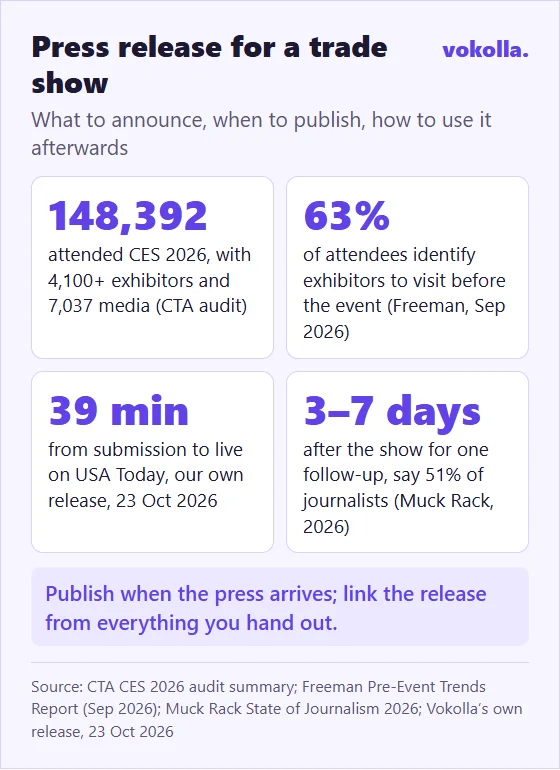
A show puts thousands of companies in front of the same visitors for four days. CES 2026 had 148,392 attendees, 55,841 of them from outside the United States, 4,100 exhibitors and 7,037 media from 82 countries, according to the audit summary the Consumer Technology Association published.
Visitors choose before they arrive. In Freeman’s September 2026 survey of 3,459 attendees and exhibitors, 63% of attendees said they identify the exhibitors they want to visit ahead of the event, and 55% look at the exhibitor list or floor plan. Of the same group, 21% of attendees and 25% of exhibitors had used AI to discover events. Most attendees prepare before they arrive, so what is public about your company in the weeks before the show matters.
Journalists work the same way. Cision’s 2026 survey of 1,899 journalists found that 66% rely on PR-provided content, such as releases, pitches and media kits, for story ideas; Muck Rack’s 2026 survey found that 88% delete pitches that miss their beat. Both companies sell PR services, so read the figures as the vendors’ own survey results. The practical point holds either way: a clear release with one specific piece of news is something a journalist or a buyer can check in a minute. Our view is that the booth gets the conversation and the release gets the record: it exists before the show, on the page a buyer finds when they search your name, and it is still there after the lights go off.
When to publish: from weeks before to days after
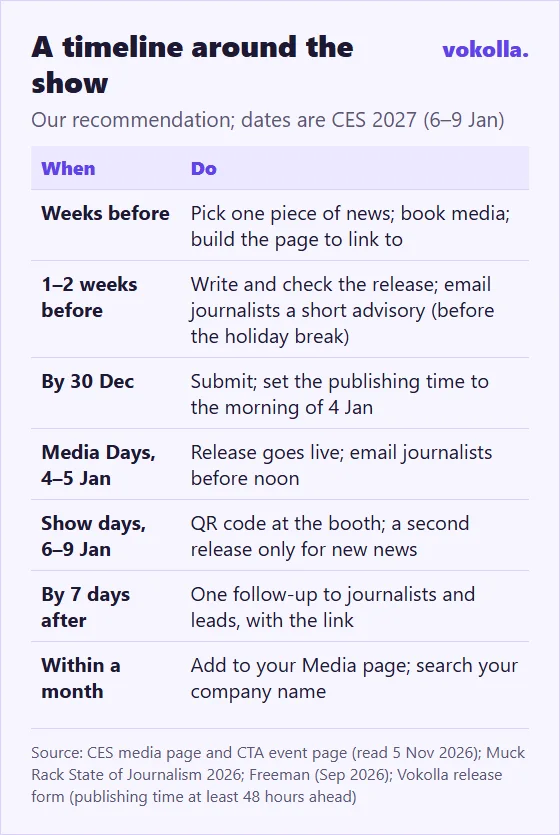
The dates below use CES 2027 as the example: the show runs 6–9 January 2027 in Las Vegas, and CES lists Media Days on 4–5 January, open only to registered media, with Unveiled Las Vegas on 4 January (CES media page, read 5 November 2026). The timeline is our recommendation, built from those dates, from what we know about how long a release takes, and from the survey results in the table; no survey gives a number of days. If you brief journalists under an embargo, or hold a press conference, set the release to go live no earlier than that time.
Our own releases reached their first live page 4, 39 and 67 minutes after submission in October 2026, and our free release is reviewed within about one business day. Our release form lets you pick the publishing time and time zone, at least 48 hours after you submit; editors review first and then schedule it for that time, so submit earlier over a holiday break (how long distribution takes).
| When | What to do | Why |
|---|---|---|
| Several weeks before | Decide the one piece of news. Book media appointments. Build the page the release will link to. | Exhibitor Magazine advises booking media appointments several weeks ahead; visitors pick their list early (Freeman). |
| One to two weeks before | Write the release, run the checks, and email a short advisory to journalists on your list; for CES 2027 this falls before the holiday break. | CES gives exhibitors a media list on the Exhibitor Dashboard; 69% of journalists in Muck Rack’s survey prefer pitches under 200 words. |
| By 30 December | Submit the release with the publishing time and time zone set to the morning of 4 January (Las Vegas is on Pacific time), or later if you hold an embargo or a press conference. | The form needs a time at least 48 hours ahead, and the New Year break leaves little slack. Allow for a question from an editor. |
| Media Days, 4–5 January | The release goes live at the time you set. Email it to journalists in the morning. | 78% of journalists in Muck Rack’s survey want pitches before noon. |
| Show days, 6–9 January | Put the release link on a QR code at the booth. Publish a second release only for genuinely new news, such as a signed partner. | A second release with the same news adds nothing a reader can use. |
| By 7 days after | Send one follow-up to journalists and the leads you met, with the release link. | In the same survey, 50% of journalists say one follow-up is ideal and 51% say it should come within 3–7 days. |
| Within a month | Add the release to a Media section on your site and search your company name to see what a buyer finds. | The release is the dated record of what you announced. |
What to announce: angles that suit a show
Editors approve a release that states one piece of news that a reader could check, so pick the single angle you can prove best. A booth number alone is not news; put it in the second paragraph, with the hall and the days you are there.
- A product shown for the first time: say what it is, what it does that the last model did not, the price or price range, and when customers can buy it.
- A partner or distributor signed at the show: name both companies, the territory and the date.
- An award or recognition from the show or its organiser.
- A result you can document: a test, a measurement or an independent certification, with the method and the date.
| Angle | Headline | Quote |
|---|---|---|
| First showing | Northfield Audio Shows Its First Wi-Fi 7 Speaker at CES 2027, Booth 51234; Pre-Orders Open at US$199 | “We built it for people who want one speaker that works in every room,” said Maria Chen, chief executive of Northfield Audio. |
| Partner signed | Northfield Audio Signs Distribution Agreement With Harbor Retail for Canada at CES 2027 | “Canadian customers asked for local support, and Harbor Retail already provides it,” said James Okoye, head of sales at Northfield Audio. |
| Documented result | Northfield Audio’s New Earbuds Last 31 Hours in an Independent Lab Test, Company Reports | “We published the test method with the result so anyone can repeat it,” said Maria Chen. |
The examples below use a fictional company, Northfield Audio, to show the shape. They are illustrations, not real announcements, and the figures in them are invented.
Which package to choose, and why
Decide by who needs to find the page. For one product on a small booth, Brand Starter at US$69 puts the release on 300+ outlets, including openPR and 25 city news sites. If buyers and journalists will search for the launch itself, Premium Media at US$379 adds AP News, USA Today, Barchart and StreetInsider; our own release was live on USA Today 39 minutes after submission. For the show’s biggest launch, Global Impact at US$659 reaches 20+ high-traffic outlets: our Global Impact release for Mubboo Flights appeared on Yahoo Finance, Business Insider’s markets site, The Globe and Mail and Barchart, and all four pages were still online 16 days later. Global Reach at US$129 adds newspaper and TV-station finance pages. Every price is on the pricing page, and the media list names the outlets in each package.
The CES exhibitor media center, run by CES’s official news distribution partner Cision PR Newswire (a paid service), says a release can be featured on the CES Exhibitor News page with a PR Newswire release purchase. That is one route. A Vokolla release runs alongside it: the price is public from US$69, you choose the publishing time, and the link goes to your own page. If you are weighing the services on price, our comparison reads each company’s own published price and date.
How to use the release after it is published
The release page only helps when people reach it. These are the places we would put the link.
- Put a Media or News section on your website with the release link, the date and the outlet. Anyone who reaches your site, from the exhibitor listing or from a search, sees it.
- Print a QR code that points to the release page, or to your launch page that links to it, on the booth’s printed material and on your badge handout.
- Put the link in every sales email to the leads you meet, one line: what was announced and where it is published.
- Post it on LinkedIn from the company page and from the person quoted, with the show dates and booth number.
- Send one follow-up to journalists within three to seven days of the show, and attach nothing: the link is enough.
- Search your company name and the product name a week later, then again after a month, and save the results with the dates. On 4 November 2026 ChatGPT answered “What is Vokolla?” by citing a newspaper page that carried our release; see press releases and AI search.
The checklist
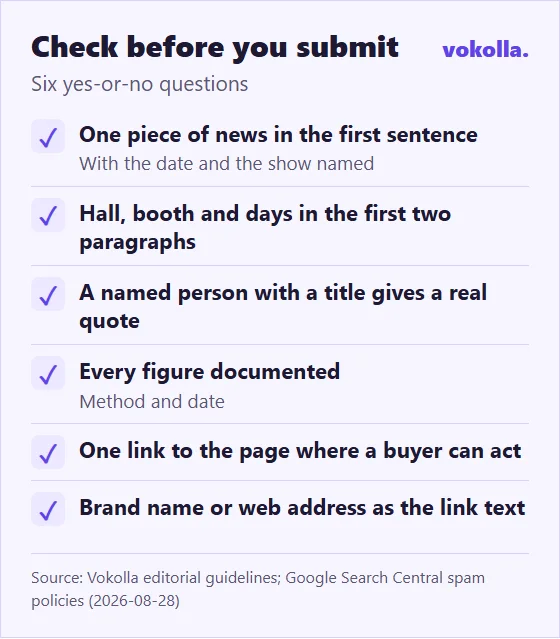
Before you submit, check that the release answers these six questions. Our how to write a press release guide covers each in detail, and the format and template shows an accepted release part by part.
- Is there one piece of news in the first sentence, with the date and the show named?
- Do the first two paragraphs give the hall, the booth and the days you are there?
- Does a named person with a title give a quote that says something?
- Is every figure one you can document, with the method and date?
- Does one link point to the page where a buyer can act?
- Is the link text your brand name or web address?
What our own releases show
Here is what the same kind of release did in our own October 2026 releases. Our USA Today release was live 39 minutes after submission on 23 October, and by 4 November both of our USA Today release pages were in Google’s index. Of the 1,489 pages we could check from nine of our paid English releases, 1,461 (98%) were still online 9 to 27 days after publication. A DoFollow Links release for TicketGlide, a ticket marketplace in our own group, carried links to its site on all 111 live pages when we checked ten days after publication.
Check yours the same way a week and a month after the show. See how long distribution takes.
Publish with Vokolla
Vokolla shows one public price per release, from US$69, with no quote, sales call or subscription. You write the release or draft it with the Vokolla AI assistant, choose the package, pay online and get a report with every live link, and an editor reviews each release before it goes out. You can try it first with one free release every 30 days; every package is on the pricing page.
Questions people ask
When should I publish a press release for a trade show?
We suggest the day journalists arrive: for CES 2027 that is Media Days on 4–5 January 2027, with the release submitted by 30 December and its publishing time set to the morning of 4 January. Prepare the page it links to, and the media advisory, one to two weeks earlier.
What should a trade show release announce?
One piece of news a reader can check: a product shown for the first time, a partner signed, an award, or a documented result. A booth number alone is not news; give it in the second paragraph.
Does CES publish my release for me?
CES hosts exhibitor releases through its official distribution partner, Cision PR Newswire, a paid service. A release on another service is separate, and you can use both.
Can I use an embargo?
Yes, by agreement with the journalists you brief: they get the news early and agree not to publish until a set time. CES publishes no embargo rules on the pages we read, so set the time in writing in your own email. Publish your release at the embargo time.
Do I need a release if I already have a booth and a website?
The booth reaches who walks past it, and your website says what you want it to say. A release is a dated page on a news site, so it reaches visitors who check you out before and after the show.
Vokolla pages for this step
- Packages →Six packages from US$69 to US$659 per release, each with a report of the live links.
- Pricing →Every package’s public price, reach and what it includes, side by side.
- Free press release →One free release every 30 days on news sites, after editor review.
- AI assistant →Connect your AI assistant to Vokolla to draft, check and save a release.
Sources
Written and checked by the Vokolla editorial team. Vokolla provides the packages described here; prices and outlets are as published on vokolla.com on the date above, and the results quoted come from our own releases. Search rankings depend on many factors, so no distribution service can guarantee them.
- Consumer Technology Association: Attendance Audit Summary, CES 2026 (148,392 attendees; 7,037 media; audited by the Alliance for Audited Media) — checked 2026-11-05
- CES: Media opportunities (Media Days 4–5 January 2027, Mandalay Bay; Unveiled Las Vegas, 4 January 2027) — checked 2026-11-05
- Consumer Technology Association: CES 2027, 6–9 January 2027, Las Vegas — checked 2026-11-05
- CES exhibitor media center, hosted by Cision PR Newswire (a paid service; vendor page) and the CES Exhibitor PR webinar page (9 Dec 2025: the Media List is on the Exhibitor Dashboard) — checked 2026-11-05
- Freeman: Trends Report, Pre-Event Edition (September 2026 survey of 3,459 attendees and exhibitors), as reported by Trade Show Executive, 13 Oct 2026 — checked 2026-11-05
- Muck Rack: State of Journalism 2026 (897 journalists analysed, surveyed 30 Jan – 2 Mar 2026; Muck Rack sells PR software) — checked 2026-11-05
- Cision: 2026 State of the Media (1,899 journalists, January–February 2026; Cision owns PR Newswire) — checked 2026-11-05
- Exhibitor Magazine: “Eight Steps to Optimize Media Outreach” (older article) — checked 2026-11-05
- Vokolla publishing records: our own releases on USA Today and partner networks (October 2026), Google, Bing and AI-answer checks on 4 Nov 2026 (internal records; the method is described on this page) — checked 2026-11-04
- USA Today: “Vokolla Launches an AI Press Release Agent…” (press release section, 23 Oct 2026) — checked 2026-11-04
- Business Insider Markets: Mubboo Flights release (19 Oct 2026) — checked 2026-11-04
- Vokolla: Press release distribution pricing (packages, prices and reach) — checked 2026-11-04
- Vokolla: Media list by package (Domain Rating and monthly visits are third-party estimates, October 2026) — checked 2026-11-04
- Vokolla: Editorial guidelines for press releases — checked 2026-11-04